Author Archives: Kathy

Best Bollywood Movies of 2015

2015 offered up a satisfying mix of sweet, intimate stories and dark thrills and chills. Here are my picks for the best Bollywood movies of 2015. (Click on the title of each movie to read my original review.)

The year ended on a triumphant note with the release of the historical epic romance Bajirao Mastani. Director Sanjay Leela Bhansali’s colorful, lavish style demands to be seen on the big screen.

Two smaller Hindi films that played at the Chicago South Asian Film Festival prove that big budgets aren’t necessary to make a great movie. Haraamkhor and Dhanak depict the struggles of childhood in very different ways, with Dhanak being easily the sweetest film of the year.

Early 2015 saw the release of two great revenge thrillers: Badlapur and NH10. While Badlapur explores the toll that a lingering desire for vengeance takes on a grieving husband (Varun Dhawan), NH10 is a race against the clock for a woman (Anushka Sharma) trying to defeat the men out to kill her.

In contrast to such dark fare, Piku lovingly and humorously explores the tense relationship between an adult daughter (Deepika Padukone) who hits the road with her ailing father (Amitabh Bachchan).

A pair of top-notch crime thrillers also made the list. Talvar‘s unique story structure sets apart this real-life murder mystery. Detective Byomkesh Bakshy! put a modern, stylish twist on a classic Indian literary detective.

Dum Laga Ke Haisha is as charming as can be, telling the tale of a loser (Ayushmann Khurrana) rebelling against his marriage to an accomplished woman (Bhumi Pednekar) who fails to fit his beauty standards. So much care went into the story that it is impossible not to fall in love with these young adults trying to grow under enormous family pressure.

My favorite movie of 2015 is a big budget, multi-starrer that nevertheless tells a smart, contemporary family story. Too often, Bollywood spectacle films are “check your brain at the door” affairs, full of bombast but devoid of substance. Director Zoya Akhtar brings together an A-list cast — including Priyanka Chopra, Anushka Sharma, Ranveer Singh, Farhan Akhtar, and Anil Kapoor — for a film that is fun and romantic, but also contains insightful critiques of the respect (or lack thereof) accorded women in modern Indian society. Director Akhtar takes the opportunity this big-budget blockbuster affords her and uses the platform to inform as well as entertain. For that reason, my favorite Hindi film of 2015 is Dil Dhadakne Do.

(Update: I watched Masaan after posting this list. Were I to re-do my rankings, I’d place Masaan in 9th place, between Dhanak and Haraamkhor.)

Kathy’s Top Ten Bollywood Movies of 2015

  1. Dil Dhadakne Do — Buy/rent at iTunes or Amazon
  2. Dum Laga Ke Haisha — Buy/rent at iTunes or Amazon
  3. Detective Byomkesh Bakshy! — Buy/rent at iTunes or Amazon
  4. Talvar — Buy at Amazon
  5. Piku — Buy/rent at iTunes or Amazon
  6. NH10 — Buy at Amazon
  7. Badlapur — Buy at Amazon
  8. Dhanak
  9. Haraamkhor
  10. Bajirao Mastani

Previous Best Movies Lists

Bollywood Box Office: January 4, 2016

Bajirao Mastani and Dilwale closed out their third weekend in theaters, finalizing the North American box office rankings for Bollywood films released in 2015. From January 1-3, 2016, Bajirao Mastani earned $772,775 from 304 theaters ($2,542 average). During the same period, Dilwale earned $308,149 from 133 theaters ($2,317 average).

The ten highest earning Bollywood films of 2015 in North America were:

  1. Bajrangi Bhaijaan: $8,114,714
  2. Bajirao Mastani: $5,832,266 (to date)
  3. Dilwale: $4,696,841 (to date)
  4. Prem Ratan Dhan Payo: $4,420,019
  5. Dil Dhadakne Do: $3,062,095
  6. Tanu Weds Manu Returns: $3,022,611
  7. Tamasha: $2,243,582
  8. Piku: $2,220,648
  9. Welcome Back: $1,379,668
  10. Singh Is Bliing: $909,399

Bajrangi Bhaijaan had the best opening weekend in 2015, both in terms of total gross ($2,613,192) and per-screen average ($9,468). Bajirao Mastani has already proven to have the best longevity of any 2015 release, having nearly quadrupled its opening weekend total in just three weeks.

2015 set a new benchmark for blockbuster releases, with both Bajrangi Bhaijaan and Prem Ratan Dhan Payo opening in more than 300 theaters in North America (304 and 310, respectively). Though PK (296) and Bang Bang (292) came close in 2014, it’s worth noting how rapid this increase in theater counts has been. The widest release in 2013 was Dhoom 3 on 239 screens, and 2012’s biggest release, Talaash, opened in just 172 theaters. More people than ever before can watch Bollywood films on the big screen in the United States and Canada.

It’s also worth noting that all of the films in the 2015 top ten were released between May and December. Shahrukh Khan’s Fan — scheduled for release on April 15 — should easily make it into the 2016 top ten, but it remains to be seen if any of the other Bollywood flicks opening in the first third of the year will prove to be breakout hits. Do any of the films on this list seem like contenders to you?

Sources: Box Office Mojo and Rentrak, via Bollywood Hungama

Streaming Video News: January 1, 2016

I updated my list of Bollywood movies on Netflix with a ton of new additions to the catalog. Netflix kicked off 2016 by adding seventeen (!) Hindi movies to the streaming catalog, along with a number of movies in other Indian languages, most notably director Mani Ratnam’s 2015 Tamil hit OK Kanmani. I added a category for films in other Indian languages at the bottom of my Netflix page. (January 2 update: Dum Laga Ke Haisha is also now on Netflix!)

Here’s a list of all the Bollywood films added to Netflix today:

Detective Byomkesh Bakshy! and Piku are two of my favorite movies of 2015, and I can’t wait to check out Randeep Hooda in Main Aur Charles, which didn’t open in US theaters. A number of these films — like Katiyabaaz and Kshay — were hits on the festival circuit, and this is the first opportunity for a wide audience to see them. Same for the Gujarati film The Good Road, India’s official submission to the 86th Oscars, which was also added today.

For everything else new on Netflix, please check out Instant Watcher.

Movie Review: Dilwale (2015)

Dilwale1.5 Stars (out of 4)

Buy or rent the movie at iTunes
Buy the DVD at Amazon
Buy the soundtrack at Amazon

Dilwale is a generic Frankenstein cobbled together from elements of countless other Bollywood comedies and romantic dramas, lurching from one predictable plot point to the next. Given the talent and budget at director Rohit Shetty’s disposal, the result is disappointing.

Shahrukh Khan plays Raj, a man absurdly devoted to the happiness of his younger brother, Veer (Varun Dhawan), so much so that he tears up and starts to shake whenever anyone mentions having a younger brother. Raj’s big secret is that he was adopted and is not Veer’s biological brother.

So Shahrukh plays a character with the same name as the one he made famous in Dilwale Dulhania Le Jayenge, with the same backstory as the one he played in Kabhi Khushi Kabhie Gham. See what I mean about Frankenstein?

When Veer falls in love with a beautiful woman named Ishita (Kriti Sanon) — whom he calls Ishu just so he can repeatedly say, “Ishu, this is a big issue” — it prompts Raj to flashback to his own failed romance.

With no scene transition of which to speak, we are transported fifteen years into the past, when “Raj” went by the name Kaali and worked as a gangster in Bulgaria. There he meets a lovely artist named Meera (Kajol, Shakrukh’s love interest both DDLJ and K3G), and they break each other’s hearts. Surely this can’t be the last we see of Meera, right?

The plot unfolds predictably, as obstacles arise in Veer’s and Raj’s paths to romance. These obstacles would disappear if Raj and Meera would stop withholding information that is unpleasant but not earth-shattering, but writer Yunus Sajawal can’t seem to think of a better way to delay the inevitable happy ending for more than two-and-a-half hours.

Further dragging out the film is a ridiculous anti-drug subplot that could not have been handled with any less subtlety. Boman Irani plays the world’s cuddliest drug kingpin, King. When King’s men try to strongarm a barkeep named Uncle Joe into dealing their goods — by banging a huge bag of weed on the cashier stand, in front of everyone in the bar — Uncle Joe responds with some incredibly direct dialogue (courtesy of writers Sajid-Farhad): “I won’t sell your drugs here. Youngsters come here to have fun.”

The “Drugs are bad, m’kay?” subplot reaches its hypocritical crescendo when Veer, his sidekick Siddhu (Varun Sharma), and well-meaning miscreant Mani (Johnny Lever), get completely drunk on booze and self-righteousness while burning a bag of King’s drugs.

Siddhu is the fourth comic role I’ve seen Sharma play, which I think gives me enough information to definitively say that Varun Sharma is not funny.

But being funny isn’t really the point in Dilwale, where roles are cast not by suitability but by similarity. Need some outrageous older comic bit players? Hire Lever and Sanjay Mishra. Does the bad guy need a bald right-hand man? Hire Pradeep Kabra.

The whole movie is uninspired because the point is not to do anything unique or innovative but to evoke memories of earlier, better films starring the same people. The only way Shetty could have tried any less hard would be not to have made the movie at all.

By only looking to the past for inspiration, Dilwale winds up peppered with sexist insults. Siddhu repeatedly steals from Veer, but he’s forgiven because he says that he only did it so that he could take his girlfriend to the movies and out for coffee. The incident is brushed off by the men onscreen, who agree that women are greedy and high-maintenance.

Jokes are also made about Kajol’s weight, based on the assumption that she — like all women — is perpetually dieting. What is this, a Cathy comic strip from 1982? Beyond being tacky and outdated, the jokes are undermined by the fact that Kajol is stunning. Her gorgeousness is the movie’s lone selling point.

There is a stretch of a few minutes when Kajol saves a scene that should be stupid, and one briefly thinks, “Ooh, this could get interesting.” That hope is short-lived when Meera falls in love with Raj just because he loves her. To quote Cathy, “Ack!”

Kajol is better than this. Shahrukh is usually better than this. Varun is definitely better than this. Kriti’s character is so level-headed that she seems like she wandered onto the wrong set. Dilwale is not the Kajol-Shahrukh romantic reunion we deserve.

Links

Movie Review: Bajirao Mastani (2015)

BajiraoMastani3 Stars (out of 4)

Buy the DVD at Amazon
Buy the soundtrack at Amazon

The historical epic Bajirao Mastani scores high marks for scale and style, but its message of religious tolerance is perhaps its real selling point.

The movie’s title bears the names of the renowned battle commander Bajirao (Ranveer Singh) and his second wife, Mastani (Deepika Padukone). Bajirao served as prime minister of the Maratha Empire in the early 1700s.

Though already married to Kashibai (Priyanka Chopra), Bajirao falls in love with Mastani while helping her to free her father’s besieged castle. Mastani herself is an accomplished warrior, a fact that impresses Bajirao as much as her beautiful looks and graceful dancing.

Before returning home, Bajirao gifts Mastani his dagger, unaware that this constitutes a marriage pact among her people. This presents a huge problem not just because Bajirao already has a wife, but because Mastani was raised in her mother’s Muslim faith, not in the Hindu faith of Mastani’s father and Bajirao himself.

When Mastani follows Bajirao to his home in Pune, she is shunned by Bajirao’s mother, Radhabai (Tanvi Azmi), who lodges Mastani in a whorehouse and appoints her the humiliating position of court dancer. Undeterred, Mastani publicly professes her love to Bajirao, who builds her a palace of her own. This does not go over well.

(Before continuing, I want to point out that, when Bajirao returns home with Mastani, he and Kashibai already have a preteen son, Nana. Given the lack of familial affection between Bajirao and Nana, I wasn’t sure if he was actually their biological son, or just some kid from the household that Kashibai calls “son.” Nana is, in fact, their child.)

The anger directed at Mastani and Bajirao by Bajirao’s mother, brother, and son is primarily based on her religion and its perceived pollution of the family line. Bajirao’s tragic flaw is his underestimation of the depth of his family’s hatred.

Kashibai has the biggest grievance against Bajirao for breaking their matrimonial vows, but she’s a pragmatist. She has a house to run while Bajirao is off sacking cities, so she is less outwardly hostile toward Mastani than her in-laws. Yet there is fury in Chopra’s eyes while Kashibai goes through the motions of keeping the peace. By virtue of her position — and Chopra’s performance — Kashibai is the film’s most interesting character.

Bajirao himself is devoted but oblivious. He’s supposedly as skilled a diplomat as he is a fighter, but he reads the vibe in his household all wrong. He acts as though he’s entitled to do what he likes without realizing that his threats are no match to his family’s hatred of Muslims. The limitations of the character don’t leave much room for Singh to shine, although his buff physique certainly fits the part.

Mastani’s character also feels underwritten. After her introduction as a fierce warrior, that aspect of her persona is diminished, replaced by an emphasis on a more passive kind of femininity. According to Wikipedia (for whatever it’s worth), the real Mastani accompanied Bajirao on his battles. It would have been fun to see more of that, although Padukone’s dancing is quite a treat.

The film’s early battle sequence is impressive, emphasizing the key players while still feeling expansive. Dim pre-dawn lighting gives a sinister tone to the fight. There’s also an effective scene later in the film as Bajirao imagines his destiny manifesting as a shadow army on black horses.

Designer Anju Modi’s costumes and jewelry pieces are so stunning as to merit a museum exhibit. The film’s sets are lavish, the dance numbers beautifully choreographed.

Tales of star-crossed lovers are always popular, but writer-director Sanjay Leela Bhansali’s choice of this particular pair is timely. Bajirao and Mastani love beyond the borders of religion, condemned by a society with hearts too small to tolerate such a union.

Links

Streaming Video News: December 18, 2015

I updated my list of Bollywood movies on Netflix with one new addition to the catalog. The 2012 crime epic Gangs of Wasseypur is now available for streaming. When the five-hour-plus film originally released in theaters, it was split into two parts. Netflix has taken that approach further, breaking the movie into eight episodes of approximately 40-minutes each. Netflix even classifies Gangs of Wasseypur as a TV show instead of a film.

I’m intrigued by this approach, as I think it could really help to make the movie more accessible. The plot is organized in a way that doesn’t suit an even split in the middle, so breaking it into smaller chapters should help maintain narrative cohesion. Psychologically, it also seems (at least to me) less daunting to commit to watching eight short episodes of a show than one five-hour film. Without having seen the episodic version, it sounds like a great idea.

For everything else new on Netflix, check out Instant Watcher.

Opening December 18: Dilwale and Bajirao Mastani

This is the year’s biggest weekend for Bollywood movies. Two potential blockbusters — Dilwale and Bajirao Mastani — open on December 18, 2015, in the United States — the same day that the new Star Wars movie hits theaters. Oops.

Both Hindi movies are getting a wide release in the States, though it remains to be seen just how big a bite Chewbacca will take out of their potential profits. I’m also imagining the following scenario playing out in a lot of American homes this weekend:

Parents: “Kids, we’re going to the movies tonight.”
Kids: “Yay, Star Wars!!”
Parents: “No, Dilwale.”
Kids: *groan*

Dilwale gets the wider local release of the two new Bollywood flicks, opening in eleven Chicago area theaters on Friday: AMC River East 21 in Chicago, Regal Gardens Stadium 1-6 in Skokie, MovieMax Cinemas in Niles, Regal Round Lake Beach Stadium 18 in Round Lake Beach, Marcus Gurnee Mills Cinema in Gurnee, Muvico Rosemont 18 in Rosemont, AMC South Barrington 30 in South Barrington, Marcus Addison Cinema in Addison, Regal Cantera Stadium 17 in Warrenville, AMC Loews Woodridge 18 in Woodridge, and AMC Loews Crestwood 18 in Crestwood. It has a listed runtime of 2 hrs. 38 min. Check out the trailer.

Bajirao Mastani is no slouch either, opening in ten Chicago area theaters on Friday: Regal Gardens Stadium 1-6 in Skokie, MovieMax Cinemas in Niles, Century 12 Evanston in Evanston, Regal Round Lake Beach Stadium 18 in Round Lake Beach, Muvico Rosemont 18 in Rosemont, AMC South Barrington 30 in South Barrington, Marcus Addison Cinema in Addison, Regal Cantera Stadium 17 in Warrenville, AMC Loews Woodridge 18 in Woodridge, and AMC Loews Crestwood 18 in Crestwood. It has a listed runtime of 2 hrs. 30 min. Check out the trailer.

Tamasha carries over for a fourth week at MovieMax and the South Barrington 30.

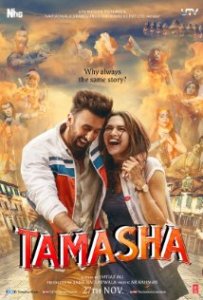
Movie Review: Tamasha (2015)

Tamasha2 Stars (out of 4)

Buy the DVD at Amazon
Buy the soundtrack at Amazon

Tamasha (“Spectacle“) doesn’t give as much as it asks of its audience in return. Writer-director Imtiaz Ali asks the audience to buy into his characters’ romantic struggles without giving enough reasons why we should care.

The romance is founded on a questionable gimmick: two strangers meet while vacationing in Corsica, and they vow to spend a week together pretending to be people they are not. They take on identities from old films, with the man (Ranbir Kapoor) posing as Don, and the woman (Deepika Padukone) assuming the moniker Mona Darling.

Their courtship hinges on the two of them not knowing a thing about one another, which means that the audience doesn’t know anything about them either. All we know about Don is that he liked stories as a kid and presently — the Corsica sequence is a flashback — performs as a tin man in a stage play. We know nothing about Mona.

The false identity gimmick makes it hard to care about these mysterious characters as they cavort about France. Ali trots out his signature trope — the spontaneous parade — in the song “Matargashti,” an event that is supposed to be charming but comes off as forced and unrealistic.

Several years after their French dalliance, Mona and Don meet again in Delhi, revealing to each other their true names: Tara and Ved. However, Ved is a boring, goateed tech guy — nothing like the ebullient Don. Tara tries a relationship with Ved, but finds that she longs for the side of him that she met in Corsica.

Despite the tagline on the movie poster — “Why always the same story?” — Tamasha is a too familiar tale of a bubbly woman teaching a bland guy how to live. As per the template, Tara has no identity of her own apart from her role in Ved’s personal growth.

Tara also has a buttoned-up corporate job, but how does she feel about it? Why aren’t scenes of her at work shot with the same grey tone that colors scenes of Ved at work, as though he’s walking under a cloud even indoors? What does she want from life, other than to be with Ved? Padukone does her best within her characters’ limitations, as does Kapoor.

As a lead character, Ved is a disappointment. He blames his mundane existence on his father, who pushed him into engineering. When Tara points out that there’s more to Ved than his job, he lashes out at her, as though angered at her nerve for suggesting that he is the source of his own unhappiness.

A lot of people hate their jobs, but it doesn’t make them dull automatons in their off hours. There’s a reason why plenty of authors are former lawyers who wrote their debut novels in spare hours over the weekend. If you have a story to tell, you find a way to tell it. Ved chose to be a dull jerk, and it’s unpleasant to watch him punish Tara for his own choices.

There’s a trivial-sounding question that actually gets at the heart of why Ved fails as a lead character: why is he in Corsica? Are we supposed to believe that an over-scheduled working stiff like Ved planned a solo vacation in an exotic resort spot like an island off the coast of France? Since everything we know about Ved points to the answer “no,” then what is he doing there? I’m curious as to whether Imtiaz Ali knows.

Links

Bollywood Box Office: December 11-13

With Dilwale and Bajirao Mastani lurking over the horizon, here’s how Tamasha and Prem Ratan Dhan Payo fared in the United States and Canada during the weekend of December 11-13, 2015:

  • Tamasha: Week 3; $140,278 from 135 theaters; $1,039 average; $2,194,012 total
  • Prem Ratan Dhan Payo: Week 5; $20,163 from 26 theaters; $776 average; $4,420,019 total

Source: Rentrak, via Bollywood Hungama

Movie Review: Despite the Gods (2012)

DespiteTheGods3 Stars (out of 4)

Buy the DVD at Amazon

The story behind the Hindi horror flop Hisss is as much about the film that wasn’t made as the film that was. Documentarian Penny Vozniak recorded director Jennifer Lynch during the making of Hisss, resulting in Despite the Gods: an engrossing feature about a filmmaker pushed out of her own movie.

Lynch spent eight months filming Hisss in India, her first time working in the country. When we first see her settling in to her Chennai apartment, she observes that India is loud. Lulls in the concussive sounds of construction work outside her apartment are filled by chatter from the noisy street below. It makes concentration and relaxation difficult, to say the least.

Lynch is accompanied on her trip by her 12-year-old daughter, Sydney, who is the real star of Despite the Gods. Sydney is wise beyond her years, encouraging her mother to stop fretting about her weight and focus on her movie. The fact that Sydney endures this odyssey with a minimum of whining is a testament to her maturity.

Hisss is beset by a number of problems: rain, a jumbled schedule, a union strike that forces the production to move to Kerala. The funny, foul-mouthed Lynch stays positive throughout, insisting that adverse circumstances often result in a better finished product.

Little does Lynch know that she’s being sabotaged from within. The producer who brought her onto the project, Govind Menon, repeatedly tries to take control of the film away from Lynch, under the pretense of serving the greater good. Touting his past directorial experience and familiarity with the way things are done in India, Menon offers to shoot portions of the film himself in order to speed things up. Lynch doesn’t bend, insisting on doing things her way.

Only after shooting ends does Menon finally get control. A note at the end of Despite the Gods reads: “The producers reject Jennifer’s final cut of Hisss. The film is over schedule and over budget. They re-cut it without her. Jennifer has publicly distanced herself from the finished film.”

Having watched Hisss, Menon clearly overestimated his ability as a storyteller. The movie is awful, although the footage Lynch shot actually looks quite good.

One issue with Despite the Gods is that Vozniak is a friend of Menon. He initially brought her onto the set to babysit Sydney, and it was Lynch who invited her to stay and film the documentary. Lynch told Indie Outlook:

There were some incredibly painful moments that were kept in Penny’s cut and other things that didn’t end up in it because producers wouldn’t allow them to be shown. Sometimes I see myself upset onscreen and think, “I was sad because this happened, but nobody will ever get a chance to see it.” And yet, this is Penny’s film, not mine. She made the film that she wanted to make to the best of her ability, and I’m honored to have been seen through her eyes.

Even with an incomplete accounting of events, Menon’s desire to shoot the film himself is obvious. He also takes it upon himself to scold Sydney when Lynch is not around. A confused Sydney seeks out her mother and asks, “Did I do something wrong?”

Besides Menon, the rest of the Indian crew is devoted and professional. The second assistant director, Yogi Dixit, is particularly charming. The caterer, Krishna, fills in as a sound effects artist and on-set masseur.

Hisss star Mallika Sherawat is smart and self-aware. She’s cognizant of the boldness of her career choices in conservative India, and she and Lynch spend much of their downtime discussing social issues.

Lynch explains the theme of her film (originally titled Nagin: The Snake Goddess): “It’s an admiration of sensual, sexual female bravery.” Sherawat wryly replies, “Oh yeah? In India?”

There’s no guarantee that Lynch’s version of Hisss would have been a success. It’s hard to imagine the scene of Sherawat making out with a snake puppet looking anything other than silly, no matter who edited it.

Still, Despite the Gods highlights that Lynch was using her film to make a point about female sexuality, and that aspect was eliminated from the version ultimately released. Maybe someday we’ll get a director’s cut of Hisss. I’m very curious to see it.

Links