Tag Archives: English

Movie Review: Dr. Cabbie (2014)

Dr Cabbie_VOD2.5 Stars (out of 4)

Buy or rent the movie at iTunes
Buy or rent the movie at Amazon
Buy the soundtrack at Amazon

Bollywood superstar Salman Khan turns producer for the Canadian film Dr. Cabbie, a comedy that takes a critical look at Canada’s medical infrastructure and immigrants’ ability to assimilate into the culture.

Vinay Virmani — the film’s co-writer — plays Dr. Deepak Veer Chopra, a recent Indian med school grad eager to start his career in Canada. He drags his mother, Nellie (Lillete Dubey), to Toronto, where they move in with her brother, Vijay (Rizwan Manji), and his blonde hippie wife, Rani (Mircea Monroe).

Despite a nationwide shortage of doctors, none of Toronto’s hospitals will accept Deepak’s Indian degree. His new pal, Tony (Kunal Nayyar), convinces the doctor to join him as a cab driver, the city’s go-to job for the over-educated and underemployed.

When Tony uploads a video of Deepak delivering a woman’s baby in the back of his cab, it launches Deepak’s career as a mobile freelance doctor, even if means he has to practice without at license. It also jump-starts Deepak’s romance with the new mom, Natalie (Adrianne Palicki).

There are some especially charming equations in Dr. Cabbie. Virmani and Palicki share a comfortable chemistry, Deepak’s earnestness pairing well with Natalie’s savvy.

Best of all is the friendship between Nellie and Rani. After initially resisting the move to Canada, Nellie is quickly won over, taking to Rani’s life of massages and facials like a fish to water. Impressed with her sister-in-law’s golden tresses and generous bosom, Nellie dons her own blonde wig and pads her bra with socks.

The funniest part of the film is Vijay’s recounting of his proposal to Rani. A flashback shows the audience the truth of what happened in a way that is far less rosy than the story he tells his sister and nephew.

The tone of the film is generally light, and so is the criticism of the Canadian medical system’s inefficiencies. Most of the racially tinged humor is benign, although a few instances are cringe-worthy.

Tony’s character exists for the purpose of inserting as many sex jokes into the script as possible, and the vast majority of the jokes just aren’t funny. It’s hard to imagine a woman being charmed by Tony’s catcalling and the set of blue plastic testicles hanging from his cab’s bumper. A subplot involving Tony’s Italian landlord and the landlord’s daughter should have been ditched entirely.

Though not perfect, Dr. Cabbie has enough cute moments and winsome performances to make it worth a glance.

Links

Movie Review: Meet the Patels (2014)

MeetThePatels3.5 Stars (out of 4)

Buy/rent the movie at iTunes
Buy the DVD at Amazon

Meet the Patels takes a hilarious look inside one family as the parents try to achieve their dream: getting their kids married.

The documentary starts humbly enough, with filmmaker Geeta Patel testing out a new camera during her family’s annual trip to India. Her younger brother, actor Ravi, is recovering from a breakup with a white woman he’d never told his parents about.

With his thirtieth birthday on the horizon, Ravi decides that maybe all of his relatives are on to something: it’s time for him to get hitched. He agrees to let his parents find his dates for him, drawing him into the vast web of Indian-American matchmaking services.

For anyone who hasn’t experienced said matchmaking, Meet the Patels is an eye-opener. The scale of Indian-American matrimonial infrastructure is immense. Beyond his own family’s network of relatives and acquaintances, Ravi finds his dates though a variety of specially targeted dating sites. His ultimate destination is a national convention just for single people named Patel.

As Ravi crisscrosses the country looking for his ideal woman — she must live in America, and she must like him — it forces both him and Geeta (who is also single) to examine their assumptions about marriage. Are their imagined versions of their future spouses the only possible versions, or should they be looking elsewhere? How do they reconcile their internal cultural conflicts as first-generation Indian-Americans?

Their parents — dad Vasant and mom Champa — face their own sort of reckoning. Why aren’t their kids married yet, when everyone else’s children are married and having kids of their own? They love their unconventional kids, but Champa feels as though she and Vasant must have erred in raising them, otherwise she’d be a grandmother already.

The hook to Meet the Patels is the loving relationship that the family shares. All four of them are funny and opinionated. Ravi and Geeta like each other well enough to live together. The Patels are an endearing bunch, struggling through the ubiquitous contemporary American problem of young people putting off the traditional markers of adulthood for as long as possible.

Watching the film, I couldn’t help but notice the parallels between the Patels and my own family. Like Geeta, I’m the elder sister to one younger brother, who is as much a best friend as he is a sibling. We were raised by parents as devoted to one another as they were to us.

Yet I recognized the piercing familiar tone of maternal guilt when Champa complains to Geeta about Geeta’s unmarried state: “I hope you never go through what we are going through.”

Champa sounds exactly like my mom, who — upon my speculation that I might never marry — asked, “So you’re just going to live in sin, eh?” I did get married, to my mother’s relief, but my husband and I decided not to have kids. This then prompted my mother to declare in front of all the relatives at my cousin’s baby shower that she was okay with this because, “Kathy would be a bad mother.” (To be fair, she was probably right!)

Apparently, Gujarati parental guilt and Catholic parental guilt are two sides of the same coin.

Few documentaries are as funny and accessible as Meet the Patels. It’s a real treat to get an honest look inside an adorable American family. This is a must watch.

Links

Opening August 28: Phantom

The Bollywood terrorism thriller Phantom — starring Saif Ali Khan and Katrina Kaif — opens in Chicago area theaters on August 28, 2015.

Phantom opens on Friday at MovieMax Cinemas in Niles, AMC South Barrington 30 in South Barrington, and Regal Cantera Stadium 17 in Warrenville. It has a listed runtime of 2 hrs. 28 min.

All Is Well carries over for a second week at all of the above theaters.

The rest of the South Barrington 30’s weekend Hindi lineup includes Brothers, Drishyam, Bajrangi Bhaijaan, and the dubbed version of Baahubali.

Also opening in limited release on Friday is Learning to Drive, starring Ben Kingsley as a Sikh driving instructor who helps Patricia Clarkson find her independence following the breakup of her marriage. Learning to Drive opens at the AMC River East 21 in Chicago, Century Centre Cinema in Chicago, and the Century 12 Evanston/Cinearts 6 in Evanston on Friday, before expanding into suburban theaters in the coming weeks.

Other Indian movies showing in the Chicago area this weekend include:

Opening June 5: Dil Dhadakne Do

One new Bollywood film hits Chicago area theaters on June 5, 2015, and it’s a big one: Dil Dhadakne Do (“Let the Heart Beat“). Zoya Akhtar directs an ensemble cast that includes Priyanka Chopra, Ranveer Singh, Anil Kapoor, and Shefali Shah as a dysfunctional family on a cruise ship that also carries Anushka Sharma and Farhan Akhtar.

DDD opens on Friday at the AMC River East 21 in Chicago, Regal Gardens Stadium 1-6 in Skokie, MovieMax Cinemas in Niles, Regal Round Lake Beach Stadium 18 in Round Lake Beach, AMC South Barrington 30 in South Barrington, Regal Cantera Stadium 17 in Warrenville, AMC Loews Woodridge 18 in Woodridge, and AMC Loews Crestwood 18 in Crestwood. Ticket demand is expected to be so high that the South Barrington 30 and Cantera 17 are showing DDD on multiple screens. It has a listed runtime of 2 hrs. 50 min.

Tanu Weds Manu Returns gets a third week at all of the above theaters, except for the Crestwood 18. Piku gets a fifth week at the South Barrington 30, Cantera 17, and MovieMax, which also holds over Welcome 2 Karachi for a second week.

The English-Hindi film Unfreedom — touted for being banned in India — also opens on June 5 at the Goodrich Randall 15 in Batavia. It has a runtime of 1 hr. 42 min. It is my least favorite film of 2015. Click here for a national theater list.

Another release of note this weekend is the restored version of director Satyajit Ray’s The Apu Trilogy. The three Bengali classics start their run on Friday at the Music Box Theatre in Chicago. Click here for a national theater list.

Other Indian movies showing in the Chicago area this weekend include Masss (Tamil w/English subtitles) and Pandaga Chesko (Telugu) at the Cinemark at Seven Bridges in Woodridge and MovieMax, which also carries Nee-na (Malayalam) and the Telugu movies Andhra Pori, Asura, and Rakshasudu.

Movie Review: Unfreedom (2015)

UnfreedomZero Stars (out of 4)

Buy or rent the movie at iTunes
Buy or rent the movie at Amazon

The fact that writer-director-producer Raj Amit Kumar believes that his English-Hindi debut film Unfreedom is an enlightened piece of social commentary is exactly what makes it so vile and offensive.

Kumar tosses together narratives without bothering to connect them. Action shifts between unrelated stories about a newly-out lesbian in New Delhi and a jihadist in New York City, though both stories have weird subplots attached to them — a woman who has a miscarriage or abortion (it’s unclear which) and a corrupt cop in cahoots with the terrorists — that aren’t resolved.

The stories are primarily excuses for pornography: sexual in the case of the lesbian, Leela (Preeti Gupta), and torture in the case of the jihadist, Husain (Bhanu Uday).

Leela flees her arranged marriage to a man in order to reunite with her female lover, Sakhi (Bhavani Lee). They haven’t seen each other in a year, and Sakhi is now dating a man. Leela murders the man in front of Sakhi in order to get her attention, and it inexplicably works. Immediately after Sakhi escorts her mortally wounded boyfriend to hospital, she returns to Leela and confesses her love for her. Not the foundation for a stable relationship.

Meanwhile, in New York, Husain is on a mission to kill a Muslim scholar for being too liberal. First, he kidnaps and tortures the scholar and one of his students: a white guy who Husain nails to a modified cross and presumably kills, so far as we ever know.

Back in India, Sakhi and Leela spend their time in an island fantasy, until they’re caught and thrown in jail. Mind you, they get busted for being lesbians, not for their connection with the boyfriend’s murder, which nobody cares about. Catching gays is apparently more important than catching killers.

With all the concern in Bollywood over the way item numbers objectify women, Unfreedom shows what real objectification looks like. Kumar treats women’s bodies like things, especially the bodies of white women. Husain’s moment of clarity — or whatever the hell happens — comes only after he has literally butchered a white woman to death.

Kumar’s sexism is most obvious in the way he portrays Leela and Sakhi. Both of them are naked throughout much of the film, but Sakhi — a white American — is depicted more salaciously. She’s an artist, a lousy one, who paints in the nude for no reason. A naked self-portrait features her standing facing forward, with her legs apart and her hands at her sides.

Husain is also shown nude on a couple of occasions, but his nudity is depicted entirely differently. He is only shown from behind while in the shower, the camera pulled back much farther than in the close shots of the women’s bodies. Husain’s genitals are not shown, and even his buttocks are obscured by the shower’s steam. His nakedness is camouflaged, while the women’s nudity is overt.

Kumar wants to make it clear that we in the audience know that Sakhi is a slut. Other characters repeatedly call her “slut” and “whore.” Her portrayal reinforces the Indian myth of the oversexed white Western female, now an instrument of corruption for both men and women.

Unfreedom conflates sex and violence throughout. When Leela and Sakhi engage in a tawdry, explicit sex scene, it’s not provocative. It’s meant to shock in the same way that Husain’s gruesome torture of the professor is meant to shock. And just in case it wasn’t clear that this is supposed to be an “edgy” film, both women are violently gang-raped.

In addition to botching his film’s message, Kumar also deserves blame for terrible handling of his actors, many of whom — like Adil Hussain — are quite talented. Lee’s performance as Sakhi is particularly awful.

If Unfreedom is Kumar’s idea of challenging, progressive cinema, he needs to do some real soul-searching.

Links

Movie Review: Bhopal — A Prayer for Rain (2014)

Bhopal_a_prayer_for_rain_poster3 Stars (out of 4)

Buy or rent the movie at iTunes
Buy the DVD at Amazon

The 1984 industrial disaster at a Union Carbide pesticide plant in Bhopal, Madhya Pradesh, isn’t a common reference in the United States the way that the Chernobyl nuclear disaster is, but it’s an event Americans should be aware of. Bhopal: A Prayer for Rain depicts a catastrophe of almost unbelievable proportions.

In 1969, American company Union Carbide builds a plant in the central Indian city of Bhopal to produce agricultural chemicals. By 1984, the decrepit plant situated in the middle of a slum struggles to make ends meet, as a drought decreases the market for the company’s products. One night in December of that year, a gas leak from the plant exposes a half-million Bhopal residents to toxic fumes.

The story of the tragedy is told from several perspectives, including those of Motwani (Kal Penn), a journalist desperate to warn the city of impending danger, and Roy (Joy Sengupta), a plant safety officer trying to prevent a disaster in the face of unsympathetic management, failing equipment, and unqualified staff.

At the film’s heart is Dilip (Rajpal Yadav), a rickshaw driver who quickly ascends from plant janitor to equipment safety monitor. He’s as unqualified for the job as everyone else at the plant, but he’s a devoted employee.

Dilip personifies the conundrum of the plant’s existence. There aren’t enough trained engineers available to operate the equipment, especially for the wages Carbide can pay in an unprofitable market. But Dilip’s meager paycheck is enough to lift his family out of dire poverty. Closing the plant permanently would economically devastate the city.

In the film, the events of the disaster coincide with the wedding of Dilip’s younger sister, an event made possible by the same company ultimately responsible for killing thousands and injuring scores of thousands more.

Though the filmmakers take sides regarding the cause of the disaster — citing corporate negligence as opposed to Carbide’s official attribution to sabotage by a disgruntled worker — the portrayal of the key figures is nuanced. Carbide’s CEO, Warren Anderson (Martin Sheen), expresses his desire to continue the social progress made possible by the Green Revolution of the 1960s. He’s proud of the economic opportunity the plant provides for the citizens of Bhopal.

Yet it takes a special kind of callousness to enable the circumstances that lead to the disaster. Anderson and Carbide refuse to admit that the chemical being manufactured in Bhopal — MIC — is dangerous to humans. Who would work there if it was? This denial leaves the ramshackle local hospital unequipped to handle an industrial disaster and gives most of the employees an unwarranted sense of security. If they were in danger, surely someone would tell them, right?

Perhaps the most chilling aspects of the story are the mechanisms are already in place to shield Carbide from corporate responsibility. The plant is technically run by an Indian subsidiary, so it’s the subsidiary’s fault for hiring untrained workers and letting the machines fall apart. It’s the subsidiary’s fault for failing to prepare for an accident that Carbide said couldn’t happen.

Scenes showing the night of the disaster are haunting not just because of the human suffering but because of the context in which it takes place. A deadly cloud blows through a shanty town of nearly half a million people going about their daily lives. As wedding guests start to fall ill, the expression in Dilip’s sister’s eyes is not fear of imminent doom but frustration: “Why is this happening on my special day?”

Performances in the film are generally good, especially Sheen’s role as Anderson. Mischa Barton’s turn as an American journalist is awkward and poorly integrated into the story. Though only the Hindi dialogue is subtitled, there are enough strong accents — including Kal Penn’s Indian accent and that of a European Carbide executive — that perhaps the English dialogue should’ve been subtitled as well.

Thirty years after the Bhopal disaster, industrial accidents caused by corporate irresponsibility are still too common all over the world. Bhopal: A Prayer for Rain implores us to (paraphrasing George Santayana) remember the past, so that we may stop repeating it.

Links

New Trailers: July 10, 2014

Fall is going to be a lot of fun if three newly released trailers are any indication of the quality of Bollywood fare that awaits us in a couple of months. The first of the three films to hit theaters is Daawat-e-Ishq (“Feast of Love“), releasing September 5. More Parineeti Chopra is always a good thing.

The following weekend sees the release of Finding Fanny, an offbeat road trip film starring Deepika Padukone and Naseeruddin Shah. The movie’s dialogue is a mix of Hindi and English. I cannot wait for September 12 to come around, because I am dying to see this.

On October 2, director Vishal Bhardwaj’s Haider hits theaters. A Hindi interpretation of Hamlet set in Kashmir? Sign me up!

Stay up to date with Bollywood Hungama’s list of Bollywood release dates.

In Theaters November 21, 2012

Most Chicago area theaters have rearranged their schedules to accommodate new releases debuting on Wednesday, November 21, to take advantage of Thursday’s Thanksgiving holiday crowds. That’s bad news for one of last week’s new Hindi releases.

Son of Sardaar is dropping out of some area theaters and seeing its daily showings cut back at others. Come Wednesday, Son of Sardaar will only be playing at the Big Cinemas Golf Glen 5 in Niles, AMC South Barrington 30 in South Barrington, and Regal Cantera Stadium 17 in Warrenville.

Last week’s other big Diwali release, Jab Tak Hai Jaan, is unaffected by the mid-week schedule update. Having earned a total of $1,941,805 in the U.S. so far, JTHJ carries over at the Golf Glen 5, South Barrington 30, Cantera 17, AMC River East 21 in Chicago, and Regal Gardens Stadium 1-6 in Skokie.

Two of Wednesday’s new releases — though not Hindi movies themselves — feature popular Bollywood actors in prominent roles. Anupam Kher stars in The Silver Linings Playbook, while Life of Pi stars Bollywood veterans like Irrfan Khan, Tabu, and Adil Hussain. Both of these English-language films open on November 21 at all five of the theaters mentioned above, as well as many other theaters in the Chicago area.

Opening September 7: Raaz 3

Raaz 3 — another sequel that’s not really a sequel — opens in Chicago area theaters on September 7, 2012. The 3D horror film stars Emraan Hashmi and Bipasha Basu.

Raaz 3 opens on Friday at the Big Cinemas Golf Glen 5 (2D only) in Niles, AMC South Barrington 30 (3D only) in South Barrington, and Regal Cantera Stadium 17 (2D and 3D) in Warrenville. The film is rated R and has a listed runtime of 2 hrs. 30 min. Read my review of the film here.

Despite opening to dismal collections of just $105,865 from seventy-four U.S. theaters, Joker gets a second week at the South Barrington 30 and Cantera 17. For comparison’s sake, the Tamil film Mugamoodi earned $55,501 from just twenty-two screens in its U.S. debut last weekend.

Shirin Farhad Ki Toh Nikal Padi gets a third weekend at the South Barrington 30, while Ek Tha Tiger sticks around for a fourth week at all of the above theaters.

Other Indian movies playing at the Golf Glen 5 this weekend include Desperate Endeavors (English), Mugamoodi (Tamil), Run Baby Run (Malayalam), and the Telugu films Shirdi Sai and Sudigadu.

I’m sad to report that the streaming video service Mela is shutting down on September 15. I updated my article on the best ways to stream Bollywood movies on the iPad to reflect the news.

In the days that Mela remains active, I recommend using it to watch the exceptional documentary Supermen of Malegoan. If you’re a masochist, check out the Hindi horror film Ghost, the current leader in the race for my worst Bollywood film of 2012. Other movies I’ve reviewed via Mela include Hate Story, Bumboo, Chaurahen, and The Forest.

The Toronto International Film Festival is underway, and this year’s City to City spotlight shines on Mumbai. The great political thriller Shanghai is among the ten films featured in the select program.

Today marked the release of the trailer for Rani Mukerji’s Aiyyaa, which opens in theaters on October 12:

Movie Review: Trishna (2011)

3 Stars (out of 4)

Buy or rent the movie at iTunes
Buy the DVD at Amazon

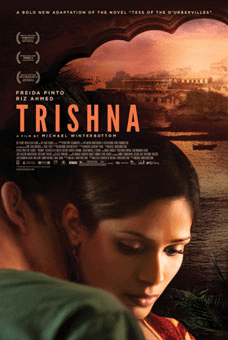
It’s gratifying when a story that’s over a century old can be reset in modern times and still feel as fresh as when it was originally written. Given the heartbreaking nature of the source material, Trishna — a retelling of Thomas Hardy’s Tess of the d’Urbervilles — is all the more depressing because of its continued relevance.

British writer-director Michael Winterbottom sets Trishna in modern-day Rajastan. The beautiful title character, played by Freida Pinto, is spotted working at a hotel by a British non-resident Indian named Jay (Riz Ahmed), who’s on a road trip with his friends. Jay’s wealthy father has sent his son to India to manage a luxury hotel. Jay would rather produce movies in Mumbai, using his father’s money, of course.

When Trishna and her father are injured in an accident that destroys her family’s jeep — their sole source of income — Jay hires Trishna to work at his family’s hotel in far-away Jaipur. She becomes her family’s breadwinner, but at a cost. One night, lecherous Jay takes advantage of her. Trishna flees home to an unexpectedly cold welcome: the family depends on the money she earns. This sends her right back into Jay’s clutches.

Hardy’s novel was printed with the subtitle: “A Pure Woman Faithfully Presented.” Trishna likewise presents a portrait of a complete person, and Pinto is portrays the character as she really is. As maddening as it is every time you wish Trishna would just run away, it’s clear that she can’t without sacrificing her family.

Country-girl Trishna’s minimal education limits her opportunities to earn money independently. Education becomes a theme as Trishna scolds the younger female members of her family to stay in school. Education is their only hope for a future away from their unsympathetic father. He delivers the cruelest blow of the film when he tells Trishna that the whole town knows she’s the family’s breadwinner, and not him. It’s an accusation, not a compliment, despite the fact that she’s just obeying his orders.

Jay is an amalgam of the characters Alec and Angel from Tess of the d’Urbervilles. The combination produces a villain both entitled and flighty, growing more monstrous the more bored he gets, resentful of his own familial obligations. Given the time limitations of a movie, I thought the combination made sense and worked well.

What didn’t work for me was the choice to have co-producer Anurag Kashyap and his wife, actress Kalki Koechlin, appear in the film as themselves during scenes when Jay is in Mumbai trying to become a producer. The closing credits list their characters as “Anurag” and “Kalki” rather than “Himself” or “Herself,” so I suppose there’s room to argue that they’re just playing a director named Anurag and an actress named Kalki.

It’s a gimmick that will go unnoticed by people unfamiliar with Bollywood films, but their scenes stuck out like a sore thumb to me because Kalki is totally obnoxious in the film. She may have just been putting on an act, but if that’s the case, give her character a different name.

The problem is that Kalki Koechlin is one of my favorite actors. I don’t read gossip columns or actor interviews unless they’re specifically talking about their jobs. The less I know about actors personally, the more I can believe them as different characters. The lasting image I take away from Trishna — accurate or not — is that Kalki Koechlin seems like a jerk, and I don’t want to think that about her.

Again, I don’t know if it’s an accurate perception, but why does she have to appear in the film as herself? It is a mistake that taints an otherwise solid film.

Links