Tag Archives: Riz Ahmed

Movie Review: Hamlet (2025)

3 Stars (out of 4)

Hamlet opens in US theaters April 10

Director Aneil Karia’s new version of Hamlet re-imagines Shakespeare’s tragedy as a modern-day business succession drama. Riz Ahmed’s bold turn as Hamlet enlivens the drama for a contemporary audience, even as it retains the play’s original dialogue.

Karia’s interpretation of a screenplay by Michael Lesslie sets the story in present-day London. Hamlet (Ahmed) returns home from abroad for his father’s funeral. His father was the owner of a firm called Elsinor, a wealthy construction company that builds high-rises. The night of the funeral, Hamlet’s paternal uncle Claudius (Art Malik) announces that he’s going to marry Gertrude (Sheeba Chaddha): his brother’s widow and Hamlet’s mother.

The wedding news comes as a shock to Hamlet, and he’s even more troubled by the fact that no one seems bothered by it but him. We don’t know where Hamlet was before his father died or how much he knew about his condition, but multiple people point out that his dad had been ill for several months. His father’s mattress still bears his silhouette in the form of a deep indentation created over his long convalescence. Everyone else has had time to mourn him and make plans for what comes next. Hamlet is the only one who experiences all this as breaking news.

In this fragile state, drugs and booze are the last things Hamlet needs, but his friend Laertes (Joe Alwyn) takes him out clubbing. Buzzing and overstimulated, Hamlet stumbles into an alley and sees the ghost of his father (played by Avijit Dutt). The ghost leads Hamlet to the top of one of Elsinor’s buildings under construction where he reveals that he was murdered by Claudius via poison dropped into his ear.

Hamlet believes the ghost and intends to prove his uncle’s guilt. The only person he confides in is Ophelia (Morfydd Clark), his former flame and Laertes’ sister. She’s concerned about Hamlet’s increasing agitation but agrees to keep his supernatural encounter a secret.

Thus Hamlet sets about trying to confirm his uncle’s guilt via a convoluted plan that involves a very direct piece of performance art at the wedding. It isn’t until the night of the wedding that Hamlet finally gets to speak privately with his mother, even though she’s been shooting him pointed looks that communicate variations on “I need to talk to you” and “We’ll talk about this later.” Chaddha is an elite talent when it comes to sending messages with her eyes.

The conversation goes poorly and comes too late to prevent the tragedy that follows, particularly when family advisor Polonius (Timothy Spall) — father of Ophelia and Laertes — interrupts mid-argument. The violent climax to the story is visceral and shocking.

Lesslie’s screenplay cuts out some major parts of the play, including Hamlet’s “Poor Yorick” speech and the characters Rosencrantz and Guildenstern. Anyone who didn’t know about them before won’t miss them, as their absence makes for a quicker narrative pace and keeps the film’s runtime under two hours.

The famous “To be or not to be” monologue is shot in a really inventive way, with Hamlet delivering it while driving. The screenplay ads a nice contemporary hook by blaming Elsinor Corporation for displacing homeless people, a variation on the “something rotten in the state of Denmark” line from the play. Hamlet only realizes this after he returns home, a further indictment that he’s been neglecting his duties as heir to the family business.

Ahmed vibrates with intensity the entire film, effectively conveying Hamlet’s sense of disconnection and his declining mental state. The casting all around is solid, with Chaddha being an inspired choice for Gertrude. Even Malik is quietly good as Claudius, who’s trying to give off “just a regular guy” vibes after killing his brother and marrying his wife.

My biggest complaint about Hamlet could be due to the fact that I watched it on a digital screener and not in a theater or on Blu-ray, but it’s worth mentioning in case it’s simply how the audio is designed. It’s very hard to hear the dialogue at times. There’s a constant murmur of background noise — whether its music or chatter — that’s meant to indicate that locations are busy and populated. In order to have a private conversation under these conditions, Hamlet whispers a lot, which is hard to hear over the background noise. Not to mention, these lines were originally written to be delivered from a stage by an actor without a microphone (because they hadn’t been invented yet). They weren’t meant to be whispered. I wish I didn’t have to spend as much time adjusting the volume as I did.

Links

Movie Review: The Reluctant Fundamentalist (2013)

TheReluctantFundamentalist3.5 Stars (out of 4)

Buy the movie at iTunes
Buy the DVD at Amazon
Buy Mira Nair’s book on the making of the film at Amazon

The Reluctant Fundamentalist reminds us that the traumas of our personal lives don’t stop for global catastrophes. The movie’s title alone doesn’t tell the whole story. Radical Islam is just one facet of a compelling narrative about some of the major issues of the last twelve years.

The tale of modern times is told through the experiences of Changez Khan (Riz Ahmed). Now a professor in his native Pakistan, Changez is questioned by a journalist — Bobby (Liev Schreiber) — about the kidnapping of an American professor at the same university. Changez stalls in revealing details of the kidnapping to Bobby by explaining how his experiences shaped his conflicted view of America.

Eager to improve the declining fortunes of his artist parents — played by Om Puri and Shabana Azmi — Changez moves to America in the late 1990s to study business. He gets a job at a Bain Capital-type firm that specializes in making companies more profitable, usually by laying off employees. He falls in love with Erica (Kate Hudson), the artsy niece of the head of his firm.

The attacks of 9/11 happen while Changez is on assignment in the Philippines, and he returns to the U.S to find that the rules of society have changed for him. In the film’s most disturbing scene, the rest of his team members waltz through airport security while Changez is subjected to an invasive strip search solely because of his ethnicity. His relationship with Erica deteriorates, and Changez wonders if America is really where he belongs.

After playing a villain in Trishna, Ahmed shows his versatility in The Reluctant Fundamentalist. Ahmed makes Changez sympathetic and relatable as he navigates a society that isn’t the pure meritocracy he expected it to be. His best friend, Wainwright (Nelsen Ellis), is the only other member of a racial minority employed at their firm. Among whites — including his boss, played by Kiefer Sutherland, and even his girlfriend — Changez feels treated like a token and not a real person.

In addition to the presence of Bollywood veterans Puri and Azmi, fans of Hindi films will find a lot of thematically familiar material in The Reluctant Fundamentalist. Changez’s troubled romantic relationship with Erica suffers as much from an undercurrent of prejudice as it does from problems in Erica’s past. He likewise struggles with disappointing his parents, who aren’t impressed by his material ambitions, even when they benefit from them. With a runtime of 130 minutes and a leisurely approach to storytelling, the pace of the film will feel familiar to Bollywood fans as well.

Early in The Reluctant Fundamentalist, Changez tells Bobby that understanding only comes with patience. It’s a criticism of American mistakes in the country’s rush to deal with Islamic terrorism, but it is also good advice for how to watch the movie. Those willing to embrace the personal drama within the movie’s larger story about American interference in Pakistan will be rewarded.

Links

Movie Review: Trishna (2011)

3 Stars (out of 4)

Buy or rent the movie at iTunes
Buy the DVD at Amazon

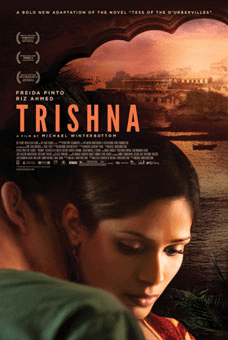
It’s gratifying when a story that’s over a century old can be reset in modern times and still feel as fresh as when it was originally written. Given the heartbreaking nature of the source material, Trishna — a retelling of Thomas Hardy’s Tess of the d’Urbervilles — is all the more depressing because of its continued relevance.

British writer-director Michael Winterbottom sets Trishna in modern-day Rajastan. The beautiful title character, played by Freida Pinto, is spotted working at a hotel by a British non-resident Indian named Jay (Riz Ahmed), who’s on a road trip with his friends. Jay’s wealthy father has sent his son to India to manage a luxury hotel. Jay would rather produce movies in Mumbai, using his father’s money, of course.

When Trishna and her father are injured in an accident that destroys her family’s jeep — their sole source of income — Jay hires Trishna to work at his family’s hotel in far-away Jaipur. She becomes her family’s breadwinner, but at a cost. One night, lecherous Jay takes advantage of her. Trishna flees home to an unexpectedly cold welcome: the family depends on the money she earns. This sends her right back into Jay’s clutches.

Hardy’s novel was printed with the subtitle: “A Pure Woman Faithfully Presented.” Trishna likewise presents a portrait of a complete person, and Pinto is portrays the character as she really is. As maddening as it is every time you wish Trishna would just run away, it’s clear that she can’t without sacrificing her family.

Country-girl Trishna’s minimal education limits her opportunities to earn money independently. Education becomes a theme as Trishna scolds the younger female members of her family to stay in school. Education is their only hope for a future away from their unsympathetic father. He delivers the cruelest blow of the film when he tells Trishna that the whole town knows she’s the family’s breadwinner, and not him. It’s an accusation, not a compliment, despite the fact that she’s just obeying his orders.

Jay is an amalgam of the characters Alec and Angel from Tess of the d’Urbervilles. The combination produces a villain both entitled and flighty, growing more monstrous the more bored he gets, resentful of his own familial obligations. Given the time limitations of a movie, I thought the combination made sense and worked well.

What didn’t work for me was the choice to have co-producer Anurag Kashyap and his wife, actress Kalki Koechlin, appear in the film as themselves during scenes when Jay is in Mumbai trying to become a producer. The closing credits list their characters as “Anurag” and “Kalki” rather than “Himself” or “Herself,” so I suppose there’s room to argue that they’re just playing a director named Anurag and an actress named Kalki.

It’s a gimmick that will go unnoticed by people unfamiliar with Bollywood films, but their scenes stuck out like a sore thumb to me because Kalki is totally obnoxious in the film. She may have just been putting on an act, but if that’s the case, give her character a different name.

The problem is that Kalki Koechlin is one of my favorite actors. I don’t read gossip columns or actor interviews unless they’re specifically talking about their jobs. The less I know about actors personally, the more I can believe them as different characters. The lasting image I take away from Trishna — accurate or not — is that Kalki Koechlin seems like a jerk, and I don’t want to think that about her.

Again, I don’t know if it’s an accurate perception, but why does she have to appear in the film as herself? It is a mistake that taints an otherwise solid film.

Links