Opening August 26: A Flying Jatt

Tiger Shroff plays a superhero in A Flying Jatt, opening in Chicago area theaters on August 26, 2016.

A Flying Jatt opens on Friday at MovieMax Cinemas in Niles and AMC South Barrington 30 in South Barrington. It has a listed runtime of 2 hrs. 29 min.

Last weekend’s new release, Happy Bhag Jayegi, only carries over at MovieMax. Construction projects at multiple Chicago area theaters will limit the number of screens available for the remainder of the year, so Bollywood movies aren’t going to stick around for as long as they would have in the past. If a movie interests you, plan on seeing it in the first week.

Rustom carries over at the South Barrington 30, Regal Cantera Stadium 17 in Warrenville, AMC Loews Woodridge 18 in Woodridge, and MovieMax, which also holds over Mohenjo Daro.

Other Indian films showing in the Chicago area this weekend:

Movie Review: Jugni (2016)

Jugni3 Stars (out of 4)

Buy the movie at Amazon or iTunes
Buy the soundtrack at Amazon or iTunes

Writer-director Shefali Bhushan makes a promising debut with Jugni. Despite some plot hiccups, Bhushan’s film shows her knack for characterization and her passion for music.

The plot issues are present from the beginning. As the opening credits run, a woman travels from Mumbai to Hasanpur, a small town in Punjab. It’s a full twelve minutes before we learn that the woman is named Vibs (short for Vibhavari), played by Sugandha Garg, who’s gaining recognizability with roles in Patang, My Name Is Khan, and the Tere Bin Laden films.

Vibs is a rookie music director looking for fresh talent for a movie soundtrack. Her target is a lauded classical singer named Bibi Saroop (Sadhana Singh), but Bibi’s son Mastana (Siddhant Behl) gets to Vibs first. Mastana is also a singer, though his tastes are more modern than his mother’s. For example, the lyrics of his biggest hit on the local party circuit rhyme “kidney” with “Sydney”.

The amount of time Vibs and Mastana spend together rankles Preeto (Anuritta Jha), Mastana’s de facto girlfriend. She and Bibi worry that Mastana is reading too much into Vibs’ interest in him, letting Bollywood dreams cloud his vision.

Mastana is used to being the big fish in his small pond, so he’s certain his local fame will translate to success in Mumbai. Even when their song is a hit, Vibs cautions Mastana about the fickleness of the industry. Promises made in Mumbai don’t mean as much as they do in Hasanpur.

This city-versus-country conflict is at the heart of Jugni, not just in the way it governs careers but relationships as well. Preeto and Mastana aren’t officially girlfriend-boyfriend because they don’t need to be; it’s just a given that they will get married someday. On the flip side, Vibs shares an apartment with her boyfriend, Sid (Samir Sharma), but recent problems have rendered their relationship essentially an open one.

A night of passion between Vibs and Mastana holds different meaning for both of them. While Vibs treats it as a fling, Mastana considers it the foundation for a romantic relationship. Much like his dreams of success in Bollywood, he also envisions a future with Vibs and pushes Preeto aside to make way.

Refreshingly, Bhushan doesn’t take the side of either character, presenting them as complex young adults at a critical stage in their lives. Mastana is naive, but is he wrong to view sex with Vibs as a significant, possibly life-changing event? Vibs is nonchalant, but why shouldn’t two adults be able to have fun without it requiring a commitment?

One side-effect of this balanced presentation is a blurring of who the film’s main character actually is. That then clouds the ultimate goals for each character, making it hard to get a sense of where we are in the story at any given point. Not every movie needs to rigidly follow a traditional structure, but Bhushan shows enough familiarity with that structure that certain deviations just make things confusing.

As for the performances, Behl — who also gets an associate writer credit for Jugni — imbues Mastana with a mixture of innocence and arrogance. Garg has a challenging job because Vibs spends a lot of time listening to other people play music, and it’s hard to make that look interesting onscreen. Garg is good at portraying Vibs’ internal conflict, making her vacillation understandable without coming across as manipulative.

Jugni is an aesthetic delight for both eyes and ears. The movie looks lovely, thanks to cinematographer Divakar Mani. Clinton Cerejo provides a terrific soundtrack, with contributions from luminaries like A. R. Rahman and Vishal Bhardwaj.

There’s an awful lot to like about Jugni. I’m really interested to watch Shefali Bhushan grow as a filmmaker.

Links

Bollywood Box Office: August 19-21, 2016

Happy Bhag Jayegi turned in a perfectly respectable opening weekend in North American theaters. From August 19-21, 2016, the romantic comedy earned $156,110 from 77 theaters, an average of $2,027 per theater.

In its second weekend in North American theaters, Rustom extended last weekend‘s narrow victory over Mohenjo Daro by a large margin. Rustom earned $359,432 from 118 theaters ($3,046 average). Those earnings are down just 53% from last weekend — one of the best retention rates of the year. Rustom‘s total earnings stand at $1,444,888.

Mohenjo Daro didn’t hold up nearly as well. It earned $166,308 from 164 theaters ($1,014 average) in its second weekend, down about 77% from last weekend (which is almost exactly the median Weekend 1-Weekend 2 drop for 2016 releases). That decline is better than Fitoor‘s 87% plunge but worse than Fan‘s 74% drop. Mohenjo Daro‘s total stands at $1,145,847, putting it in ninth place for the year — not good enough for a movie that opened in more than 200 theaters.

Sultan held on for a seventh week in two theaters, earning $1,247 ($624 average) to bring its total to $6,191,282.

Source: Rentrak, via Bollywood Hungama

Streaming Video News: August 21, 2016

I updated my list of Bollywood movies on Netflix with one new addition to the catalog. The charming adventure Dhanak (“Rainbow“) is now available for streaming. I loved this sweet movie about an adorable brother and sister who hit the road in search of a cure for the boy’s blindness.

In other strange Netflix news, 2016’s Laal Rang was available for streaming for less than a week before being pulled from the service. I’ll update my list if it returns.

Movie Review: Happy Bhag Jayegi (2016)

HappyBhagJayegi2 Stars (out of 4)

Buy the DVD at Amazon
Buy the soundtrack at Amazon or iTunes

You might think that the woman named Happy would be the main character in a movie titled Happy Bhag Jayegi (“Happy Will Run Away“). You’d be wrong.

Happy (Diana Penty) is a plot catalyst rather than a real character. She exists to cause problems that other people must fix, ostensibly in the name of getting Happy what she wants, but really in order to advance their own character development.

Of the film’s four major characters, Happy is introduced third, ten minutes into the film. The first character we meet is Bilal Ahmed (Abhay Deol), the film’s true protagonist on whose emotional growth the story depends.

Bilal’s father is a prominent Pakistani politician determined to make his son follow in his footsteps and “change the future of Pakistan.” Bilal meekly walks his predetermined path, too timid to speak up for what he really wants.

The Ahmeds visit Amritsar for an agricultural summit aimed at fostering ties between the neighboring countries. Elsewhere in town, a local goon/politician named Bagga (Jimmy Shergill) takes the stage to perform at a celebration before his upcoming wedding. His bride-to-be — Happy, appearing onscreen for the first time — waits until the show is underway before secretly leaping out of a window into the back of a truck. Only instead of landing in the vehicle owned by a friend of her boyfriend, Guddu (Ali Fazal), she mistakenly jumps into a truck taking goods from the agricultural summit to the Ahmed family home in Lahore.

Bilal scrambles to find a way to get Happy back home without creating an international incident (and without his father finding out), but Happy won’t leave unless her marriage to Guddu is secured. Bilal enlists the help of his fiancée, Zoya (Momal Sheikh), and the police constable, Afridi (Piyush Mishra), to pull off a complicated cross-border scheme.

Happy meets the minimum requirements for a generic Bollywood romantic comedy female lead in that she’s beautiful and feisty, with a penchant for drinking and a domineering attitude that make her irresistible to male Bollywood romantic comedy characters. But that’s all there is to her.

In contrast, Zoya is refreshingly complex. Bilal’s childhood friend and the daughter of a wealthy businessman, Zoya and Bilal have been betrothed since birth. She views Happy as a problem to be solved, but Bilal’s infatuation with the interloper makes Zoya question whether her own romance with him is one-sided. She doesn’t want to be a constant reminder to Bilal of the choices he wasn’t allowed to make for himself. Yet Zoya is a team player, and she doesn’t let her doubts interfere with her duties, nor does she resort to trickery to keep Bilal and Happy apart.

Another unfortunate feature of Happy’s character is her lack of agency. After making her fateful leap into the truck, she spends most of the film in jail, in hiding, or kidnapped. When she receives her father’s blessing at the end, it’s not because of anything she’s done but because of the actions of one of the men.

It’s also worth pointing out that, after Happy runs away, both Guddu and Bagga continue to express their desire to marry her. However, her father grabs a gun and says he’s going to kill her. Even if he doesn’t mean it literally, it’s not the kind of joke you can make when women and men who elope are still murdered by their families with alarming regularity in Pakistan and India.

Unlike the cookie-cutter title character, the men in Happy Bhag Jayegi are thoughtfully written. Bilal has spent his life resisting his future in politics only for Happy’s plight to show him that he’s a good leader. Guddu’s future is as amorphous as Bilal’s is fixed, plaguing the young lover with doubts about his ability to provide for his beloved. Bagga is a goon, but also a decent guy who genuinely cares for Happy.

The performances from the likeable cast are generally quite good. It’s clear that Penty is capable of more than the material she was given. The plot unfolds at a decent clip and heads in some unexpected directions.

One more knock against Happy Bhag Jayegi may only be relevant to international viewers. Many of the jokes are wordplay humor, especially involving the different meanings of words in Urdu versus Punjabi or Hindi. These jokes aren’t translated with context, so it’s impossible tell what’s supposed to be funny.

There are the elements of a good movie present in Happy Bhag Jayegi. If only the title didn’t feel like a bait-and-switch.

Links

Opening August 19: Happy Bhag Jayegi

Diana Penty plays a runaway bride in the romantic comedy Happy Bhag Jayegi, the only new Bollywood film opening in the Chicago area on August 19, 2016. Penty’s co-stars include Abhay Deol, Jimmy Shergill, and Ali Fazal.

Happy Bhag Jayegi opens on Friday at MovieMax Cinemas in Niles and AMC South Barrington 30 in South Barrington. It has a listed runtime of 2 hrs. 6 min.

Mohenjo Daro carries over for a second weekend in seven local theaters: MovieMax, South Barrington 30, AMC River East 21 in Chicago, Regal Round Lake Beach Stadium 18 in Round Lake Beach, Marcus Addison Cinema in Addison, Regal Cantera Stadium 17 in Warrenville, and AMC Loews Woodridge 18 in Woodridge. However, most theaters are only showing Mohenjo Daro once or twice per day.

Rustom gets a second weekend in all six of the theaters in which it opened last week (and with more showings per day than Mohenjo Daro): River East 21, MovieMax, South Barrington 30, Cantera 17, Woodridge 18, and Century Stratford Square in Bloomingdale.

Other Indian movies showing in the Chicago area this weekend include:

Bollywood Box Office: August 12-14, 2016

The battle between Rustom and Mohenjo Daro has been decided in North America, with Rustom emerging the victor by a greater margin than it first appears. From August 12-14, 2016, Rustom earned $757,004 from 132 theaters ($5,735 average). During the same weekend, Mohenjo Daro earned almost as much — $728,236 — but in over a hundred more theaters (237, to be exact). That gave Mohenjo Daro a much lower per-theater average of $3,073.

To put these performances in context for the year, Mohenjo Daro released into the third highest number of theaters in North America, but its opening weekend gross was only sixth best and its opening weekend average a disappointing eleventh. On the other hand, Rustom released into the eighth highest number of theaters for 2016, but its opening weekend gross and average were both fifth best.

Both movies will wind up earning $1 million here, so at least Mohenjo Daro star Hrithik Roshan can hang his hat on that. It’s now a question of how widely the two film’s fortunes will diverge going forward, and anecdotal evidence from the Chicago area hints at a brighter future for Rustom. Last weekend saw Mohenjo Daro open in nine Chicago area theaters, compared to Rustom‘s six. Rustom is carrying over for a second weekend in all six of its original theaters, while Mohenjo Daro is down to seven. More importantly, three of those seven theaters are only showing Mohenjo Daro twice per day over the weekend, and another is only showing it once daily. So, despite the higher theater count, Mohenjo Daro gets only twenty showings across the Chicago area on Friday, while Rustom gets 22.

If Mohenjo Daro‘s showings are already being cut back dramatically, the movie could be down to just one or two theaters in Chicago by next weekend. If that plays out the same way in other metropolitan areas across the United States and Canada, Mohenjo Daro could have a lot of trouble going forward. Worst case scenario is a quick burnout like Fitoor earlier this year, which made 2/3s of its total earnings in its first weekend. A 1.5 multiplier would see Mohenjo Daro post total earnings just shy of $1.1 million, which would put it in tenth place for the year. That would be bad.

Other Bollywood movies still in North American theaters:

  • Dishoom: Week 3; $5,863 from nine theaters; $651 average; $803,195 total
  • Sultan: Week 6; $1,738 from two theaters; $869 average; $6,189,464 total

Source: Rentrak, via Bollywood Hungama

Movie Review: Rustom (2016)

Rustom3 Stars (out of 4)

Buy the DVD at Amazon
Buy the soundtrack at Amazon or iTunes

An open-and-shut murder case turns out to be anything but in Rustom, a movie based on a real-life case from 1959. Period costumes and decor give this drama a stylish flair.

The title character Rustom Pavri (Akshay Kumar) is a decorated Navy officer. His ship returns to Mumbai — then Bombay — ahead of schedule, causing him to catch his wife Cynthia (Ileana D’Cruz) in an extramarital affair with their mutual friend, Vikram (Arjan Bajwa).

Rustom returns to his ship to check a gun and ammunition out of the munitions cabinet, logging the withdrawal with the duty officer. He heads to Vikram’s mansion where he shoots the wealthy playboy to death, then turns himself into the police.

Chief Police Inspector Vincent Lobo (Pawan Malhotra) is immediately suspicious of Rustom’s calm demeanor, his refusal to be housed in a Navy jail, and his insistence on representing himself at trial. To Vikram’s bereaved sister, Priti (Esha Gupta), Rustom’s actions feed her hopes of an easy victory in court.

But Rustom has a few things working in his favor. Erach (Kumud Mishra) — a publisher from the same Parsi community as Rustom — uses his newspaper to run stories painting the officer in a favorable light, driving sales and tainting the jury pool at the same time. Erach’s contentious relationship with the trial judge (Anang Desai) provides the film’s comic relief.

Also on Rustom’s side is public sentimentality toward soldiers, a bias that Rustom himself exploits. When representing himself at trial, Rustom casually responds to the prosecutor’s (Sachin Khedekar) complaint about the symbolic impact of the officer’s uniform by saying that wearing his uniform is one of his unchangeable habits, just like breathing or defending his country.

Director Tinu Suresh Desai shows the power of the uniform in an early scene whose significance is easy to miss. Fresh off his ship, Rustom stops to buy some flowers for Cynthia from a street vendor. Just in the background, a pair of young women stare dreamily at Rustom, likely envisioning themselves the lucky recipients of a bouquet from a handsome man in uniform someday.

Writer Vipul K. Rawal draws from the way the jury was influenced in the real case of Officer K. M. Nanavati to make observations about the way blind veneration of the military can lead society to overlook the shortcomings of both individual officers and larger institutions. His story is critical, but not cynical.

Probably the biggest selling point for Rustom is its visual appeal. Costume designer Ameira Punvani showcases a stunning array of attire, adding ostentatious touches to the wardrobes of the wealthy siblings, Vikram and Priti. There are also loads of classic cars and furniture pieces to drool over among the set dressings.

Completing the period aesthetic is the cast, smartly assembled by Shruti Mahajan. Malhotra looks like he was plucked straight from a mid-century detectives catalog. Bajwa was born to play a rich, 1950s Lothario. The way he leers at Cynthia is positively nauseating, and I mean that as a compliment.

Gupta suits the film perfectly as well, poured into her glamorous cocktail attire, haughty expression permanently in place. I wish there were more to her character, but one can’t fault Priti’s single-minded drive to bring her brother’s killer to justice.

By necessity, Rustom has to play his cards close to the vest, so this isn’t one of Kumar’s flashier roles. Still, he fills Rustom with enough charm and intelligence to keep both the audience and the other characters guessing about his endgame.

D’Cruz gets to show the most emotional range as Cynthia, a woman overwhelmed by guilt and loneliness. There’s more to the story than she realizes, leaving her to suffer from a mistake that may or may not be entirely her fault. D’Cruz does a fine job containing Cynthia’s inner torment behind a brave public face.

Rustom is an entertaining movie, its vibrant style counting for a lot, given the relative dearth of period films in Bollywood. It’s also patriotic without being blindly so. Overall, it’s worth a watch.

Links

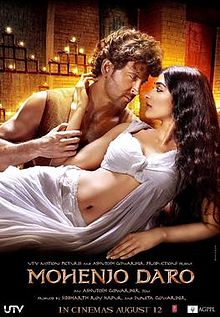
Movie Review: Mohenjo Daro (2016)

MohenjoDaro1.5 Stars (out of 4)

Buy the DVD at Amazon
Buy the soundtrack at iTunes

Even without context, Mohenjo Daro isn’t a very good movie, but it’s especially disappointing when considered within the landscape of recent Indian films and with regard to director Ashutosh Gowariker’s past achievements.

Gowariker’s story takes place in the ancient Indus Valley city of Mohenjo Daro, around 2,000 years B.C. Hrithik Roshan plays Sarman, a nearby farmer with a mysterious connection to the city that he doesn’t understand.

Sarman’s uncle Durjan (Nitish Bharadwaj) caves to Sarman’s relentless begging and allows his nephew to go to the Mohenjo Daro, albeit with warnings about the city’s many dangers. At forty-two, Roshan is too old play a character so immature that he opens the “only in case of life or death” package that his uncle gives him as soon as Durjan is out of sight.

When Sarman arrives at the metropolis he finds a place governed by greedy politicians fearful of the merciless senate leader Maham (Kabir Bedi) and his bully of a son, Moonja (Arunoday Singh). Maham orders a tax increase, even as farmers struggle with diminishing yields due to Maham’s damming of the river.

Sarman is fed up and ready to head home when, wouldn’t you know it, he spots a beautiful woman who makes him change his mind. (Conveniently, everything of import in Mohenjo Daro happens at exactly the right moment.) The woman is Chaani (Pooja Hegde), daughter of the head priest (Manish Chaudhary) and The Chosen One of Mohenjo Daro.

Chaani presents all kinds of problems in the story (none of which are Hegde’s fault). Right after Sarman admonishes his buddy and traveling companion Hojo to stop ogling women, Chaani shows up in an outfit that demands ogling. Her backless, floor-length dress has slits all the way up both thighs, a cutout to expose her navel, and a pushup bra. So, it’s bad when other men leer at women, but not when Sarman does it?

Then there’s the part about Chaani being The Chosen One. A prophesy at the time of her birth decreed that she would make a decision that would usher in a new era for Mohenjo Daro, but she never makes such a decision. She’s just a bystander as the people forget about her divine destiny and declare Sarman the savior of Mohenjo Daro.

With very little written or archeological evidence to go by, Gowariker was free to style his version of Mohenjo Daro as he wished. The results are bizarre, not in a fanciful way but in an impractical one. In addition to feathers and several kilos of metal beads, Chaani’s elaborate headdress has slices of geodes that hang next to her face. One can only imagine how annoying it must have been for Hegde to have slabs of rock clanking against her cheek in nearly every scene. And don’t get me started on helpful city guard Lothar’s (Diganta Hizarika) 1980s side-ponytail.

There are weird visual nods to classic Christian stories from Hollywood, too. In flashbacks, Maham is styled like an evil Jesus. Narendra Jha as the crazy prophet Jakhiro looks like Charlton Heston’s Moses from The Ten Commandments.

The lack of historical data was an opportunity to create something visually stunning, but Mohenjo Daro just isn’t. Worse, it looks really bad when compared to last year’s historical epic, Baahubali: The Beginning. In every respect — costuming, CGI, fight scenes, musical numbers — Mohenjo Daro looks like a lackluster version of Baahubali, with a less compelling story.

The bland, obvious plot is perhaps the most shocking element of Mohenjo Daro. Gowariker has a great track record for writing and directing engrossing stories that subtly convey his political ideals. Lagaan had poor, rural Indians literally beating the British at their own game. Swades showed how innovation and dedication to community can circumvent the slow movement of government. Khelein Hum Jee Jaan Sey saw young Indians pushed to violence by oppressive British rule. In Jodhaa Akbar, Roshan played a progressive emperor who embraced multiculturalism.

Gowariker ditches the nuance and character motivations of his previous films for cliched populism. Sarman declares that The People are fed up paying the senate’s taxes, and The People cheer in unison, somehow instinctively knowing that this outsider is the savior who can lead them out of poverty, and causing them to forget about the crew of murderous hill goons Maham employs as bodyguards, a la Tyrion Lannister.

It’s too easy. The idea that all of India’s (or anywhere’s) problems could be solved if the masses would rise up as one behind a charismatic leader is lazy and unsatisfying, whether the action takes place in the modern day or thousands of years ago. It absolves the masses of having to do the hard work that was such an important part of Lagaan, Swades, and Khelein Hum Jee Jaan Sey. Just wait around for a messiah — but not the woman we thought was The Chosen One. This other guy instead.

Even the manner in which the story is presented is ham-handed. A. R. Rahman provides a score full of uncharacteristically garish musical cues. The single corniest moment sees one character tell another, “something something something YOUR FATHER,” followed by a noisy instrumental blast and a zoom to closeup on the listener’s face.

There are also none of the culture-clash elements from Gowariker’s previous films present in Mohenjo Daro. Sarman is an outsider, but it’s not really a problem. He adapts to life in the city almost immediately, making friends and falling in love without a hitch. Then again, there’s not enough to Chaani’s character to make her a complicating factor. She’s there to look pretty, which Hegde does exceedingly well.

The actors aren’t to blame for Mohenjo Daro‘s shortcomings. No one is particularly good or bad, although I did enjoy Singh’s performance as the thwarted heir apparent more than I have some of his past work. This will be one of Roshan’s most forgettable roles.

There’s not enough substance here to tell if Mohenjo Daro could have been more than it is. It’s just the unfortunate product of a talented filmmaker who appears to have lost his way, sublimating his ideals for pandering that pleases no one.

Links

Streaming Video News: August 15, 2016

I updated my list of Bollywood movies on Netflix with three new additions to the streaming catalog, including two 2016 theatrical releases. The highest profile addition is Airlift, which stars Akshay Kumar in a fictionalized version of 1990 evacuation of 170,000 Indian citizens from Kuwait following Iraq’s invasion. I felt the movie fell short of its potential, but it is a fitting choice for some patriotic Independence Day viewing.

Also new is Laal Rang, a movie that no one but me bothered to watch when it released in April. If you’ve ever wondered why Shah Shahid of Blank Page Beatdown and I are such massive Randeep Hooda fans, watch Laal Rang and understand.

The last addition is John & Jane, a 2005 documentary about Indian call center workers by director Ashim Ahluwalia of Miss Lovely fame.

For everything else new on Netflix, check Instant Watcher.