
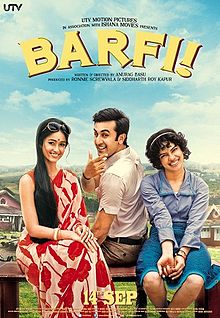
 4 Stars (out of 4)
Buy or rent the movie at iTunes
Buy the DVD at Amazon
Buy the soundtrack at Amazon
Like its namesake confection, Barfi! is certainly sweet. Not a frothy sweetness but a complex one with real depth and substance. Barfi! is not to be missed.
The film defies convention yet feels familiar. Flashbacks within flashbacks within flashforwards play with typical narrative format in a way that works better than it should.
The bulk of the action alternates between two times and places — 1972 and 1978, Darjeeling and Kolkata — framed by scenes set in the present day. The film’s narrator, Shruti (Ileana D’Cruz), recalls how her life changed in 1972 when her family moved from Kolkata to Darjeeling and she met Barfi (Ranbir Kapoor).
“Barfi” is how the deaf young man pronounces his given name, Murphy, so everyone calls him by his nickname. Unemployed Barfi spends his days making mischief around town, to the consternation of police inspector Dutta (Saurabh Shukla). Though he has a crush on Shruti, Barfi settles for friendship with her, because she is engaged. The two spend their days racing bicycles and bumming rides on train cars, falling in love in the process.
In the hands of a writer-director less skilled than Anurag Basu, Barfi’s penchant for mischief could be a cheap way to substitute quirkiness for character development. That’s not the case here. Barfi acts like an overgrown child because no one expects anything from him. He’s the town’s beloved mascot, cared for by his doting father, but that’s it.
Barfi’s outsider status makes a romantic match with Shruti impossible, even if she didn’t have a perfect-on-paper fiance waiting for her back in Kolkata. There’s no way her parents would accept a deaf son-in-law, even if the reason they give is their desire to spare her from the harsh judgements of society.
Shruti herself fails Barfi’s loyalty test. She lets go of his hand and leaps from his side as a light pole falls toward them. Having doctored the light pole himself, Barfi knows they were never in any danger. Like others before her, Shruti abandoned Barfi at the first sign of danger.
The one person to pass the loyalty test is Jhilmil (Priyanka Chopra), the autistic granddaughter of a wealthy local man. Having spent most of her childhood at a sanitarium — so as not to embarrass her snooty parents — she’s summoned to the side of her ailing grandfather. Barfi’s father is the grandfather’s driver, and Barfi and Jhilmil were childhood friends.
Jhilmil’s parents are no less embarrassed by their now-adult daughter when she returns. Jhilmil shuns almost all physical contact, screams and panics when she gets mud on her shoes, and loudly sings along with the band at a society party. The only person in Darjeeling who warms to Jhilmil is Barfi. Caring for her gives him purpose, and he provides her with a sense of security.
These themes — security and purpose — are universal, and those are the main challenges for Barfi and Jhilmil, not their special needs. Basu writes the characters as real people, not as a collection of physical and mental issues to be triumphed over. Shruti — the “normal” character among the three — is actually the most flawed, in that she lacks courage.
D’Cruz, an actress who has predominantly worked in Telugu films thus far, is a fine avatar for the audience. She nicely portrays the conflict inside Shruti, who would like to follow her heart but lacks the will to do it.
Ranbir Kapoor is the only actor who could have played Barfi. He has great physicality, both in scenes where he runs from Inspector Dutta (Saurabh Shukla is also great in the film) and where he bares his soul to Shruti using only gestures, no words. Kapoor makes Barfi more than just a lovable rascal.
But the standout performance in the film is by Priyanka Chopra. I’ve long appreciated the risks she takes in the roles she chooses, even if they don’t always work out. Playing an autistic woman could have gone poorly, but Chopra is perfect.
Like Kapoor, Chopra has very little dialog in the film. Jhilmil spends most of the time staring at the ground or observing the action around her, yet Chopra makes it easy to read Jhilmil’s emotions. Chopra’s depiction of autistic characteristics is accurate and respectful. Despite having a condition that makes forming emotional connections with other people difficult, there’s a lot to love about Jhilmil.
Other things to love about Barfi! include the beautiful scenery and music. Transitions between scenes are frequently accomplished by a pan over the silhouettes of three musicians — a guitarist, a violinist, and an accordion player — who seem to follow the characters everywhere.
Barfi! is a really special film. I laughed out loud, I cried, and I would happily watch it again tomorrow.
Links
- Barfi! Official Website
- Barfi! at Wikipedia
- Barfi! at IMDb


