Movie Review: Gunday (2014)

Gunday2.5 Stars (out of 4)

Buy or rent the movie at iTunes
Buy the DVD at Amazon
Buy the soundtrack at Amazon

Editor’s note: So, a lot of people have been coming to this review via IMDb, because Gunday is — after just one week in theaters — already the lowest-rated movie of all time. Lower than The Hottie and the Nottie, Birdemic, and even Manos: The Hands of Fate. As of February 22, it’s at 1.2/10, a full .8 ahead of its nearest competitor.

Is Gunday really that bad? As a movie, no. You can read below how I thought it was problematic, but passable.

Then why is it ranked as IMDb’s worst movie ever? It looks like the movie’s portrayal of the Bangladesh Liberation War has angered a lot of people, who have coordinated to give it as many 1/10 reviews as possible. Look at the IMDb user reviews, and several of them have the exact same title: “Manipulating Bangladesh’s Liberation War history.”

Unfortunately, I’m not familiar with the true events that Gunday references. So while I still think it’s okay as a film, I certainly wouldn’t vouch for it being historically accurate!

Abrupt changes in tone and an abundance of slow-mo keep Gunday (“The Outlaws“) from establishing its own voice or finding a rhythm.

The story begins in 1971 at the end of the war that established Bangladesh as an independent nation. 14-year-old orphans Bikram (Darshan Gurjar) and Bala (Jayesh V. Kardak) survive the deprivation of a refuge camp by working as gun runners. When Bala shoots an army officer to save Bikram’s life, the boys flee to Calcutta.

Fast-forward ten years, and Bikram (Ranveer Singh) and Bala (Arjun Kapoor) are the unofficial kings of Calcutta, controlling all of the city’s black market commodities. The buddies do everything together, while savvy Bikram keeps Bala’s temper in check.

As soon as the guys’ present-day circumstances are established, an anchor drops onto the plot in the form of a love interest: a cabaret dancer named Nandita (Priyanka Chopra).

The premise that two guys are such good buddies that they decide to share the same girl could be cute in a more lighthearted movie than this one. But Gunday starts out grim, and it returns to being so once Nandita chooses one guy over the other. The thirty-minute wacky romantic-comedy interval doesn’t fit.

That’s not the only aspect of Gunday that doesn’t make sense tonally. Action sequences vary from dramatic and realistic to outright loony. Bala causes an earthquake before shooting up through the ground, as though propelled by a geyser. A fish is wielded as a deadly weapon.

The goofy action sequences are pretty entertaining, but again, they don’t feel right in the context of the movie. Gunday would’ve been better had writer-director Ali Abbas Zafar established surreal action as the dominant tone of the movie.

Such a tone would’ve also explained the volume of slow-motion used in the film. Walking, running, dancing: seemingly every form of motility is presented in slow-motion. The impact of the two scenes in the movie that actually benefit from the treatment is dulled by its application to so many mundane activities.

There is a ridiculous amount of skin on display in Gunday, and not just by Chopra’s cabaret dancer. In the movie’s funniest fight scene, Bikram and Bala exchange blows, ripping off each other’s shirts in the process. The shirts come off in slow-mo (of course), exposing Singh’s and Kapoor’s hairless, tanned, greased-up, muscular torsos. It’s not supposed to be as hilarious as it is.

As much attention as is given to the guys’ muscles — with special attention paid to Singh’s perky buns — Irrfan Khan wins for Best Body, and he gets to keep his clothes on.

Khan’s star power is on full display as the police inspector tasked with bringing down Bikram and Bala and returning order to Calcutta. Saurab Shukla’s understated role as the lawyer who watches over Bikram and Bala is also notable.

Chopra is fine as Nandita, though she’s not given much to do besides look sexy, early on. Her performance improves as Nandita realizes the consequences of having strained the friendship between the two gangsters.

It almost seems as if the role of Bikram was written with Singh in mind, and his charisma is undeniable. Kapoor is very good at playing edgy anti-heroes, and it’s a shame when Bala gets turned into a mindless beefcake goofball during the romance portion of the movie. His hair-trigger is shelved for the sake of song-and-dance numbers and out-of-place comedy bits.

As a surreal dark comedy or action flick, Gunday could’ve been really interesting, but there’s no place for light romantic tomfoolery in such a film. A clear vision rather than a please-all approach would’ve done wonders.

Links
Opening February 14: Gunday

Celebrate Valentine’s Day with shootouts and coal-thievery. Gunday (a plural form of “goon,” not the name of the most violent day of the week) hits Chicago area theaters on February 14, 2014.

Gunday opens on Friday in seven local theaters: AMC River East 21 in Chicago, Regal Gardens Stadium 1-6 in Skokie, Big Cinemas Golf Glen 5 in Niles, AMC South Barrington 30 in South Barrington, Marcus Addison in Addison, Regal Cantera Stadium 17 in Warrenville, and AMC Loews Woodridge 18 in Woodridge.

After a solid performance in its opening weekend, the romantic comedy Hasee Toh Phasee gets a second week at the River East 21, Golf Glen 5, South Barrington 30, and Cantera 17.

Other Indian movies showing at the Golf Glen 5 this weekend include Idhu Kathirvelan Kadhal (Tamil) and Ohm Shaanthi Ohshaana (Malayalam).

Box Office: February 7-9

North American Bollywood fans were in the mood for love, turning out in impressive numbers for the romantic comedy Hasee Toh Phasee. In its opening weekend in 88 U.S. and Canadian theaters, the film earned $336,985 (according to Box Office Mojo).

Hasee Toh Phasee‘s per screen earnings of $3,829 bested every other film in the top twenty-five apart from The LEGO Movie and The Monuments Men, which finished the weekend in first and second place, respectively.

The success of Hasee Toh Phasee points to an upward trend in the young careers of the two lead actors: Sidharth Malhotra and Parineeti Chopra. This is only Malhotra’s second film after 2012’s Student of the Year, which earned $326,508 from 106 theaters ($3,080 per screen) in its opening weekend in North America, going on to earn a total of $670,086.

Chopra debuted in a supporting role in 2011’s Ladies vs Ricky Bahl, which earned $222,019 from 80 theaters ($2775 per screen) in its opening weekend (according to Bollywood Hungama). Ishaqzaade — Chopra’s second film and first lead role — didn’t release theatrically in the U.S.

Chopra had greater success with 2013’s Shuddh Desi Romance. It earned $345,624 from 116 theaters ($2976 per screen) in its first weekend, finishing its North American run with $641,000 in total earnings.

Distributor Reliance Big Pictures should be pleased if Hasee Toh Phasee ends up earning around $650,000 in the U.S. and Canada.

Movie Review: Hasee Toh Phasee (2014)

HTP3 Stars (out of 4)

Buy or rent the movie at iTunes
Buy the DVD at Amazon
Buy the soundtrack at Amazon

Finally, a movie in which the nerdy girl wins the hero’s heart without having to undergo a glamorous makeover. The tomboy reigns supreme in Hasee Toh Phasee (“She Smiles, She’s Snared“).

The tomboy at the heart of the film is Meeta (Parineeti Chopra), a clever, socially awkward young woman who stands out from her sisters because of her Harry Potter hairdo. In 2006, she flees from her sister’s wedding with the aid of stranger with a Rick Springfield coiffure, Nikhil (Sidharth Malhotra).

Nikhil is also clever, but more socially adept and far more cautious than Meeta. She invites him to join her on a trip, but he declines and returns to the wedding. Inside, he immediately falls in love with the first pretty woman he sees, a model named Karishma (Adah Sharma).

Fast-forward seven years, and Nikhil is hoping to finally do something right in Karishma’s eyes by marrying her. Things get complicated for the groom when Karishma asks Nikhil to look after her loony sister and keep her away from the wedding. The sister is Meeta, of course.

Meeta is one of the most well-developed characters in recent memory. All of her social tics — e.g. her extreme literalness and tendency not to blink during conversations — make her feel real, and they seem appropriate for a woman who’d rather be working in her chemistry lab than making small talk at a wedding.

Meeta comes alive in Chopra’s hands. She makes a character that could’ve been annoying into a vibrant and lovable person, and she’s at her best in a scene in which Meeta’s emotions get the best of her. Meeta’s relationship with her father, Devesh (Manoj Joshi), is touching. Unlike most people, he sees past Meeta’s quirks to who she really is.

In a movie with a character as memorable as Meeta and the theme of being true to oneself, Nikhil is a little too nebulous, especially since his character’s emotional development drives the story. It’s not clear why Nikhil is as reticent and fearful of disappointing people as he is, so his constant self-sabotage seems to come from nowhere. Even his final decision is forced on him more than it is self-generated.

Malhotra performs well as Nikhil, but he’s hampered by the way his character is written. He’s also too conventionally handsome for the part. When Devesh rhetorically asks what Karishma sees in him, it’s obvious: he makes nice arm candy at industry parties, in addition to being irrationally devoted to her.

There are several entertaining supporting characters in the film, none more so than Nikhil’s cousin, Abhinandan, who once almost became a contestant on “Indian Idol.” He sings and shimmies, hoping to impress Meeta, who barely notices him. One could make the case that he’d be as devoted a partner to Meeta as Nikhil, even if he’s not her intellectual equal.

The other component keeping Hasee Toh Phasee from perfection is the story structure. It starts too slowly, and the flow is interrupted along the way. Many scenes are too long relative to the degree that they show character development or move the story forward.

That said, Hasee Toh Phasee is worth checking out for its progressive female lead character, who’s both smart and pretty, even in jeans and a hoodie. That she’s played by a superstar in the making is an added bonus.

Links

New Trailer: February 6, 2014

The trailer for Yash Raj Films’ Bewakoofiyaan is out now. The romantic comedy — starring Sonam Kapoor, Ayushmann Khurrana, and Rishi Kapoor — hits theaters on March 14. It looks sort of cute, but uninspired. [Update: I changed the video to one featuring English subtitles. I’m still not impressed.]

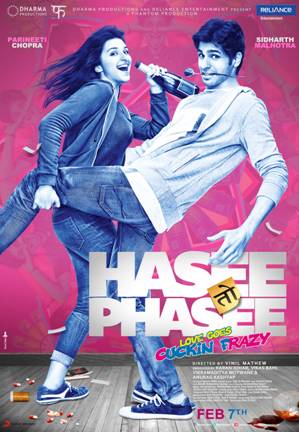
Opening February 7: Hasee Toh Phasee

The romantic comedy Hasee Toh Phasee — starring Parineeti Chopra and Sidharth Malhotra — opens in Chicago area theaters on February 7, 2014. I love the English translation of the title (according to Wikipedia): “She Smiles, She’s Snared!”.

Hasee Toh Phasee opens on Friday at the AMC River East 21 in Chicago, Regal Gardens Stadium 1-6 in Skokie, Big Cinemas Golf Glen 5 in Niles, AMC South Barrington 30 in South Barrington, and Regal Cantera Stadium 17 in Warrenville. It has a listed runtime of 2 hrs. 20 min.

Jai Ho carries over for a third weekend at the Golf Glen 5 and South Barrington 30.

Other Indian movies playing in the Chicago area this weekend include Heart Attack (Telugu, no subtitles) at the Cinemark at Seven Bridges in Woodridge and Golf Glen 5, which is also showing Drishyam (Malayalam), Paisa (Telugu), and Pannaiyarum Padminiyum (Tamil).

New Trailer: February 4, 2014

The trailer for Ankhon Dekhi released today in advance of its theatrical release on March 21, 2014. Although the cast features a lot of likeable character actors, I’ll be surprised if the movie opens in the U.S.

Box Office: January 31-February 2, 2014

Following a less-than-stellar opening weekend performance in American theaters, Jai Ho‘s earnings cratered in its second weekend. According to Box Office Mojo, Jai Ho‘s earnings fell nearly eighty percent in its second weekend, earning just $176,214 in the U.S. and Canada.

For comparison’s sake, theaters that carried 11-week-old films like Philomena or The Hunger Games: Catching Fire earned more per screen ($1,702 and $1,144 respectively) than did theaters that gave Jai Ho a second week ($904).

Jai Ho‘s total U.S./Canada earnings of $1,187,266 so far put it well off the pace of recent Salman Khan films like Dabangg 2 ($2,519,190), Ek Tha Tiger ($2,347,774), and Bodyguard ($1,834,384).

New Trailers: February 3, 2014

Two new HIndi movies released their trailers today. First up is the erotic horror film Ragini MMS 2, starring the voluptuous Sunny Leone. The trailer doesn’t pull any punches: Ragini MMS 2 is an unapologetic skin flick with a few scares. The video isn’t safe to watch at work since it features lots of shots of a barely clad Leone and some English swear words. Ragini MMS 2 hits theaters on March 21.

March 28 sees the release of Youngistan, a romance set against the backdrop of Indian politics. Without official English subtitles — turn on the video’s CC function for some funny but unhelpful English captions — it’s hard to discern the plot, but I’ll watch almost anything with Boman Irani.

I’m skeptical that either of these movies will release in the U.S. due to their relative lack of star power. Of the two, I’m more intrigued by Ragini MMS 2 because of its potential for unintentional hilarity and great drinking games. Close-up shot of Sunny Leone’s butt? DRINK! Awkward dirty talk? DRINK! Which of the two films are you more excited to see?

Movie Review: Bombay Talkies (2013)

Bombay_Talkies3 Stars (out of 4)

Buy the DVD at Amazon
Buy the soundtrack at Amazon

Bombay Talkies is a collection of short films by four young directors, created to honor one hundred years of cinema in India. The results are mixed, but the two best shorts make the whole film worth watching.

Ajeeb Dastaan Hai Yeh by Karan Johar

Johar’s short — a story of a gay tabloid intern (played by Saqib Saleem) who upends the life of his married boss (Rani Mukerji) — is the least successful of the four films. It doesn’t feel like a complete story, but rather a subplot of a full-length feature. The events depicted in the short would’ve made a nice catalyst for the further development of Mukerji’s character or an interesting interlude in a longer movie about Saleem’s character, struggling to find his way both as a young adult and as a gay man who’s been cast out from his family. The short film as it stands doesn’t work.

Star by Dibakar Banerjee

Banerjee’s effort is much more polished and showcases the incredible talent of Nawazuddin Siddiqui. Siddiqui plays Puradev, a failed actor who hops from job to job while waiting for his big break. Banerjee’s narrative includes some charming whimsical elements, such as Puradev’s pet emu and the disappointed ghost of his acting mentor. Siddiqui shines in a great scene in which Puradev pantomimes the events of his day for his daughter’s amusement.

Sheila Ki Jawaani by Zoya Akhtar

Akhtar’s short is the best of the bunch. Her story concerns a little boy named Vicky (Naman Jain) who wants to be a dancer, much to the chagrin of his macho father (played by Ranvir Shorey). Vicky’s idol, actress Katrina Kaif, appears to him in a vision, encouraging him to follow his dreams covertly. He gets further support from his understanding older sister, Kavya (Khushi Dubey).

Like Banerjee’s short, Akhtar’s movie includes some fantastical elements, celebrating the way in which movies allow us to envision a more magical version of reality. Hindi movies rarely feature child protagonists, so it’s refreshing to see a story that focuses on the concerns of children. Jain and Dubey are terrific.

Kaif’s advice to Vicky — be true to your dreams, but don’t broadcast them — seems like a bit of a bummer until her audience is taken into consideration. Vicky — like all children — has so little control over his present circumstances that there’s wisdom in trying to make his day-to-day life easier until he’s an adult and can do what he wants. It’s also a warning to parents to remember that children need respect as individuals as much as they need guidance and protection.

Murabba by Anurag Kashyap

After Akhtar’s delightful short, Kashyap’s film is a downer. His story follows a rural guy named Vijay (Vineet Kumar Singh) on his quest to meet Amitabh Bachchan and get him to take a bite of a piece of preserved fruit. Vijay’s father believes he’ll be cured of his ailments if he eats the rest of the fruit blessed by Bachchan’s bite, and he sends his son on a fool’s errand. Given the security retinues of modern stars, Vijay’s task is practically impossible to complete, and much suffering is inflicted upon the dutiful son in the process. It’s not fun to watch, and the payoff isn’t worth it.

“Apna Bombay Talkies”

The quartet of films is followed by a cheesy song-and-dance number featuring clips of old films and lip-syncing by current Bollywood stars. It’s almost as painfully self-congratulatory as the celebrity role-call song “Deewangi Deewangi” from Om Shanti Om, but it’s not as well choreographed. Check it out:

Links