Tag Archives: Zero Stars

Movie Review: Dirty Politics (2015)

DirtyPoliticsZero Stars (out of 4)

Buy/rent the movie at iTunes
Buy the DVD at Amazon

About three-quarters of the way through the movie, my hands grip my head as if trying to contain an imminent explosion. I scream, “What is happening?!” and tear at my hair. That sums up the entire experience of watching Dirty Politics.

The movie’s problems are immediately apparent, most obviously so in the way the film looks. The camera never stops moving. It doesn’t matter if the movement obscures the faces of the characters who are speaking: camera movement is paramount! The action can be dramatic, such as a crane shot from directly overhead that swoops down to ground level then back up again. It can be more subtle, such as persistent zoom-ins on actors’ faces.

In one shot, the camera rapidly zooms in to closeup and pulls back twice in the span of about three seconds. A judge says, “Court is adjourned,” and the camera pans from the judge up to a clock above his chair, even though there’s no significance to the clock or the time of day. Then the same shot is repeated a few minutes later, again for no reason.

I don’t blame cinematographer Panveer Selvam for this travesty of technique as much as I do director K.C. Bokadia, who also wrote this farce. Bokadia’s vision for Dirty Politics is obviously shaped by a fundamental misunderstanding of how to make movies.

The story opens in the middle of a search for missing dancer-turned-politician Anokhi Devi (Mallika Sherawat). We know this because the characters say the name “Anokhi Devi” about a hundred times in the first ten minutes. Characters are introduced in quick succession without a sense of where they fit into the larger story, and an absence of backstory is keenly felt.

Anokhi Devi’s appearance via flashback more than twenty minutes into the runtime doesn’t really clear things up. Her dancing grabs the attention of political party leader Dinanath (Om Puri). In exchange for sex, Dinanath promises to make her the party’s candidate in the next election. Naturally.

There’s a hullabaloo because a gangster named Mukhtiar (Jackie Shroff) wants the same candidacy. He gets a great introduction from Anokhi Devi’s secretary, Banaram (Rajpal Yadav), who announces his arrival at her house: “He’s Mukhtiar. A well-known goon of our area.”

Dirty Politics is full of hilariously ponderous lines. When Anupam Kher’s character Mishra — who is a CBI officer and a lawyer who’s sixty days away from retirement(!) — presents his case in court, the defense attorney responds: “He is very cleverly trying to make his points strong.” Eloquently said, man who doesn’t realize that he’s describing the very nature of his own job.

One can only imagine how Bokadia managed to rope so many talented actors into this doomed project. In addition to vets like Kher, Shroff, and Puri, Naseeruddin Shah his a role as an activist who steals the movie’s absurd closing scene. Govind Namdeo’s overacting is the height of comedy. Atul Kulkarni and Sushant Singh remind us why they are rarely called upon to play action heroes.

Shah’s character has a daughter whose sole narrative purpose is to be raped in order to blackmail him. There are only three women in the whole movie, and all of them are brutalized: two in order to intimidate their relatives, and Anokhi Devi for aspiring to a more meaningful purpose than that of Dinanath’s mistress.

Puri and Sherawat deserve some modest praise for fumbling through the most awkward sex scenes in cinema history. If Bokadia was counting on sex to sell Dirty Politics, he obviously didn’t watch any footage of his movie as it was being shot.

One can only fathom the sheer terror racing through the mind of editor Prakash Jha as he received each batch of footage. “How am I supposed to make a movie from this?” he asks himself. “There’s nothing to work with!” Hence how we end up with the exact same reaction shot of Jackie Shroff staring at a desk — his jaw muscles twitching — four times in succession.

Bonus: Everything you need to know about the lack of craft that went into making Dirty Politics, in just twelve seconds!

 Links

Movie Review: Unfreedom (2015)

UnfreedomZero Stars (out of 4)

Buy or rent the movie at iTunes
Buy or rent the movie at Amazon

The fact that writer-director-producer Raj Amit Kumar believes that his English-Hindi debut film Unfreedom is an enlightened piece of social commentary is exactly what makes it so vile and offensive.

Kumar tosses together narratives without bothering to connect them. Action shifts between unrelated stories about a newly-out lesbian in New Delhi and a jihadist in New York City, though both stories have weird subplots attached to them — a woman who has a miscarriage or abortion (it’s unclear which) and a corrupt cop in cahoots with the terrorists — that aren’t resolved.

The stories are primarily excuses for pornography: sexual in the case of the lesbian, Leela (Preeti Gupta), and torture in the case of the jihadist, Husain (Bhanu Uday).

Leela flees her arranged marriage to a man in order to reunite with her female lover, Sakhi (Bhavani Lee). They haven’t seen each other in a year, and Sakhi is now dating a man. Leela murders the man in front of Sakhi in order to get her attention, and it inexplicably works. Immediately after Sakhi escorts her mortally wounded boyfriend to hospital, she returns to Leela and confesses her love for her. Not the foundation for a stable relationship.

Meanwhile, in New York, Husain is on a mission to kill a Muslim scholar for being too liberal. First, he kidnaps and tortures the scholar and one of his students: a white guy who Husain nails to a modified cross and presumably kills, so far as we ever know.

Back in India, Sakhi and Leela spend their time in an island fantasy, until they’re caught and thrown in jail. Mind you, they get busted for being lesbians, not for their connection with the boyfriend’s murder, which nobody cares about. Catching gays is apparently more important than catching killers.

With all the concern in Bollywood over the way item numbers objectify women, Unfreedom shows what real objectification looks like. Kumar treats women’s bodies like things, especially the bodies of white women. Husain’s moment of clarity — or whatever the hell happens — comes only after he has literally butchered a white woman to death.

Kumar’s sexism is most obvious in the way he portrays Leela and Sakhi. Both of them are naked throughout much of the film, but Sakhi — a white American — is depicted more salaciously. She’s an artist, a lousy one, who paints in the nude for no reason. A naked self-portrait features her standing facing forward, with her legs apart and her hands at her sides.

Husain is also shown nude on a couple of occasions, but his nudity is depicted entirely differently. He is only shown from behind while in the shower, the camera pulled back much farther than in the close shots of the women’s bodies. Husain’s genitals are not shown, and even his buttocks are obscured by the shower’s steam. His nakedness is camouflaged, while the women’s nudity is overt.

Kumar wants to make it clear that we in the audience know that Sakhi is a slut. Other characters repeatedly call her “slut” and “whore.” Her portrayal reinforces the Indian myth of the oversexed white Western female, now an instrument of corruption for both men and women.

Unfreedom conflates sex and violence throughout. When Leela and Sakhi engage in a tawdry, explicit sex scene, it’s not provocative. It’s meant to shock in the same way that Husain’s gruesome torture of the professor is meant to shock. And just in case it wasn’t clear that this is supposed to be an “edgy” film, both women are violently gang-raped.

In addition to botching his film’s message, Kumar also deserves blame for terrible handling of his actors, many of whom — like Adil Hussain — are quite talented. Lee’s performance as Sakhi is particularly awful.

If Unfreedom is Kumar’s idea of challenging, progressive cinema, he needs to do some real soul-searching.

Links

Movie Review: Shamitabh (2015)

ShamithahfilmZero Stars (out of 4)

Buy the DVD at Amazon
Buy the soundtrack at Amazon

For all but a few of Shamitabh‘s two hours and thirty minutes, I wished I was anyplace other than the theater. I would spare you that same pain.

The element of Shamitabh that should’ve precluded it from ever being made is its asinine premise. Dhanush plays Danish — all three leads play characters with variations of their own names — a mute, small-town guy who wants to be an actor. He fails to break into the Mumbai film industry until a sympathetic assistant director, Akshara (Akshara Haasan), takes him under her wing. Akshara’s father is a doctor whose colleagues in Finland have created a revolutionary technology to aid mute people.

The technology involves implanting a chip in the patient’s throat that acts as a receiver. When words are spoken aloud by someone wearing a connected earpiece/microphone, the sound comes out of the mouth of mute patient when he moves his lips. In essence, the technology turns a mute person into a living ventriloquist’s dummy.

This invention is idiotic. Why would a mute person want to speak if he always had to do so in someone else’s voice, never able to speak his own thoughts? Who would want to be the person permanently tethered to mute person, effectively rendered mute themselves for the sake of someone else?

Somehow, Danish becomes a superstar actor after he hires Amitabh (Amitabh Bachchan) — a drunk with a great baritone — to supply his voice while making movies. No one on the movie set wonders why a 30-year-old guy sounds like a man in his 70s.

The sheer stupidity of the premise is reason enough to avoid Shamitabh, but there are many other reasons to dislike it as well. Writer-director R. Balki clearly intends for Shamitabh to be an exploration of the actor’s craft and filmmaking in general. The stupid premise might have worked as a satire, but Balki’s Shamitabh is a straightforward wannabe tear-jerker that provides no insight on its subject matter.

For a movie about filmmaking, there’s a distinct absence of craft in Shamitabh. Shots are framed awkwardly. Transitions are jerky. The editing is poor. Scenes are too long. A romance scene between Danish and an actress is totally out-of-place. The dialogue is too on the nose.

More distracting than any of these flaws is the movie’s music. The songs are horrible, but the incidental music is downright clownish. Any emotional moment is punctuated with garish musical cues so amateurish that it’s hard to believe that this is Balki’s third film.

Perhaps the greatest indictment of a film that’s supposed to be about actors is that the acting is terrible. Dhanush’s movements are exaggerated to a ridiculous degree, as though his body is rebelling against the fact that he can’t talk. Akshara’s facial expressions are bizarre, and she delivers her dialogue in either a monotone or hysterical screaming. She needed better direction in her debut film.

There are moments when the legendary Bachchan shows his skill, in subtle reactions to some ridiculous request by Danish. But Bachchan gives a number of excessive monologues that would be tiresome no matter who delivered them, and they destroy the flow of the film.

Watching Shamitabh is a uniquely painful movie-going experience that should be avoided at all costs.

Links

Movie Review: Kick (2014)

Kick0 Stars (out of 4)

Buy the DVD at Amazon
Buy the soundtrack at Amazon

Suspension of disbelief is one thing, but Kick asks its audience to forget everything they know about quality filmmaking for 146 minutes. Kick is boring, annoying, and offensively stupid.

Though no one associated with this turd comes off well, Kick is primarily a failure of storytelling. The moronic plot lacks any sense of organization. Explanations come out of left field. The characters — in particular Nawazuddin Siddiqui’s villainous rich guy, Faroz — operate without clear motivation. There’s nothing in this that makes a lick of sense.

Though Kick is a Salman Khan vehicle, the movie opens with Shaina (Jacqueline Fernandez) moping about in Warsaw, Poland. She shares a train ride with Himanshu (Randeep Hooda), a top cop visiting from India. Their families want the two of them to marry, but Shaina explains that she’s still mourning the end of her previous relationship.

The movie should’ve stopped at that point. When Randeep Hooda starts talking marriage — especially while looking cute in a sweater vest — the only answer is, “Yes.” Roll credits. Instead, we get forty-five minutes of flashbacks to Shaina’s romance with annoying lout Devi Lal (Khan).

It’s hard to believe that a woman intelligent enough to become a licensed psychiatrist would fall for a schmuck as irritating as Devi Lal, but Shaina does nonetheless. He dumps her after she suggests that — since he finds steady employment and conventional romance a kind of “hell” that interferes with his adrenaline addiction — they live with her dad after marriage. Devi Lal declares that he won’t be a live-in son-in-law and stalks off.

It takes nearly two hours before alleged genius cop Himanshu realizes that the master thief “Devil” he’s tracked to Warsaw is Shaina’s ex, Devi Lal, who’s managed to worm his way into Shaina’s care with a purported case of amnesia.

Things get increasingly stupid as politically connected healthcare tycoon Feroz is revealed to be Devil’s next target. Siddiqui plays Feroz as a cackling supervillain, but he doesn’t have a sinister agenda or plan for world domination. He’s just a rich guy who’s kind of a dick.

(Speaking of genitalia, did no one on the crew notice that Randeep’s nuts were practically busting out of his pants during Himanshu’s balcony drinking scene with Devi Lal?)

The explanation for Devi Lal’s transition from unemployed schmo to master thief hinges on writer-director Sajid Nadiadwala’s exploitation of disabled children to provoke audience sympathy. It’s tacky.

It also doesn’t hold up to scrutiny from a story perspective. No matter what Devil’s Robin Hood-like motivations are, he kills several Polish police officers who try to stop his destructive chase through downtown Warsaw (which may have actually been London, since Devil drives a red double-decker bus headed for King’s Cross).

But, this being a Salman Khan film, morality always tilts in Khan’s favor. No matter how many lives Devi Lal/Devil takes, he’s always the hero because his intentions were good. Like every Khan character, Devi Lal’s only flaw is that he doesn’t have a girlfriend when the movie begins.

There’s nothing good about this movie. The performances are terrible. Even the choreography sucks because it has to accommodate Khan’s stiffness.

Enough. We’ve seen this all before. Kick just takes the typical Khan movie to jaw-dropping new lows.

Links

Movie Review: Humshakals (2014)

Humshakals_poster0 Stars (out of 4)

Buy the DVD at Amazon
Buy the soundtrack at Amazon

How does a filmmaker who goes out of his way to set a low bar for himself still fail to make a movie that’s even slightly funny or appropriate? Director Sajid Khan achieves that feat with Humshakals (“Lookalikes“), his worst film yet in a career full of horrible films.

Khan opens Humshakals with an allegedly humorous director’s note about having forgotten something important a wise man once told him. Then he introduces his main character, Ashok (Saif Ali Khan), a millionaire moonlighting as a terrible standup comedian. Later, Ashok and his best friend, Kumar (Riteish Deshmukh), are tortured by being forced to watch Khan’s awful 2013 film Himmatwala.

Ashok’s bad jokes are pertinent because they set up a theme that runs through all of Khan’s movies: a lack of respect for women. Even if Khan doesn’t personally feel that way, he panders to the segment of the audience that does.

Ashok’s jokes are straight out of my 8-year-old nephew’s joke book, yet TV presenter Shanaya (Tamannaah Bhatia) finds them unironically hilarious. Beautiful and stupid: Khan’s ideal woman.

Shanaya’s not the only mental lightweight in the movie. Ashok and Kumar are imprisoned in a mental asylum by Ashok’s evil uncle, Mamaji (Ram Kapoor), alongside a pair of identical lookalikes, also named Ashok (Saif) and Kumar (Riteish), only the lookalikes have the mental capacity of children.

In yet another knock against women, the asylum’s psychologist, Dr. Shivani (Esha Gupta), falls instantly in love with Stupid Ashok when he tells her she’s pretty. Shivani — a doctor — is so insecure and desperate to have her physical appearance validated that she agrees to marry the first man who compliments her, even if he has the intellectual capacity of a grade schooler.

At least twice more Khan asserts the belief that a woman’s most important quality is her appearance. Shivani, Shanaya, and Mishti (Bipasha Basu) — a doctor, a TV presenter, and Rich Ashok’s estate manager — save the day by baring their midriffs and performing a racy dance number.

The worst is what happens when hefty Mamaji’s lookalike, Johnny (Ram), dresses in drag to help Rich Ashok and Rich Kumar. As soon as Johnny appears on screen in a dress and wig, the soundtrack is punctuated with elephant sound effects. Not when Johnny is dressed as a man of exactly the same proportions, only when he’s pretending to be a woman.

When a woman’s only value is how sexually appealing she is to straight men, there’s no greater character flaw than being overweight or unattractive. It’s such an egregious flaw that it deserves ridicule, even though an overweight man does not.

Khan really, really likes to poke fun at people he thinks are abnormal. Jokes are made at the expense of overweight women, little people, gays, Koreans, and especially the mentally ill. Everyone in the movie with a mental illness is also portrayed as being intellectually deficient.

Know who else Khan thinks are hilarious? Nazis. The asylum’s warden (played by Satish Shah) wears an SS uniform and prays to a photo of Adolf Hitler. He gives a “Heil Hitler” salute and threatens to send Ashok and Kumar to the “gas chamber.” Because there’s nothing funnier than genocide.

In addition to lacking empathy or an appropriate sense of humor, Khan is also a thief. Stupid Ashok mistakes a model of an orphanage for an “orphanage for ants,” a joke lifted from 2001’s Zoolander (I’ve included a video of the original below). Khan stole a joke from Planes, Trains, and Automobiles for Himmatwala, so this is a pattern.

On top of all these offenses, Humshakals just plain sucks. Shots are out of focus. The plot moves at a snail’s pace. The songs are soulless. The choreography is lazy. The acting is bad, even though Ram Kapoor tries to humanize his characters.

With this track record of misogyny, intellectual property theft, and general disrespect for large segments of the global community, it’s time for actors to question whether appearing in a Sajid Khan film is worth the paycheck. I hope that the actors in Humshakals didn’t realize how offensive the movie was as they were making it (although Saif and Riteish should’ve known better when asked to prance around as a pair of gay stereotypes). I’m trying not let this piece of garbage tarnish my respect for them as performers, but it’s difficult.

Links

Movie Review: Karle Pyaar Karle (2014)

Karle_Pyaar_Karle_Movie_PosterZero Stars (out of 4)

Buy the soundtrack at Amazon

At times, Karle Pyaar Karle (“Fall in Love,” according to the translation of the title song’s lyrics) veers into So Bad, It’s Good territory. I almost want to recommend it, but the movie is so inept and offensive that I can’t.

Karle Pyaar Karle is primarily a vehicle for producer Suneel Darshan to launch the acting career of his son, Shiv. Therein lies the problem. Shiv Darshan doesn’t have the acting chops to be a leading man. A gym membership does not a hero make.

Darshan the younger plays Kabir, the human equivalent of Poochie the Dog from The Simpsons: full of attitude and brashness, so desperate to come off as cool that he winds up a total dud instead.

Kabir has the emotional IQ of a potato, and he jokes inappropriately throughout the whole film. Director Rajesh Pandey is so insecure in Darshan’s ability to be funny that he gives Kabir a pair of toadies who laugh at everything he says. An example of Kabir’s comic genius: “Don’t pass gas, and stop acting like such an ass.”

Kabir’s only truly funny moments are when Darshan tries to emote.

College-guy Kabir returns to his hometown after a fifteen year absence, following that one awkward time that he stabbed his best friend’s step-dad. Kabir’s frequent run-ins with the law have kept the family from settling down, yet Kabir has the nerve to be upset when his mom asks him to stay out of trouble. He later blames his wild ways on his mother’s inability to control him. What a guy.

Kabir sees his now-grown-up-and-hot friend — the one with the skewered step-dad — Preet (Hasleen Kaur), but she doesn’t recognize him. Following some ridiculous banter that results in him getting a lap dance at a blood drive, Kabir corners Preet in the empty school library. He pins her hands behind her back, bends her over a table, and essentially threatens to rape her until she begs for her freedom.

As Preet flees the library, she realizes who Kabir is and runs to hug him. WTF?! It doesn’t matter that Kabir knew he wasn’t going to rape her. Preet feared she was going to be raped, yet she forgets about it entirely within ten seconds.

Karle Pyaar Karle has a lot of issues with the way it depicts women. Preet’s entire wardrobe is skimpy club-wear, and every white woman in the movie wears a bikini-top. When Preet catches Kabir seducing another woman out of her clothes to win a bet, Kabir calls Preet a slut for having spent time with him platonically.

The woman who gives the lap dance — the same one who disrobes, I think — gets the only legitimately funny lines in the whole movie: “If your girlfriend donates her kidney to you, you should get a new girlfriend. Who wants a girlfriend with just one kidney?”

The most offensive part of the movie happens following the broken engagement between Preet and Jazz, the son of a gangster named DG (presumably so-named because someone had a giant Dolce & Gabbana logo necklace he could wear during the shoot). DG insists that Preet is going to get married regardless, but to whom? A random flunky? Another son we didn’t know about?

Nope. He’s going to marry her to a black guy.

The gangster considers it a punishment to marry this young, Indian woman to an African man. Preet’s mom evidently agrees, procuring bottles of poison for herself and her daughter to drink before the ceremony.

The insults continue after Kabir rescues Preet (though not her mom, whom they leave at the gangster’s mansion, the bottle of poison at her lips). Kabir threatens to return Preet to “that black bull,” and Preet repeats the slur.

Come on, Karle Pyaar Karle. Why couldn’t you just let me enjoy your insane plot twists, soft-core dance numbers, rocket launchers, and multiple exploding cars? Why did you have to ruin things with rape threats, racism, and perpetuating moral double standards for women? Why couldn’t you just be stupid and harmless?

Links

Movie Review: Grand Masti (2013)

Grand_MastiZero Stars (out of 4)

Buy the DVD at Amazon
Buy the soundtrack at Amazon

If there is any country in which one would expect filmmakers to steer clear of rape jokes, it would be India. Nevertheless, on the same day that four of the perpetrators of last year’s horrific gang rape and murder were sentenced to death, director-producer Indra Kumar released Grand Masti: a movie that features a joke about gang rape.

The rape joke is the perfect example of Grand Masti‘s tone-deafness and sexism. In attempting to push the boundaries of what Indian audiences are willing to accept in an adult comedy, the tone of Kumar’s film feels like what passed for funny in Hollywood films in the late 1970s and early 1980s. In exchange for squeezing a record number of masturbation jokes into his film, Kumar reduces his female characters to nothing more than sperm receptacles.

(Correction: all of the sperm remains safely contained within ManForce condoms, a brand whose corporate sponsorship purchased a bizarre instance of product placement in the film.)

Grand Masti focuses on three asshole best friends: Amar (Ritesh Deshmukh), Meet (Vivek Oberoi), and Prem (Aftab Shidasani). Six years after graduating from college, the three assholes aren’t having enough sex with their smoking hot wives as they would like, so they travel to their college reunion — who the hell holds a college reunion after just six years? — hoping to have a lot of sex with a lot of co-eds.

Why are the guys so love starved that they’re driven to cheat on their wives? Amar’s wife, Mamta (Sonalee Kulkarni), is busy taking care of their infant son; Meet’s wife, Unatti (Karishma Tanna), is working overtime so that they can afford to buy a house; and Prem’s wife, Tulsi (Manjari Fadnis), is at the beck-and-call of Prem’s demanding parents, who live with the couple. All of the women would like to have sex with their husbands, but their other responsibilities keep getting in the way.

So, again, these three assholes don’t magically swap bodies with some single guys, nor do they find themselves facing temptation against their will. They actively seek out extramarital affairs because their gorgeous, willing wives are overwhelmed with the burdens of earning money and caring for their children and parents. It’s impossible to feel empathy for lead characters as loathsome as these three jerks.

Just as a bonus, the trio attempts to murder the dean of the college to keep their wives from discovering their cheating ways. What sweethearts!

These three tools become even less appealing whenever they are in the presence of any women other than their wives. They ogle and drool like animals, heads bobbing in time with the bounce of a woman’s breasts as she walks by.

This cartoonish horniness is particularly pronounced when the guys are in the presence of white women, of whom there are a lot in Grand Masti. All of the white women in the movie wear skimpier outfits than their ethnic Indian counterparts. They are ogled more freely by the male characters and are more likely to be groped or humped during dance numbers. It reinforces the Indian stereotype that Western women are immoral and willing targets for sexual predators. It’s offensive.

Not willing to limit the stereotyping to white women, Meet warns Prem about an angry East Asian woman: “She might know Kung Fu!”

In addition to being offensive and lacking sympathetic main characters, the immature, tired gags in Grand Masti go on way too long. Bits that are mildly amusing the first time are repeated for minutes at a stretch, blunting their impact. The acting is uniformly lousy.

It’s hard to believe that a movie this out-of-touch could be made in 2013. It just goes to show how far society still has to go before women are seen by all men as humans of equal status, and not just sex objects.

Links

Movie Review: Ekk Deewana Tha (2012)

Zero Stars (out of 4)

Buy the DVD at Amazon
Buy the soundtrack at Amazon

“Sachin, you’re such a selfish jerk.” This is told to the main character by his best friend, and it is the core problem in a movie full of problems. The hero of the romance Ekk Deewana Tha (“There Was a Crazy Guy“) is such an odious bastard that it’s frustrating to see him rewarded with his obligatory happy ending.

The film sets itself up as a modern-day Romeo and Juliet romance between a pair of star-crossed lovers: a Hindu guy and a Christian girl. Religious differences ultimately play little part in the film except as an excuse for her father to object to the marriage (the guy’s parents don’t care). There are plenty of other, better reasons for her parents to object, namely that the guy is a possessive whack-job.

Sachin — the above mentioned “selfish jerk” — is a 22-year-old Hindu, played by a perpetually flustered Prateik. The Christian girl is Jessie (Amy Jackson), a 23-year-old financial analyst who talks during movies. Sachin sees Jessie, falls immediately in love (lust, actually), and sets about wooing her. He isn’t put off by the potential objections of her parents on religious grounds, although he is really bothered by the fact that she’s a year older than him. Huh?

He’s also not put off by the fact that she’s not interested in him. Sachin waits outside their shared apartment complex for Jessie, follows her to work, even travels across the country to see her, despite her protests to leave her alone. On their train journey back to Mumbai from Kerela, he ignores his pledge to just be friends and forcefully kisses her as she tries to push him away.

Sachin offers this defense when Jessie gets upset over his unwanted physical contact: “We were friends, but then I saw you, and I forgot about it.”

Sachin’s feelings of lust for Jessie convince him that they are a sign of his destiny. Because he feels urges, it is divine will that they be satisfied. If Jessie objects, it’s just because he hasn’t sufficiently convinced her that his understanding of the cosmic order is the correct one.

That’s not the logic of a romantic hero. That’s the logic of a rapist.

Furthering the insult to women everywhere, Jessie eventually confesses that her protestations were really her way of masking the true love she instantly felt for Sachin. Take heart, spurned lovers! When a woman says, “No!”, she really means, “Yes! I love you!”

The pain of being subjected to the archaic attitudes toward women in Ekk Deewana Tha is compounded by the fact that the film is mind-numbingly boring for all of its 137 minutes. When not being sexist and offensive, the movie spends its time being long-winded and banal, as Sachin and Jessie talk about how much she likes math and how many movies she’s seen. Listening to them was more like being forced to overhear boring restaurant conversation from a nearby table than witnessing dialogue written by a professional screenwriter.

A strong background knowledge of Bollywood is required to understand the endless, pointless movie references in Ekk Deewana Tha. Likewise, references to language differences between Hindi and Malayalam are lost on English speakers reliant upon subtitles. McDonald’s and Gloria Jeans product placements aside, this is not a film made for an audience outside of India, and Indian audiences deserve better than this.

Links

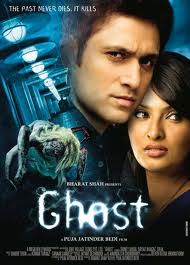
Movie Review: Ghost (2012)

Zero Stars (out of 4)

Buy the DVD at Amazon

Rare is the movie that manages to get everything wrong, lacking a single attribute of a successful film. Ghost is that movie: a film so pathetically executed as to be an object lesson in how not to make a movie.

Ghost is a horror movie (not a remake of the American film), though what kind of horror movie is unclear. Supernatural thriller? Monster movie? Spiritual lesson? Torture porn?

Of course a single film can use elements of all the above horror sub-genres, but debutant writer-director Puja Jatinder Bedi is so unfocused in her storytelling style that I’m not even sure she knows what kind of movie she’s making. There’s no consistency of theme or message, no continuity, and it’s not even clear who the main character is.

Ghost opens with the grisly murders of a doctor and a nurse initially seen having sex in a hospital lavatory. When they are discovered by pious Dr. Suhani (Sayali Bhagat), it seems likely that the film is meant to be a spiritual parable about the dangers of sin.

In case that message isn’t clear enough, the opening credits are subtitled with the following text: “Christ represents the divine life power that illuminates and liberates the soul from the evil powers of Satan. O SONS OF ADAM AWAKEN AND EMBODY CHRIST WITHIN YOU.”

The divine punishment angle quickly falls apart, as it becomes clear that the two deaths (and the ones to follow) are the work of a vengeful spirit, not acts of divine judgment.

Freelance detective Vijay (Shiney Ahuja) investigates the murders and discovers that the spirit is likely that of a murdered hospital intern, the subtly-named Mary Magdallen (Julia Bliss).

Mary is Vijay’s wife, of whom he has no memory thanks to a mild head injury, of which he also has no memory. In fact, he seems unaware of having a memory gap of however long it took him to fall in love, get married, and have his wife die. Apparently, he has no friends either, because I’d wager that one of them might have let slip at some point that Vijay has (or had) a wife.

Since everything about Ghost stinks, I’m going to focus on a few of its worst offenses. First is a pet peeve of mine: casting actors with inappropriate accents. Mary is supposed to be Australian, but Bliss is Russian and sounds it. Either make the character Russian, or cast a different actress.

Next is the way the movie fetishizes violence against women. The whole movie is gory, but flashbacks of Mary’s murder-by-torture and her body’s subsequent dismembering are shown in almost loving detail. As a woman, director Bedi should have exercised better judgement and not pandered to the base desires of misogynists.

The most egregious offense in Ghost is its silly perversion of religion for tawdry thrills. Christian imagery pervades the film: Mary’s name and the details of her murder (hint: a cross is involved), “plagues” of frogs and locusts at various crime scenes, a computerized artist’s rendering of Hell, etc. The imagery symbolizes nothing and makes little sense in the context of the film. I think it’s just there to show that the filmmakers have read the Bible — or, more likely, stopped by a Sunday School class once or twice.

At the scenes of two murders, Monster Mary is accompanied by a cryptic figure, whose left half resembles Jesus and right half resembles a devil. The figure’s significance is unclear and is never discussed. The film ends with a shot of Mary in her appealing mortal form, hugging Jesus (regular Jesus, that is; not the half-Jesus-half-devil guy).

Are we supposed to believe that Jesus — Mr. Forgiveness — is cool with one of his acolytes exacting bloody revenge from beyond the grave? Wasn’t one of the whole points of Jesus’ existence to convey that revenge is God’s domain and that forgiveness is a path to salvation?

If I were a Christian, I might be offended. But Ghost is so stupid and inept that taking its offenses seriously gives it more credit than it deserves.

Links

  • Ghost is available for free on Mela‘s iPad app until February 10
  • Ghost at Wikipedia
  • Ghost at IMDb

Movie Review: Rascals (2011)

Zero Stars (out of 4)

Buy the DVD at Amazon
Buy the soundtrack at Amazon

Director David Dhawan is responsible for my worst Bollywood movie of 2009: Do Knot Disturb. Dhawan looks on track to reclaim the title this year with Rascals, a movie that exemplifies filmmaking at its laziest.

Let me start with a small example of the laziness that permeates Rascals. Early in the film, a tough guy named Anthony (Arjun Rampal) walks into a bar to watch a soccer game, and he places a bet on Brazil. Cut to the TV for a shot of the game, and it’s a game between Germany and Argentina.

A mistake like that wouldn’t have been a big deal if the movie was otherwise competently made. But here’s what it tells me about Dhawan’s level of respect for the audience: he has none. He thinks that moviegoers will be happy to spend two hours watching Ajay Devgn and Sanjay Dutt slap each other while Kangana Ranaut struts around in a bikini.

The problems stem from the crap story at the heart of Rascals. The plot is essentially a dumbed-down version of Bluffmaster!, but without a moral compass. Devgan and Dutt play Bhagat and Chetan (respectively), a pair of thieves who each independently steal from Anthony on the same day. Both flee to Bangkok, where they become rivals for the affections of Khushi (Ranaut).

Bhagat and Chetan spend the bulk of the film trying to thwart each other’s advances on clueless Khushi. Anthony doesn’t reenter the story until the last twenty minutes or so.

Rascals feels much longer than its two-hour runtime. Scenes are introduced without any set-up, and frequently without narrative purpose. Despite having two action stars as its leads, there are few action scenes, but lots of boring conversations between characters. Ranaut’s shrill delivery makes these scenes almost unbearable.

It’s not entirely Ranaut’s fault that her character so irritating. Khushi isn’t written to have any sort of depth or personality: she’s a dumb sex object, as is the only other major female character in Rascals, an escort named Dolly (Lisa Haydon).

A reliance upon stereotypes is another example of creative laziness in Rascals. Women are stupid and only good for sex; white women are particularly slutty (as evidence by the suspiciously high number of scantily clad, blonde backup dancers in Thailand); men are sex-crazed.

Not wanting to let an opportunity for casual racism slip by, Dhawan includes a scene in which Bhagat and Chetan are caught up in a bank robbery. The robbers are all black Africans. In Thailand.

I won’t go so far as to say that Dhawan is racist or sexist (though I can’t figure out why he thought it was cool to have Anthony vent his anger toward Bhagat and Chetan by slapping his innocent sister in the face). I just think he’s careless. Careless about the messages his movies send, not to mention careless about details.

Details like having the characters in Rascals celebrate Christmas just days after they celebrated Valentine’s Day.

Links