Tag Archives: Sikander Kher

Movie Review: Ikkis (2026)

4 Stars (out of 4)

Watch Ikkis on Amazon Prime

Ikkis (“Twenty-one“) is the best demonstration of filmmaker Sriram Raghavan’s skills yet, despite it being quite different from the other movies in his oeuvre. Though it lacks the physical danger of his earlier thrillers like Johnny Gaddaar, Badlapur, and Andhadhun, Ikkis is still built around a main character’s central tension: am I going to break his heart?

The title refers to the age at which Indian Army 2nd Lieutenant Arun Khetarpal (Agastya Nanda) died in the waning days of the 1971 India-Pakistan War. Thirty years later, Arun’s framed photo hangs on the wall of a house in Lahore, Pakistan belonging to Brigadier Jaan Mohammad Nisar (Jaideep Ahlawat). The photo’s curious existence is made even more intriguing when Nisar hides it before his houseguest arrives.

That guest is Brigadier Madan Lal Khetarpal (Dharmendra), Arun’s father. The elder Khetarpal grew up and studied in Pakistan before Partition drove his family to move to India. He returns for a class reunion and a visit to his hometown, staying with Nisar, his wife Maryam (Ekavali Khanna), and their adult daughter Saba (Avani Rai).

The rapport between the family and their guest is immediate, and Khetarpal is glad to have their company at the reunion. He also speaks freely about his own family, including Arun. Through Khetarpal’s reminiscences, we get to know about his first-born son, and we see Arun’s life in flashbacks.

Though Ikkis is based on a true story, this isn’t a hagiography. During his officer training days, Arun is a capable leader, but he is just as bad at anticipating consequences as most 21-year-olds are. He struggles to balance his military duties with his new romantic relationship with medical student Kiran (Simar Bhatia). He follows rules to a fault.

That’s why Arun’s death in combat has always been a mystery to his father. The official report states that Arun — who was assigned to be a tank commander when sent to the front in 1971 — turned off his radio and disobeyed orders in his final moments. That doesn’t sound like the Arun his father knew.

Questions linger over Ikkis: Why does Nisar have a photo of Arun? Why is he hiding it from Khetarpal? What really happened to Arun on the battlefield? The answers are decades old and pose no immediate danger, but they create a tension that propels the story forward, building as Nisar’s fondness for the elderly Khetarpal grows.

That affection is what makes the film so special. This is Dharmendra’s last movie, and his tremendous talent shines through as a father searching for something to finally help him make sense of his son’s death. Ahlawat deftly portrays the internal conflict between Nisar’s respect for Khetarwal and his guilt at keeping secrets from him. The warmth between the two actors is a joy to watch.

After a forgettable debut in The Archies, Nanda shows much more promise playing Arun. He’s a competent guide through history, showing us a war that looks much like any other war. Young men raised on heroic stories are eager to make a name for themselves, even though many of them won’t survive to tell their own tales. One of Arun’s senior officers Risaldar Sagat Singh (Sikander Kher) warns Arun not to “go looking for death,” but Singh later repairs a tank tread with a fresh bullet wound to the shoulder. He makes heroism look easy, so of course it would appeal to Arun and his classmates.

That’s the trick with anti-war movies: they always end up showing the cool parts of war. Tanks are cool. Getting shot and acting like it’s no big deal is cool. Raghavan does his best not to glamorize war, but it’s ultimately up to the older characters like Khetarpal and Nisar to explain that war is bad for everyone.

Hindi films about cross-border relationships used to be far more common, which makes Ikkis not just unique but important. There’s truth in the film’s central idea that India and Pakistan are more alike than they are different. The first thing Arun and his tank crew remake upon when they roll across the border is that it looks the same as the land on the other side. Frequent reminders about our shared humanity are vital.

Links

[Disclaimer: my Amazon links include an affiliate tag, and I may earn a commission on purchases made via those links. Thanks for helping to support this website!]

Series Review: Citadel – Honey Bunny (2024)

1.5 Stars (out of 4)

Watch Citadel: Honey Bunny on Amazon Prime

A streaming franchise with multiple international spin-offs is intriguing in theory, but not so much in practice, at least in the case of Citadel: Honey Bunny. There’s barely enough material in the new Indian spin-off to support a feature-length film, let alone a six-episode series with a nearly five-hour runtime.

Citadel: Honey Bunny is a prequel to the original series created by the Russo brothers and an origin story for Priyanka Chopra Jonas’s character. Surprisingly, Chopra Jonas doesn’t make a cameo at the beginning or end of Honey Bunny to make that connection explicit. Instead, the show creators count on you to remember her character’s name: Nadia.

This new series flashes back to India in 2000, where 7-year-old Nadia (Kashvi Majmundar) is on the run with her mother Honey (Samantha Ruth Prabhu). Honey is a former spy waiting for her past to catch up with her, training Nadia to fight, hide, and run when the time comes.

Honey’s own entry into the world of espionage happened in 1992. With her Bollywood acting career floundering, a stuntman named Bunny (Varun Dhawan) hired her for an unorthodox gig: distract a rich guy in a hotel bar long enough for Bunny and his colleagues to grab something from his room. When Bunny’s crew fails, she offers to nab the item herself, and thus a spy is born.

That’s about where Episode 1 leaves off and the descent into boredom begins. Episodes 2 and 3 are primarily filler, cutting between the 1992 and 2000 timelines. Real forward momentum resumes in Episode 4, continuing a slow build until a very entertaining finale with some truly exciting action sequences.

It’s not just that little happens through the middle of the series. It’s that there’s nothing fun about it. The action scenes are forgettable, as are the settings. The 1992 timeline sends Honey & Bunny’s crew to Belgrade to recover a piece of all-powerful tech. Given the geographical, architectural, and cultural diversity within India itself, taking the action out of the country is a disappointing choice.

Worst of all, the acting is monotone from an impressive cast that — besides the two popular leads — includes Kay Kay Menon as Baba, head of Bunny’s spy organization; Saqib Saleem as Baba’s flunky KD; and Sikander Kher as the rival spy Shaan.

The most obvious explanation for the show’s flat tone is network interference, because the cast is much better than they are allowed to be (at least until the last couple of episodes). There’s a generic “OTT spy drama” feel to Honey Bunny, as if the cast and crew were shoved into a mold with no room for them to utilize their unique talents.

Same goes for Raj & DK, who directed the series and co-wrote it with Sita Menon. There’s little of their signature wit until very late in the proceedings. It feels like they created the show in reverse, making sure to end with a great finale but running out of time to flesh out the rest of the story. Subplots and character development points are introduced but not explored, despite long stretches where not much happens.

Another big reason why this isn’t Raj & DK’s best work is that the whole series is terribly lit. They rely on natural lighting that often leaves the actors in shadows or backlit. It’s frequently hard to make out character’s faces, even during pivotal emotional moments. I kept squinting at the screen, not that it helped.

The (probable) network-mandated homogenizing squashes a lot of what could have been good about the series — and a lot of what would have made it feel very Indian. Though the 1992 timeline starts on the set of a Bollywood film, the location is abandoned after the first episode in favor of the Belgrade jaunt. How fun might it have been to imagine rival spy agencies operating within a film industry that was the domain of organized crime at the time?

Then there’s the waste of talent. Especially given how slow and dull Citadel: Honey Bunny is through its midpoint, I can’t imagine it winning over many new fans who only watched because of the Citadel name. Will they be inspired to seek out any of the actors’ other projects? Will they watch Raj & DK’s other Amazon Prime series — Farzi and The Family Man — after this? I doubt it.

Links

[Disclaimer: my Amazon links include an affiliate tag, and I may earn a commission on purchases made via those links. Thanks for helping to support this website!]

Movie Review: Monica, O My Darling (2022)

3.5 Stars (out of 4)

Watch Monica, O My Darling on Netflix

Sometimes, getting everything you ever wanted just isn’t worth it. Monica, O My Darling — based on mystery author Keigo Higashino’s story “Burûtasu No Shinzou” — explores the dangers that lurk at the top of the socioeconomic ladder.

Jay (Rajkummar Rao) worked his way up from nothing to become an engineer. He’s just been named to the board of directors of Unicorn Robotics, and he’s engaged to Niki (Akansha Ranjan Kapoor), the bubbly daughter of Unicorn’s founder and CEO.

Jay’s also about to lose everything thanks to an affair with the CEO’s assistant, Monica (Huma Qureshi). She tells Jay she’s pregnant with his baby, which she wants to keep. She’ll happily stay quiet about it so long as he pays her.

Jay considers confessing his infidelity to Niki. But when Niki relays a story about a man who cheated on her cousin and says her family will likely kill him or send him to jail, Jay believes her and says nothing.

The thing about Jay is, he’s ambitious but not ruthless. Not in the way rich people are. Not in the way his jealous future brother-in-law Nishi (Sikander Kher) is.

Nishi arranges a meeting with Jay and Arvind (Bagavathi Perumal) — the company’s head of accounting — at a seedy motel. (Special kudos to whoever is responsible for the delightfully bizarre animal art on the walls of the motel.) Apparently, Monica has told all three men that they are the father of her baby and demanded money from each of them. Nishi’s solution is to kill Monica and have Jay and Arvind dispose of the body. If they’re all involved, then none of them will rat on the others. There’s no way regular guys like Jay and Arvind would come up with something so dastardly on their own.

Of course, there are hiccups in the plan’s execution. People die, and Jay falls under suspicion from an unusual detective, ACP Naidu (Radhika Apte).

The tone of Monica, O My Darling isn’t that of a straightforward mystery, but it’s not as colorful and brash as another Netflix Original comic thriller, Ludo. Director Vasan Bala strikes a balance where the film feels simultaneously realistic and unrealistic. The audience is aware they’re watching a film — in particular in scenes when a frame appears around the edges of the screen to mimic the shape of an old TV console and the men imagine Monica scheming like a movie villain — but the stakes feel high nonetheless.

Perhaps the best example of this is in the film’s fight scenes. There are only a few fights in Monica, O My Darling, but they are the movie’s most emotionally impactful sequences. The fight choreography is loose to the point that it appears at first like the actors are just goofing around. As the fight drags on, the gravity of the situation builds and becomes oppressive.

The casting in Monica, O My Darling is outstanding. Rao is the perfect normal guy and Qureshi an ideal vamp. Perumal provides great comic relief. Sukant Goel is creepy as Gaurya — a childhood acquaintance of Jay who wants to be more important than he is. Kher and Apte chew through their scenery like a couple of sharks. They are so fun to watch.

The mystery driving the story forward is compelling, but the payoff is a little unsatisfying. It doesn’t meet Aristotle’s standard of “surprising yet inevitable.” Nevertheless, Monica, O My Darling is an engrossing film with a killer soundtrack. It’s a wonderful followup to Bala’s previous feature film: the excellent karate movie Mard Ko Dard Nahi Hota (“The Man Who Feels No Pain.”)

Links

Movie Review: The Zoya Factor (2019)

3 Stars (out of 4)

Rent or buy the movie at iTunes
Buy the soundtrack at iTunes
Buy the book at Amazon

A young woman’s good fortune causes headaches for both her and the captain of India’s cricket team as they try to win the World Cup in The Zoya Factor, based on Anuja Chauhan’s 2008 novel of the same name.

The novel and movie are both set in a timeline based on the 2011 Cricket World Cup tournament played in India, but the members of the Indian cricket team are all fictional.

Sonam Kapoor Ahuja plays Zoya, a copywriter struggling to fit in at her snooty advertising firm who’s rejected by potential romantic suitors because of her middle-class background. At least her dad Vijayendra (Sanjay Kapoor, Kapoor Ahuja’s real-life uncle) and older brother Zoravar (Sikander Kher) love her. They believe she brings them luck in their local cricket pickup games because she was born the day India won its last World Cup in 1983.

Zoya is sent on a make-or-break work assignment to photograph members of the Indian Cricket Team. She gets off to a mixed start with the team’s handsome captain, Nikhil (Dulquer Salmaan), who is charmed by her exuberance and frustrated by her determination. But when he sees Zoya’s co-workers ignore her at breakfast the next morning, he invites her to eat with the team, where she tells them that she’s her family’s lucky charm on the cricket pitch. The team wins their match that afternoon, and Zoya becomes their lucky charm, too.

Screenwriters Pradhuman Singh and Neha Rakesh Sharma skillfully adapt Chauhan’s novel, so that all of drama in the film arises from the characters’ conflicting motivations. Zoya is of course delighted when handsome, rich Nikhil takes a romantic interest in her, but she’s just as thrilled to finally fit in with a group. The team’s most superstitious players — Shivy (Abhilash Chaudhary) and Harry (Gandharv Dewan) — value Zoya for her good luck, but they also genuinely like her because she takes an interest in them. She approaches them differently than Nikhil, who believes that hard work is the only factor in team’s success. When he insists that Zoya stay away from the team, lest they put too much faith in her, he doesn’t realize that her presence has a reassuring affect on jittery players like Shivy and Harry, making them more relaxed on the pitch and helping them perform better.

Even the story’s villain, Robin (Angad Bedi), has understandable motives. It would be a lot easier for Robin to reclaim the captaincy he lost to Nikhil if the public and the Indian Cricket Board give Zoya the credit for the team’s victories — especially when Nikhil is trying to keep her away. It just so happens that Robin’s uncle is the head of the Cricket Board, which makes Zoya an offer that forces her to choose what’s really important to her.

Sikander Kher is stealthily terrific in the movie, and his character plays an important part in steering Zoya’s choices. As her big brother, he’s sincerely concerned for her well-being, but he also reinforces all of Zoya’s insecurities by asking her why someone as popular as Nikhil would be with a nobody like her. Adding insult to injury is that she hates his nickname for her, delightfully translated in the English subtitles as “Spongebob.”

The whole cast is likeable, and Salmaan and Kapoor Ahuja are quite cute together. There’s a distracting amount of product placement in The Zoya Factor, but it’s otherwise a sweet, fun romantic comedy.

Links

Movie Review: Tere Bin Laden – Dead or Alive (2016)

TereBinLadenDeadOrAlive2.5 Stars (out of 4)

The comedy sequel Tere Bin Laden: Dead or Alive starts out strong, but the story doesn’t have enough momentum to sustain laughs. Two films in this franchise are enough.

Tere Bin Laden: Dead or Alive (TBL 2, henceforth) begins in 2009. Manish Paul plays Abhishek Sharma, the real-life writer and director of both movies. Abhishek (the character) gets the greenlight to make his first film — Tere Bin Laden — after he spots Paddi Singh (Pradhuman Singh), a dead ringer for Osama Bin Laden. There’s a helpful refresher on the first film, which proved to be enough of a hit to merit a followup.

Shortly after production on the sequel begins, the real Bin Laden is assassinated by the United States. This puts the kibosh on Abhishek’s movie but not Paddi’s career as a lookalike. With no body or video proof of Bin Laden’s death, an inept terrorist organization in Pakistan wants Paddi so they can claim that Bin Laden is with them, alive and well. Meanwhile, the US wants to recreate the assassination, substituting video of Paddi’s murder as footage of Bin Laden’s death.

The early stages of TBL 2 are full of great bits. Ali Zafar — the star of Tere Bin Laden — appears in a funny cameo, playing an egomaniacal, womanizing version of himself. The Pakistani terror organization stages its own version of the Olympics, with games like the Bomb Relay and Landmine Jump. If you blow yourself up, you win!

The sharpest barbs are reserved for the Americans. Their drone control room is set up like an arcade, complete with coin-operated remote weapons. The “Chief of Invasions” is a man named David DoSomething, played by Sikander Kher in white-face makeup and a blond comb-over wig. Kher’s southern accent is deliberately hilarious.

In order to dupe Paddi and Abhishek, David dons brown-face makeup to pose as David Chadha, an NRI Hollywood producer. He quickly masters Hindi, though he mispronounces his last name as “cheddar.”

The movie acknowledges just how racist this is gambit is, with David consulting a makeup chart featuring a range of ethnically appropriate skin tones. When President Obama (Iman Crosson) sees David in his desi avatar, he quips, “I see you painted your white-ass face brown.” Considering that TBL 2 released on the same day as Gods of Egypt — a Hollywood film featuring no Egyptian actors — the digs seem deserved.

Though supporting characters like David, his female assistant Junior (Mya Uyeda), and President Obama are funny, they often feel better suited for a sketch comedy show rather than a feature film. There’s something missing from TBL 2 that causes it to slow down as soon as all of the characters are introduced.

One potential explanation that there’s no B-story in the plot. Elements such as Abhishek’s abandoned career as a confectioner and his fraught friendship with Paddi are introduced but don’t go anywhere. The story needs an anchor or emotional hook of some sort. Jokes aren’t enough.

TBL 2‘s strongest attribute is its subtitling and localization. It’s among the best I’ve ever seen in a Hindi film. For example, the Hindi word “jalebi” is translated as “churro,” substituting a piped, fried sweet popular in India for one popular in the U.S. Kudos to the TBL 2 translation team, the real stars of the film!

Links

Movie Review: Aurangzeb (2013)

Aurangzeb3.5 Stars (out of 4)

Buy or rent the movie at iTunes
Buy the DVD at Amazon

Aurangzeb should not work. The premise is silly: a long-lost twin impersonates his brother to take down their father’s criminal empire. Yet writer-director Atul Sabharwal executes his vision with such sincerity that the movie succeeds. I unapologetically love this action soap opera.

Sabharwal worked in television before this, his feature film debut, and it shows. There are so many twists and turns in the plot that it feels like a full season of a TV series condensed into one 140-minute movie. Aurangzeb: The Series would fit right in alongside The Vampire Diaries on The CW.

Arya (Pritviraj Sukumaran) — the film’s narrator — has a troubled relationship with his father, a disgraced police officer played by Anupam Kher in a moving cameo. Because of his father’s emotional distance, Arya was primarily raised by his uncle, Ravi (Rishi Kapoor), a crooked cop.

On his deathbed, Arya’s father confesses that he has a secret wife and son that Arya is now obligated to take care of. Arya resentfully breaks the news to the woman, Veera (Tanvi Azmi), only to realize that her son looks exactly like the son of the criminal mastermind, Yashwardhan (Jackie Shroff).

Uncle Ravi realizes that Veera and her son, Vishal (Arjun Kapoor), are Yashwardhan’s wife and son, presumed dead for the last 25 years after a “botched” police shootout that cost Arya’s father his job. In order to clear his father’s name, Arya and Ravi conspire to kidnap Yashwardhan’s son Ajay (also played by Arjun Kapoor) so that Vishal can impersonate his identical twin brother while acting as a police informant. Ravi explains that Vishal must act like Aurangzeb, the Mughal emperor who gained his throne by defeating the brothers ahead of him in the line of succession.

The soapiness of the story is enhanced by an amazing soundtrack. Heartrending musical themes accompany Veera’s confessions to her sons. Bombastic rock blares when Ajay (or Vishal) strides into a room, ready to bust some heads. Thankfully, the soundtrack album includes several of the great instrumental songs by Amartya Rahut and Vipin Mishra.

As with any good soap opera, the film is really about family conflicts: brothers turned against one another, children resentful of their parents’ favoritism, and parents who feel they can’t express their feelings to their hot-headed sons. Arya hates Vishal because of the love his own father showed the gangster’s son. Vishal hates his mother for robbing him of a relationship with his biological father. Ajay hates everybody.

As in his debut, Ishaqzaade, Arjun Kapoor plays a scumbag, and he’s great at it. Ajay is loathsome almost beyond the point of sympathy, yet the hurt behind his lashing out is always obvious. Vishal undergoes some real character growth as he, too, as his timidity gives way to aggression.

Pritviraj puts Arya in a similarly precarious position to Ajay’s. One of Arya’s early scenes has him belittling his dying father, so it’s hard to love him. However, it does give him room to grow when he’s forced to choose between his father’s “family first” approach to morality or his uncle’s belief in success at any cost.

Rishi Kapoor is compelling as the head of a family of corrupt cops. Ravi’s son, Dev (Sikander Kher), is involved in the family business, too, and gets to do some sleazy stuff.

Jackie Shroff plays the most sympathetic of the movie’s flawed father figures. Yashwardhan is old enough that he’s not the fearsome thug he once was, making it hard for Vishal to reconcile the man before him with the villainous image he was sold.

The movie isn’t all emotional turmoil. There are plenty of cool fight scenes to keep things entertaining, and it’s impressive how well they integrate with the melodrama. This kind of action-soap opera can’t succeed if it’s done halfway, and Sabharwal goes all out. Aurangzeb is exciting, touching, and totally engrossing.

Links

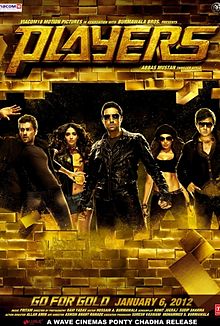
Movie Review: Players (2012)

3 Stars (out of 4)

Buy the DVD at Amazon
Buy the soundtrack at Amazon

With source material as rich as not one, but two, versions of The Italian Job to draw from, Players should be a slam dunk. Wisely, filmmaking duo Abbas-Mustan take the best aspects from their inspiration and add enough new touches to make it an enjoyable Indian action flick.

My biggest fear before seeing Players was that it wouldn’t be able to hold interest for 2 hours and 47 minutes. But Players is about as well-paced as a nearly three-hour-long movie can be, hitting plot points at the right times so as not to let the action drag.

Abhishek Bachchan anchors the film as Charlie Masceranas, a career thief. He learns from a dying friend about the Russian government’s plans to transfer a large amount of gold bars to Romania. With the help of his imprisoned mentor, Victor (Vinod Khanna), Charlie assembles a team of experts to execute a daring heist.

The team includes Charlie’s sometimes girlfriend, Riya (Bipasha Basu), master of disguise Sunny (Omi Vaidya), explosives expert Bilal (Sikander Kher), illusionist Ronnie (Bobby Deol) and a hacker named Spider (Neil Nitin Mukesh).

So as not to appear to condone thievery, the filmmakers give the crew corny motivations for stealing the gold. Charlie wants to fulfill Victor’s dream of opening India’s largest orphanage. Ronnie, a former magician, wants to build a fully automated house for his daughter, who was accidentally paralyzed during one of his tricks.

Ronnie gets some unintentionally hilarious lines when he explains the end of his stage career: “Magic doesn’t do anything. It only ruins lives.”

Thankfully, Sunny, Bilal, Spider and Riya are just in it for the money. When the plan goes awry, Victor’s daughter, Naina (Sonam Kapoor), comes to Charlie’s aid.

There are some nice interactions between the team members. Sunny and Bilal are funny sparring partners, and Naina’s crush on Charlie creates tension between her and Riya. Charlie is the anchor, but this really is an ensemble film.

Besides the star cast, the movie’s main attractions are its action sequences. The gold-theft scene is tense, and the car chases are pretty good. Strange editing and artificially sped-up shots keep the fight scenes from looking their best, but interesting locales like Russia and New Zealand elevate the whole experience.

A tendency toward corniness pervades Players, to its detriment. It keeps the film from achieving the snappy sophistication of the films that inspired it. In addition to Charlie’s and Ronnie’s Robin Hood motivations, the score heavy-handedly tries to provoke emotions.

The most pandering element in Players is the needless inclusion of comic actor Johnny Lever, a regular feature in Abbas-Mustan films. I don’t find Lever funny, or more accurately, I don’t find the outrageous characters he always plays funny. That directors feel the need to pair his appearances with wacky sound effects just makes things worse. Any spell the movie could hope to cast is broken when Lever appears onscreen.

Another element that can’t be overlooked is how pointedly the movie targets a male audience. Basu and Kapoor both have a couple of forgettable dance numbers requiring to them to gyrate in skimpy dresses. Another female character is viewed through frosted glass as she showers. Almost every Anglo woman in the movie is kitted out in hot pants.

Yet the male stars aren’t required to doff their clothes, apart from a brief scene featuring Mukesh in a bubble bath. Bachchan and Deol are regular romantic leads, and Kher is clearly fit. Why not work in a shirtless shot of one of them, in the name of gender equality?

The thread of sexism isn’t limited to who’s asked to expose the most skin. Naina and Riya are both asked to play the role of seductress to aid the team, which features five men (six, including Victor) and only two women. Language denigrating women goes largely unchallenged by the male heroes.

That said, Players works as an action film. It hits the right notes often enough to sustain excitement for almost three hours, which is the primary objective of any action movie.

Links