Tag Archives: Sriram Raghavan

Movie Review: Ikkis (2026)

4 Stars (out of 4)

Watch Ikkis on Amazon Prime

Ikkis (“Twenty-one“) is the best demonstration of filmmaker Sriram Raghavan’s skills yet, despite it being quite different from the other movies in his oeuvre. Though it lacks the physical danger of his earlier thrillers like Johnny Gaddaar, Badlapur, and Andhadhun, Ikkis is still built around a main character’s central tension: am I going to break his heart?

The title refers to the age at which Indian Army 2nd Lieutenant Arun Khetarpal (Agastya Nanda) died in the waning days of the 1971 India-Pakistan War. Thirty years later, Arun’s framed photo hangs on the wall of a house in Lahore, Pakistan belonging to Brigadier Jaan Mohammad Nisar (Jaideep Ahlawat). The photo’s curious existence is made even more intriguing when Nisar hides it before his houseguest arrives.

That guest is Brigadier Madan Lal Khetarpal (Dharmendra), Arun’s father. The elder Khetarpal grew up and studied in Pakistan before Partition drove his family to move to India. He returns for a class reunion and a visit to his hometown, staying with Nisar, his wife Maryam (Ekavali Khanna), and their adult daughter Saba (Avani Rai).

The rapport between the family and their guest is immediate, and Khetarpal is glad to have their company at the reunion. He also speaks freely about his own family, including Arun. Through Khetarpal’s reminiscences, we get to know about his first-born son, and we see Arun’s life in flashbacks.

Though Ikkis is based on a true story, this isn’t a hagiography. During his officer training days, Arun is a capable leader, but he is just as bad at anticipating consequences as most 21-year-olds are. He struggles to balance his military duties with his new romantic relationship with medical student Kiran (Simar Bhatia). He follows rules to a fault.

That’s why Arun’s death in combat has always been a mystery to his father. The official report states that Arun — who was assigned to be a tank commander when sent to the front in 1971 — turned off his radio and disobeyed orders in his final moments. That doesn’t sound like the Arun his father knew.

Questions linger over Ikkis: Why does Nisar have a photo of Arun? Why is he hiding it from Khetarpal? What really happened to Arun on the battlefield? The answers are decades old and pose no immediate danger, but they create a tension that propels the story forward, building as Nisar’s fondness for the elderly Khetarpal grows.

That affection is what makes the film so special. This is Dharmendra’s last movie, and his tremendous talent shines through as a father searching for something to finally help him make sense of his son’s death. Ahlawat deftly portrays the internal conflict between Nisar’s respect for Khetarwal and his guilt at keeping secrets from him. The warmth between the two actors is a joy to watch.

After a forgettable debut in The Archies, Nanda shows much more promise playing Arun. He’s a competent guide through history, showing us a war that looks much like any other war. Young men raised on heroic stories are eager to make a name for themselves, even though many of them won’t survive to tell their own tales. One of Arun’s senior officers Risaldar Sagat Singh (Sikander Kher) warns Arun not to “go looking for death,” but Singh later repairs a tank tread with a fresh bullet wound to the shoulder. He makes heroism look easy, so of course it would appeal to Arun and his classmates.

That’s the trick with anti-war movies: they always end up showing the cool parts of war. Tanks are cool. Getting shot and acting like it’s no big deal is cool. Raghavan does his best not to glamorize war, but it’s ultimately up to the older characters like Khetarpal and Nisar to explain that war is bad for everyone.

Hindi films about cross-border relationships used to be far more common, which makes Ikkis not just unique but important. There’s truth in the film’s central idea that India and Pakistan are more alike than they are different. The first thing Arun and his tank crew remake upon when they roll across the border is that it looks the same as the land on the other side. Frequent reminders about our shared humanity are vital.

Links

[Disclaimer: my Amazon links include an affiliate tag, and I may earn a commission on purchases made via those links. Thanks for helping to support this website!]

Movie Review: Merry Christmas (2024)

2 Stars (out of 4)

“Merry Christmas” was filmed simultaneously in Hindi and Tamil. This is a review of the Hindi version.

Something got lost in Merry Christmas‘s translation from page to screen. The mystery doesn’t quite work, due in no small part to a miscast lead duo.

Director Sriram Raghavan’s latest thriller is an adaptation of French author Frédéric Dard’s novel Bird in a Cage. Set in “Mumbai when it was called Bombay,” the story follows a fateful meeting between two mysterious strangers on Christmas Eve.

Albert (Vijay Sethupathi) returns to his mother’s apartment for the first time in years after working abroad. Mom died a while ago, and her walker still stands next to the bed, as if waiting for its user to return.

He goes to a fancy restaurant and watches a man ditch a beautiful woman, Maria (Katrina Kaif), and her little daughter, Annie (Pari Maheshwari Sharma), in the middle of dinner. Intrigued, Albert follows mother and child to the movies. When Annie falls asleep, Albert offers to carry her home.

Maria invites Albert in for a drink and puts on some music to set the mood while she puts Annie to bed. Christmas tunes, surely. Or maybe something seductive? Nope, Maria puts on “In the Hall of the Mountain King” by Edvard Grieg.

This sequence in Maria’s apartment is where the film lost me. Besides the weird musical choice — which is explained later, though not exactly why that particular piece of music needed to be used — the apartment is lit so brightly from above that it looks like the set of a TV sitcom. The unnatural lighting makes a goofy sequence in which Albert and Maria dance to holiday tunes look downright bizarre.

It’s a shame since building interiors are otherwise one of the film’s strongest suits. The decor in the restaurant and theater are gorgeous. The wallpaper in Maria’s apartment is seriously stunning.

This is also the point in the movie where we should start to get a sense of who Albert and Maria are and what they might want from each other. Yet there is zero chemistry between Sethupathi and Kaif, so it’s hard to tell. They both look like they are just going through the motions.

The problem really is just the two of them together. In a flashback scene opposite Radhika Apte, Sethupathi is an entirely different actor. And I’ve seen Kaif in enough films to know she’s capable of much better with the right partner.

The disconnect between the two leads makes the first half of the film crawl until a suspicious death resets the pace and raises questions. Unfortunately, the renewed tempo doesn’t last for long, slowed again by acting that feels flat.

When the truth of what is happening is revealed, it lacks a sense of inevitability. I suspect there are details that might have stood out more in the book that weren’t emphasized visually in the film. Rather than ending with the audience saying, “Aha!” Merry Christmas ends with an “Okay.”

Links

Movie Review: Andhadhun (2018)

4 Stars (out of 4)

Buy the DVD at Amazon
Buy the soundtrack at iTunes

Neo-noir filmmaker Sriram Raghavan made his best movie yet: the black comedy Andhadhun (“Blindly“).

Ayushmann Khurrana stars as Akash, a talented blind musician living in Pune. He gets a gig as the piano player at trendy restaurant after the owner’s beautiful daughter, Sophie (Radhika Apte), runs into him with her scooter. The job puts Akash in touch with some high rollers, including former film star Pramod Sinha (Anil Dhawan). Pramod hires Akash to serenade him and his young wife Simi (Tabu) on their anniversary, and things don’t go as planned.

Raghavan’s script — co-written with Yogesh Chandekar, Hemanth Rao, and frequent collaborators Arijit Biswas and Pooja Ladha Surti (who also edited Andhadhun) — rewards fans of crime thrillers with familiar genre nods like femmes fatales and characters who aren’t what they seem. Yet the story veers in unexpected ways, forcing the audience into a giddy series of emotional pivots, from shock to uneasy chuckles to horror to hysterical laughter, all in a matter of seconds. It’s astonishing how well Andhadhun pulls this off.

Khurrana’s filmography is full of nice-guy roles, and the sympathy he inspires serves Akash well early on, before we discover that the pianist has his own secrets. His more complicated character contrasts with that of Sophie, who has the movie’s “sunshine role”, according to Ladha Sutri. A love scene between Akash and Sophie is wonderfully steamy despite its brevity.

Then there’s Tabu. She’s glorious in this, so much fun to watch as the ambitious trophy wife (who is shown at one point reading a book titled Anita: A Trophy Wife). She’s charming and chilling, and also hilarious as the movie’s main source of dark humor.

Raghavan and his co-writers ensure that every supporting character has their own clear motivations, which not only elevates the overall quality of the story, but makes it that much easier to get great performances from the whole cast. Ashwini Kalsekar is a laugh riot as the enthusiastic-but-out-of-the-loop wife of a police officer, played by Manav Vij.

Sound design plays a huge role in Andhadhun, as it has in Raghavan’s previous movies. Here, Raghavan expertly deploys tunes to shock the audience or punctuate a joke. Amit Trivedi’s terrific original songs are interspersed with Bollywood hits from the 1970s (ostensibly from the soundtracks of Pramod Sinha’s films).

Khurrana learned to play the piano well enough that cinematographer K. U. Mohanan could shoot Akash playing in full frame, instead of filming him from the chest up and inserting shots of a real pianist’s hands doing the playing. It’s an example of the cast & crew’s dedication that helps make Andhadhun so darned fun to watch.

Links

Movie Review: Johnny Gaddaar (2007)

JohnnyGaddaar3 Stars (out of 4)

Buy the soundtrack at Amazon

Bollywood loves its own history. Too many Hindi films cater to fans with a depth of Bollywood knowledge at the expense of newcomers to the genre, who feel left out of the inside jokes. The neo-noir thriller Johnny Gaddaar (“Johnny the Traitor“) avoids that trap, enthusiastically paying homage to the past while providing enough context to welcome Bollywood newcomers.

It helps that writer-director Sriram Raghavan really understands how and why stories work onscreen. That understanding manifests subtly in the two films he made after Johnny Gaddaar: Agent Vinod and Badlapur. In Johnny Gaddaar, his references are explicit, using clips from other movies to advance his own heist story.

“Johnny” is an alias used by Vikram (Neil Nitin Mukesh), junior member of a quintet that runs a gambling ring. Veteran crook Seshadri (Dharmendra) holds together the uneasy group, which consists of Vikram, casino owner Prakash (Vinay Pathak), financier Shardul (Zakir Hussain), and the crew’s muscle, Shivay (Dayanand Shetty).

Vikram breaks a cardinal rule by falling in love with Shardul’s wife, Mini (Rimi Sen). In order to get enough cash for the two of them to flee to Canada, Vikram decides to steal the money the group pooled for a deal with the corrupt policeman, Kalyan (Govind Namdeo).

Even though he’s the most educated member of the crew, Vikram is also the newest to a life of crime. He concocts a solid plan to steal the cash, going so far as to chloroform himself in order to time how long his victim will remain unconscious. Yet he lacks the wiliness of an experienced crook, and his plan goes wrong in ways he never anticipated.

The primary theme of the film is the danger of unintended consequences, not just the direct effects on one’s own life but the psychological damage incurred when one inflicts pain on others, intentionally or not.

Vikram and his gang aren’t violent. He doesn’t own a gun, and the others aren’t in the habit of carrying theirs with them. Shiva is a gentle giant. When Vikram experiences his first taste of violence, it disturbs him. Sadly, that first experience makes violence a possible response to future conflicts, in a way it never was before.

It helps that Mukesh — in his first film role — looks as young and slight as he does. He doesn’t appear the least bit tough. It’s easy to accept him as the naive character he plays.

There’s another theme in the film about the nature of love, namely that Vikram doesn’t know what real love is. How can he be sure of his feelings for Mini or her feelings for him when they developed under duress? Vikram protests to Seshadri that their love is real, and Seshadri just shrugs.

Seshadri is one of multiple examples of what true love is that Vikram ignores in pursuit of his affair. Widowed Seshadri reminisces while listening to a recording of his wife singing. Prakash dotes on his wife, Varsha (Ashwini Kalsekar), a proud working mom. Shiva has a sweet, budding romance with the nurse who cares for his ailing mother.

Shardul doesn’t seem like such a bad husband to Mini, at least by mafia-film standards. He comes home and wants to catch up on the day with his wife, but she can’t get away from him fast enough. Her disgust for him is so obvious that you almost feel bad for the guy.

Even Kalyan — who is the scariest character in the film — tries to warn Vikram about the danger he’s in. When Vikram confesses that his favorite actor is Amitabh Bachchan, Kalyan asks if Vikram has seen Parwana, a movie in which Bachchan plays an obsessed lover who resorts to murder when his beloved falls for another man. Of course, Vikram hasn’t seen the movie.

Clips from Parwana are interspersed throughout Johnny Gaddaar, along with snippets of other Bollywood and Hollywood films. For movie buffs, it’s fun to try to spot all of the references Raghavan includes in his movie. The references never derail the story, and Raghavan makes some explicit enough that even non-movie buffs can feel included (as when Seshadri says he feels like he’s in a scene from Scarface as the gang counts their loot).

Johnny Gaddaar is a balanced, solid thriller that feels like a love letter to films of the past. It’s worth watching just to see an early piece of work by a promising director.

Links

Movie Review: Badlapur (2015)

Badlapur_Poster3.5 Stars (out of 4)

Buy the DVD at Amazon
Buy the soundtrack at Amazon

Badlapur is a jaw-dropping thriller that examines the perils of revenge. After a pair of delightful comic performances in his two previous films, Varun Dhawan shines as a grieving husband who becomes a monster.

Heed the tagline at the end of the Badlapur trailer: “Don’t miss the beginning.” The movie opens with a bank robbery and carjacking. The owner of the car (played by Yami Gautam) and her young son are killed in gruesome — if somewhat accidental — fashion during the escape attempt. One of the robbers (played by Vinay Pathak) flees with the loot, while the other, Liak (Nawazuddin Siddiqui), turns himself in to the police.

Badlapur‘s plot follows two parallel stories: Liak’s life behind bars, and the quest for revenge undertaken by Raghu (Dhawan), husband of Misha (Gautam) and father of their son.

The movie is clearly inspired by the Korean film I Saw the Devil — most obviously in a scene in which a man in a car pulls up to a stranded female motorist — which was remade in India last year as Ek Villain. Badlapur is a more fitting successor to the Korean film than the acknowledged remake.

What differentiates Badlapur‘s lead character from the secret service agent at the core of I Saw the Devil is that Raghu has no special skills to aid his revenge quest. He works in advertising before the murders, and takes a job as a factory foreman after Liak is imprisoned.

Because he’s just a regular guy, Raghu’s plans seem a little disorganized. It’s not clear when he will feel his vengeance complete. He intends to wait until Liak’s twenty-year prison sentence is over, then follow Liak when he retrieves his share of the money from Harman (Pathak), his accomplice. Raghu’s timetable is accelerated when a well-meaning-but-naive charity worker, Shoba (Divya Dutta), asks Raghu to petition for Liak’s early release so he can seek medical treatment.

Raghu is content to wait to enact his revenge upon Liak and Harman, but he has far less patience for the women who willingly maintain relationships with the criminals. This goes for Shoba, Harman’s wife, Koko (Radhika Apte), and especially Liak’s girlfriend, Jimli (Huma Qureshi).

Jimli is first to experience Raghu’s rage. Because she is a prostitute, Raghu has no compunction about raping her, thus “ruining” her for Liak. That Raghu feels his money can compensate Jimli for the rape is the sign that he’s gone off the deep end. When Liak asks him what makes the two of them so different, Raghu doesn’t have a good answer.

Every performance in Badlapur is pitch perfect. Dutta and Apte are sympathetic, and Qureshi is superb. Pathak doesn’t get as much screentime as Siddiqui, but he features in the movie’s best scene, in which Harman and Raghu silently size each other up as they ride in an elevator.

Siddiqui is great, but Liak’s character is tricky to embrace. There’s only so much he can do since he spends much of the film in jail, and every scene reinforces that he’s a bad guy. The volume of storytime devoted to Liak has less to do with the character and more to do with a desire to keep Siddiqui on screen for as long as possible.

In only his fourth film, Dhawan extends his acting range in impressive fashion. His portrayal of Raghu is chilling. He’s far scarier than Liak or Harman, but he also has the capacity to act normal when it serves his purpose.

Badlapur has trouble maintaining momentum early on. Raghu’s brutalization of Jimli is followed by flashbacks to his romance with Misha and low-key scenes of Liak’s exploits in jail. Raghu feels a bit absent from the film’s ultimate resolution, but perhaps that fits given that he isn’t a criminal mastermind capable of engineering a dramatic climax.

One thing director Sriram Raghavan excels at is sound design. There isn’t much in the way of background music in Badlapur, and the movie is often punctuated by street noise like barking dogs. The undercurrent of everyday sounds makes the film feel more realistic, heightening its impact.

Not a movie for the faint of heart, Badlapur rewards its audience with great performances and a nuanced take on the revenge genre. If nothing else, it establishes Varun Dhawan as the most exciting young actor in Bollywood today.

Links

Movie Review: Agent Vinod (2012)

3 Stars (out of 4)

Buy the DVD at Amazon
Buy the soundtrack at Amazon

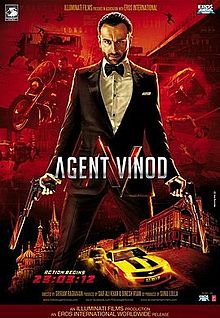
Nothing in Agent Vinod makes any logical sense. It’s all crazy action that couldn’t possibly happen the way it does. Yet Agent Vinod is so fun and so totally committed to its insanity that I don’t care. I really, really liked this movie.

In simplest terms, Agent Vinod is a spy movie. A suitcase-sized nuclear device is stolen from Russia, and Indian spy Agent Vinod (Saif Ali Khan) follows the clues to Morocco. There, he poses as a courier to gain access to David Kazan (Prem Chopra), an international arms dealer with a suspicious personal physician named Ruby (Kareena Kapoor).

Vinod’s search for the nuclear device takes him all over the world: India, Pakistan, Russia, Latvia, England, even South Africa, just for kicks. Why the nuke was stolen is unimportant. What is important is that Vinod gets to fight a lot of people.

There are some spectacular set pieces and moments that are truly startling. For example, a car brakes to a stop, only to be immediately smashed into by another vehicle from out of frame. The effect is akin to a “gotcha” moment in a horror movie, and it’s delightfully effective.

Without a doubt, the film’s best scene is a shootout in the lobby of a fleabag motel in Latvia that is shot in a single take. The technical impressiveness of the scene is topped when an unlikely participant joins the shootout at the end of the scene. It was so unexpected, I laughed out loud.

In fact, I laughed out loud from sheer joy a number of times during Agent Vinod. It’s a great throwback to ’70s-era spy movies, right down to the garish interiors and the catchy “wakka chikka” guitar score that punctuates crucial events.

The special effects are also decidedly low-tech, but very well-executed. Most of the action is hand-to-hand combat or shootouts from close range. The only noticeable computer-generated effect involves a helicopter flying low over Delhi, and it stands out for looking fake.

Khan and Kapoor do an admirable job playing their roles completely straight. The costumer designer and tailors deserve an appreciative nod for making Khan look dashing in his perfectly fitted Oxford shirts.

Khan produced Agent Vinod, in addition to starring in it, which convinces me of one thing: I think this is exactly the film he set out to make. Yes, Agent Vinod is campy and preposterous, and it’s surely not for everyone. But I respect the fact that Khan and director Sriram Raghavan had a vision and executed it. If that relegates it to cult-film status, so be it. If it works for you (as it did for me), it really works.

Links