Tag Archives: Movie Review

Movie Review: Tanu Weds Manu (2011)

2 Stars (out of 4)

Buy the DVD at Amazon
Buy the soundtrack at Amazon

Consider the Saltine cracker: a food so bland and inoffensive it’s one of the few things you can keep down when you have the stomach flu. It’s salted, but not enough to make it a go-to snack when you’re craving something salty. In fact, you kind of forget about that box of Saltines, relegating it to the back of the cupboard until the next time you either come down with the flu or run out of anything else to eat.

Tanu Weds Manu is the Saltine cracker of movies.

There’s nothing particularly wrong with Tanu Weds Manu. The costumes are pretty, the music is peppy, and the main characters are basically nice people. But there’s nothing to Tanu Weds Manu. Movies need conflict and urgency to maintain interest, and Tanu Weds Manu is devoid of both.

Since the title gives away the movie’s ending, I don’t feel I’m spoiling anything with this summary of the film.

Manu (R. Madhavan): Hi, Tanu. Our parents want us to get married. You’re pretty, so I’m game.
Tanu (Kangana Ranaut): I don’t want to marry you.
Manu: Okay. I’ll leave.
Tanu: Wait. You seem like a nice enough guy, but I want to marry someone else.
Manu: Okay. I’ll leave.
Tanu: Wait. I changed my mind. I want to marry you.
Other Guy (Jimmy Shergill): Hey, what about me?
Tanu & Manu: Sorry, but the title says we have to get married.
Other Guy: Okay. I’ll leave.

There you have it. Tanu’s a bit of a bad girl in that she drinks and smokes, but she’s otherwise uncontroversial. Manu is a terminally nice doctor and a bit of a pushover. There’s no real chemistry between them, so their romance feels like titular destiny more than anything else. Shergill’s villain, Raja, gets into fights, but he’s basically non-threatening. Everyone else in the film is forgettable.

Watching Tanu Weds Manu, I was reminded of my mother-in-law’s stance on the children’s book series Junie B. Jones. My mother-in-law, Joan (whom I love), refuses to read Junie B. Jones books to my 7-year-old niece because Junie B. uses incorrect grammar and sometimes gets sassy with adults, as if merely exposing my niece to these concepts would trigger some kind of pre-teen linguistic rebellion.

I imagine Joan’s ideal kids’ book to be one in which the child protagonist cleans her room and finishes her homework with enough time to play a game of Yahtzee with her adoring grandmother before the girl’s bedtime at 6 p.m. There’s nothing offensive about such a story, but who’d want to read it? Same goes for Tanu Weds Manu.

Links

Movie Review: Aashayein (2010)

2.5 Stars (out of 4)

Buy the DVD at Amazon
Buy the soundtrack at Amazon

Aashayein (“Hopes”) is the story of Rahul (John Abraham), an affable guy in his mid-thirties whose ship has finally come in. He wins big gambling on a cricket match, giving him the financial freedom to finally marry his girlfriend Nafisa (Sonal Sehgal) and buy a share in a luxury resort at the foot of the Himalayas. But when he collapses at a celebratory party, he learns that he may not have the time to realize his dreams.

Rahul is diagnosed with incurable lung cancer so advanced that he has only a matter of months to live. Nafisa wants to get married as planned, but Rahul doesn’t want to leave her a widow. He runs away to a hospice to spend his final days.

The hospice looks nothing like one imagines a real hospice. Instead of a clinic, Aashayein‘s hospice is a beach resort where meals are made to order. That the hospice purports to run entirely on donations strains credulity, but it gives Rahul an excuse to buy a room at the facility (sorry, poor people who were on the waiting list ahead of him).

There he meets a group of other terminally ill people: a businessman estranged from his family, a former prostitute, a sick boy with supposedly divine powers. It’s never stated definitively whether the boy, Govinda (Ashwin Chitale) is really magical (he says he just makes up stories, and they make people happy), or if the dreams he inspires in Rahul are merely manifestations of the dementia symptomatic of Rahul’s advancing illness.

The most compelling resident is the crass 17-year-old girl, Padma (Anaitha Nair). She’s rude and has a dark sense of humor, but she’s immediately smitten with Rahul.

Padma’s anti-social behavior stems from the fact that she’s acutely aware of all that she won’t experience in life. Unlike Rahul, she doesn’t have a supportive family or friends. It has the unfortunate effect of making Rahul seem like more of a jerk than the girl with the gallows sense of humor.

I think that writer-director Nagesh Kukunoor intended to portray Rahul as a screw-up who redeems himself. At the beginning, he’s seen smoking, drinking and gambling. But Rahul is a nice guy, at least at first: a good friend and a devoted boyfriend. Kukunoor seems to be saying that self-destructive vices outweigh human decency when it comes to judging character. I wasn’t convinced.

Rahul’s eventual decision to run away seems uncharacteristically mean. It would be one thing if he did it for his own sake, but he thinks he’s doing Nafisa a favor. She explains that Rahul only has to suffer for a few months, while she and his friends will suffer for the rest of their lives without him.

That said, Rahul’s running away is presented as one of the various ways people deal with devastating news: the businessman’s estrangement, Padma’s biting wit, the prostitute’s calm acceptance.

Rahul uses his money to enrich the lives of his fellow patients, both as a way of atoning for his past and as a way to feel like he matters. Whether or not he atones for hurting Nafisa, I’m not sure. As in real life, Rahul just doesn’t have enough time.

Links

Movie Review: 7 Khoon Maaf (2011)

4 Stars (out of 4)

Buy or rent the movie at iTunes
Buy the DVD at Amazon
Buy the Soundtrack at Amazon

Director Vishal Bhardwaj’s movies have always suffered a bit in translation. Whether due to a lack of nuance in the English subtitles or particular regional references that require context, I felt like I didn’t fully experience films like The Blue Umbrella, Omkara or Kaminey.

Not so with 7 Khoon Maaf (“Seven Murders Forgiven”). It’s Bhardwaj’s most universally accessible work yet. It’s perfect in the way of all cult films: not flawless, but giddy, emotionally effective and memorable.

7 Khoon Maaf chronicles the love life of a black widow named Susanna (Priyanka Chopra). The film is based on “Susanna’s Seven Husbands,” a short story by Ruskin Bond. The title itself is a clue that things don’t turn out so well for the men in Susanna’s life.

The story is narrated by Arun (Vivaan Shah), a forensics expert tasked with confirming the death of the serial spouse murderer. Arun explains to his wife (Konkona Sen Sharma) the nature of his relationship with Susanna when she was alive: he was Susanna’s ward, and she funded his education. But the more Arun explains, the more bizarre the story becomes.

Shortly after the death of her father, the wealthy, orphaned twenty-year-old Susanna marries Major Edwin Rodriques (Neil Nitin Mukesh). Edwin has a temper, and he terrorizes his wife and her loyal servants: a butler named Ghalib (Harish Khanna), a maid named Maggie (Usha Uthup) and a stablehand named Goonga (Shashi Malviya).

As Edwin becomes more dangerous, Susanna and her servants decide to get rid of him in a way that looks accidental. Thus begins the deadly cycle of Susanna’s romantic life.

The film is darkly humorous, and a bit perverse at times. Some of the more visceral visuals reminded me of Guillermo del Toro’s films like The Devil’s Backbone and Pan’s Labyrinth, though there are few special effects in 7 Khoon Maaf.

Also reminiscent of del Toro is the pervasive religious symbolism throughout the film. Susanna is a Christian, so hymns pervade the soundtrack, which was also composed by Bhardwaj. Given the number of weddings and funerals Susanna must attend, church is a frequent setting.

Much attention in the promotions for the film has been given to Susanna’s husbands: the rock star (John Abraham), the poet (Irrfan Khan), the healer (Naseeruddin Shah). But all of them, by design, have limited roles in the film.

Much more central to the plot are Susanna’s accomplices, Ghalib, Maggie and Goonga. They evolve from pragmatic problem solvers into a trio of gleeful assassins. The three actors deserve much credit for enriching the film.

Arun likewise plays a central role, aging from a child to a man throughout the film. Vivaan Shah is competent in his first film role, playing a man who watches his patron’s life unravel from a distance — sometimes a physical one but also an emotional distance, due to being much younger than Susanna.

But the success of the movie depends entirely on Chopra, Bollywood’s most ambitious actress, and she does not disappoint. Susanna ages approximately 35 years through the course of the film, and Chopra adapts accordingly. She walks a fine line, making Susanna charming and innocent, and then merciless and deadly.

7 Khoon Maaf is an all-or-nothing film. It either works for you or it doesn’t. Its strangeness will be a turn-off for some viewers, while others will lament a lack of explosive action scenes. But, if you’re in the mood for something a little different, beware: Susanna might just steal your heart.

Links

Movie Review: Pankh (2010)

0 Stars (out of 4)

Buy the DVD at Amazon
Buy the soundtrack at Amazon

Normally, I don’t write reviews of movies I don’t finish, but I’m making an exception for Pankh. I had to stop the DVD after 30 minutes, because director Sudipto Chattopadhyay’s ceaselessly spinning and rotating camera gave me motion sickness.

Pankh is Chattopadhyay’s first directorial effort, under the banner White Feather Arthouse Films. Chattopadhyay seems to think making an “art” movie is little more than a license to disregard the rules of competent filmmaking and get away with stuff the censor board would normally disallow.

The movie’s story is fractured into flashbacks and dream sequences that interrupt the flow of the action set in the present. The story revolves around a young man named Jerry (Maradona Rebello). When he was a child, Jerry’s mother, Mary (Lilette Dubey), tried to foist her own dreams of screen stardom onto her son, making him appear in movies dressed as a girl under the stage name “Baby Kusum.”

As an adult, Jerry predictably struggles with his sexual and gender identities. He seeks refuge in a fantasy world where he meets with a glamorous screen diva, played by Bipasha Basu.

The dream sequences are the most physically unsettling parts of the movie. In one, the camera, trained on Basu, rotates on a pivot while simultaneously tilting from side-to-side, like a rocking boat. I got dizzy watching it and turned the DVD off.

But stupid camera techniques are used in the present day scenes as well. At one point, as Jerry talks to an old acquaintance, the camera is turned 90 degrees to the left. Jerry’s face is visible in the top right corner of the screen, while his body is off camera. All that’s visible of his friend is the top of his head in the bottom left corner of the screen.

I could forgive the nauseating camera work if it had a point. In The Blair Witch Project, the shaky handheld camera shots were supposed to make it feel like a documentary. Chattopadhyay uses the camera the way he does in Pankh just because he can.

Chattopadhyay tries to make Pankh edgier with somewhat scandalous content. Jerry smokes and does drugs. Characters swear profusely in English, and their Hindi curse words are bleeped. In one fantasy scene, Jerry is depicted as Jesus carrying a cross. Jerry and another male character are shown masturbating.

As a filmmaker, Chattopadhyay is like the 13-year-old boy left home alone, trying to get away with doing as many “adult” things as possible before his parents return. There’s no maturity to his attempts at edginess. I can only imagine how painful — physically and emotionally — it would’ve been to endure the final 70 minutes of Pankh.

Links

Movie Review: Patiala House (2011)

3 Stars (out of 4)

Buy the DVD at Amazon
Buy the soundtrack at Amazon

For Americans interested in learning about Bollywood, sports movies are a good way to start. The formula is largely the same the world over, with a few country- or culture-specific differences. As such, Patiala House feels familiar and offers a good introduction to Bollywood for newcomers.

Part of the reason for Patiala House‘s familiarity is that the plot shares much in common with 2002’s The Rookie, starring Dennis Quaid. In both movies, an ordinary guy gets his first shot in the big leagues at an age when most athletes are considering retirement. In The Rookie, the game is baseball. In Patiala House, it’s cricket.

Akshay Kumar plays Gattu, the dutiful eldest son of a prominent Indian immigrant leader in the London suburb of Southall. In the 1970s, Gattu’s father, Gurtej (Rishi Kapoor), responds to violent attacks on Indians by organizing the immigrants and shunning white British culture. He turns their cul-de-sac into a Punjabi enclave within Southall.

Gurtej’s hatred of white Britishers is so intense that he forced Gattu to turn down an invitation to join the English national cricket team when the boy was 17. Now, at the age of 34, a dejected Gattu manages his father’s corner store, only playing cricket when he practices pitching by himself at a local park late at night.

An English national team scout notices Gattu’s solo practice sessions and asks him to try out for the team. Gattu doesn’t wish to anger his father again, but he’s pressured to try out by Simran (Anushka Sharma), a lovely girl with a tarnished reputation. Gattu’s younger siblings also beg him to join the team, reasoning that if loyal Gattu can stand up to their domineering father, it may give them a chance to follow their own dreams as well.

The movie offers some insight into the insidious nature of racism as it pertains to immigrants. In an effort to protect his family, Gurtej cuts himself off from the dominant culture so completely that he doesn’t notice that things have changed. The fact that he lives in a different world than that of his children takes a toll on the family.

Gurtej makes Amy Chua’s “Tiger Mother” seem like a kitten. He’s so convinced that he knows what’s best for his family — and all the Indians in Southall, really — that he’s impossible to argue with. When his children threaten to engage in any activity that seems remotely British, he threatens suicide. It’s no wonder Gattu’s siblings see him as their only hope for a future they choose for themselves.

The siblings don’t get enough airtime to become fully formed characters. In fact, I’m not 100% certain that they are all biologically related to Gattu; they just live in the same house. Screentime is dominated by Gurtej, Gattu and Simran.

Kumar gives a restrained performance as Gattu, a man so bound by duty that he sacrifices his own happiness. It’s a much stronger showing for Kumar than some of his other recent dramatic roles, as in Blue and 8×10 Tasveer.

Sharma is emerging as one of Bollywood’s brightest stars. She’s beautiful, charming and effortless. Sharma has a wonderful, subtle comic sensibility, and she handles most of the jokes in Patiala House. Her face is so expressive, and she’s able to pull off a pratfall without overdoing it.

The fact that Patiala House is somewhat predictable is actually a selling point. Sports fables should be predictable. We go to them to feel uplifted and hopeful. Patiala House does a fine job being exactly what it’s supposed to be.

Links

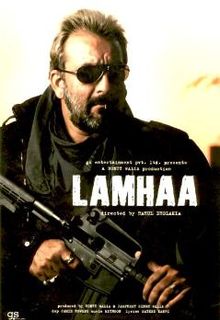
Movie Review: Lamhaa (2010)

2 Stars (out of 4)

Buy or rent the movie at iTunes
Buy the DVD at Amazon
Buy the soundtrack at Amazon

I should start by noting that, in the case of this review, the star rating above is likely instructive only to my fellow Americans and other Westerners who have an average or below-average understanding of the ongoing dispute over Kashmir. To fully appreciate Lamhaa (“Moment”), one needs a familiarity with the history, geography and politics of Kashmir that I (and I suspect most Americans) don’t have.

While I got the gist of the movie and enjoyed many of the performances, I came away uncertain of the motivations of various factions and what their relationships to one another are. Since I can’t be sure how much of the fault for the misunderstanding lies with the filmmaker and how much lies with me, I can only half-heartedly recommend Lamhaa to American filmgoers.

The plot concerns the return of an Indian Army officer, Vikram (Sanjay Dutt), to Kashmir, where he served during deadly riots that engulfed the region in 1989. Various separatist groups are working with politicians and industrialists to inflame public passion for autonomous self-rule and spur another round of riots twenty years later. To what end, I’m not sure, though it’s clear that money and power are at stake.

When Vikram arrives on the scene, he’s shown in slow-motion tossing his backpack over his shoulder and striding purposefully toward the camera. It’s the tough-guy-fantasy version of a beautiful blonde swinging her long hair over her shoulder in slow-mo. Besides the silly slow-mo, the cinematography is quite good, with quick zooms and a hand-held feel akin to the Syfy series Battlestar Galactica.

In trying to uncover plans for the renewed uprising, Vikram assumes the identity “Gul.” He meets Aziza (Bipasha Basu), the hot-tempered daughter of a local politician, Haji (Anupam Kher). Haji adopted Aziza after her own politician father was assassinated, raising her to lead a female gang of thugs known as the Fatima Squad.

Vikram saves Aziza’s life, and she gradually begins to trust him. When her childhood sweetheart, Aatif (Kunal Kapoor), pledges to run for office without using Haji’s violent tactics, Aziza begins to realize just how dangerous Haji is. She and Vikram work to uncover exactly what Haji has secretly been planning.

The actual unfolding of events is much more muddled than my recap. There are insurgent groups training child soldiers; industrialists doing business with the governments of India and Pakistan as well as the insurgents; “half-widows” trying to learn the fates of husbands arrested years ago by the Indian army.

Elements like the half-widows seem inserted into the movie just for the sake of providing a complete picture of the problems in Kashmir. They do little to advance the plot. The song montages are similarly needless time-fillers. A montage of Dutt’s character playing with little kids is particularly awkward.

What makes Lamhaa truly confusing are the frequent changes in location throughout Kashmir, India and Pakistan. Each new location is labeled at the bottom of the screen, but the labels are covered up by English dialog subtitles. There are scenes of border crossings, but thanks to the subtitles covering the location names, I have no idea which borders were being crossed.

The final impression given by Lamhaa — and the one that I believe the director wanted to convey — is that Kashmir is a complex place controlled by people whose desire for power and wealth overrides the needs of citizens with serious problems. I only wish a true understanding of the movie didn’t require the use of a map and some Venn diagrams.

Links

Movie Review: The Great Indian Butterfly (2007)

1 Star (out of 4)

Buy or rent the movie at iTunes
Buy the DVD at Amazon

After debuting at a couple of festivals in 2007, The Great Indian Butterfly sat on the shelf for years before getting its theatrical release in 2010. I understand why.

The experience of watching The Great Indian Butterfly (TGIB) is uncomfortable. It’s like being a kid trapped in a car on a long road trip while your parents argue in the front seat… about their sex life. Ick.

The movie begins in the middle of an argument between married couple Meera (Sandhya Mridul) and Krish (Aamir Bashir). Krish — playing the role of the bumbling husband from every TV commercial or sitcom ever — has screwed up again by turning off the alarm clock, causing the couple to miss their flight. Meera complains about everything, even Krish’s solution to drive to their vacation destination.

Part of the point of the trip is so that amateur entomologist Krish can search for the legendary titular insect, which supposedly has the power to bestow happiness on he who finds it. The legend is revealed in abrupt cutaways to a random white guy in a Hawaiian shirt (Barry John) waxing poetic about his own search for the butterfly. The character plays the same role as Spike Lee’s “magical negro” archetype. Does that make him the Magical Anglo?

The unhappy couple hits the road, and the bickering continues. The dialog is almost entirely in English, allowing Meera and Krish to throw about the F-word with abandon. They argue in absolutes: you never, you always.

Eventually, the sources of their problems are revealed. Krish resents Meera for getting an abortion. Meera is jealous of Krish’s pretty ex-girlfriend, Liza (Koel Purie), whom Krish would’ve preferred to marry. When Meera overhears Krish talking on the phone with Liza, she goes ballistic and leaves.

The couple’s arguments don’t provide any insight into the human condition or comment on the complexities of marriage. Meera and Krish are simply two resentful people intent on making each other miserable.

The trouble with starting the movie in the middle of a fight between two mean people is that it doesn’t give the audience anyone to identify with. Meera and Krish are awful toward each other, casually throwing out insults so mean that most of us  wouldn’t think of speaking them to our spouses even in our worst moments.

Meera and Krish have no children, so there’s not even the “staying together for the kids” excuse holding them together. TGIB aims to rectify that problem by intimating that having a child will fix the couple’s relationship. That solution rarely works.

There’s not much to recommend this movie. The acting and writing are bad, and the cinematographer manages to make the resort paradise Goa look dull. The positives are that TGIB is short (only 90 minutes), and there are a number of time-wasting musical montages that can be fast-forwarded through if you’re watching on DVD.

Links

Movie Review: Dhobi Ghat (2011)

4 Stars (out of 4)

Buy the DVD at Amazon

I live in a busy Chicago suburb with 150,000 residents. Despite living in a condominium building with several other families, I can go days without talking to anyone besides my husband. I see the UPS delivery man more often than my friends, who are scattered across the metro area.

This is the type of modern, urban isolation that writer-director Kiran Rao captures in her debut effort, Dhobi Ghat (Mumbai Diaries). All four of Dhobi Ghat‘s main characters are, in their own ways, isolated, despite living in crowded Mumbai.

Rather than impose a convenient narrative upon the four lead characters, Rao’s plot drops in on them during a specific period in their lives and leaves before delivering a tidy ending. It feels more like a documentary than a fictional film.

Adding to the documentary feel, the film opens with home movie footage shot from the backseat of a taxi, by a woman we later learn is Yasmin (Kriti Malhotra). Having recently moved to Mumbai after getting married, she records mundane scenes from her new life to send to her brother back home.

Brooding artist Arun (Aamir Khan) finds some of Yasmin’s video letters and forms something of an obsession with the woman on the tapes. His video obsession is more convenient than a relationship with a real woman, such as American investment banker Shai (Monica Dogra), who’s herself a bit obsessed with Arun.

Shai befriends the young man who does her laundry, aspiring actor Mannu (Prateik Babbar). Mannu, who also does Arun’s laundry, quickly develops a crush on Shai.

There’s an emotional distance between all of the characters, and Rao uses the camera to emphasize it. The characters are shown through windows or through the lens of amateur photographer Shai’s camera. Their reactions are captured in the reflections of mirrors.

The relationship between Shai and Mannu is the most interesting. How deep can their friendship be when he works for her? Is he really her peer? Shai doesn’t give it much thought. Mannu does.

Prateik Babbar is perfect as Mannu: a handsome guy whose shy nature and low social rank have made him incongruously meek. Khan, Dogra and Malhotra are compelling as the other leads, making as much out of their silent moments as they do out of their dialog.

Dhobi Ghat is a remarkably quiet movie. Not exactly quiet, but absent most of the usual sound effects and musical score. Much of the background noise is provided by urban sounds: rain, traffic, old movie music played on a record player in a nearby apartment.

Mumbai itself has a starring role in Dhobi Ghat. The film is shot in locations around the city, not on movie sets. There’s no attempt to hide Mumbai’s flaws, which serve to make the city more appealing and familiar, even to one who’s never been there.

Aamir Khan used his star power to force Indian multiplexes to show Dhobi Ghat without the usual intermission break. It may have cost the theaters some concession sales, but it allowed the movie to flow for its entire 100 minute runtime. An interval would broken the movie’s spell.

Should Dhobi Ghat succeed at the box office, it could persuade more Indian filmmakers to craft shorter films meant to be viewed in one sitting. Rao’s economy of characters, plot and runtime demonstrate how less can often be much more.

Links

Movie Review: Yamla Pagla Deewana (2011)

2 Stars (out of 4)

Buy the DVD at Amazon
Buy the soundtrack at Amazon

The primary selling-point of Yamla Pagla Deewana (“Nutty Loony Crazy,” according to the lyrics of the title track) is that it stars Bollywood legend Dharmendra and his two sons, Sunny and Bobby Deol. But what if you didn’t know who the three leads were? Would the movie be as successful? I don’t think so.

Sunny Deol’s character, Paramveer, has lived in Canada with his mother since he was a child, after his thieving father ran off with his younger brother. After thirty years apart, Param’s mom begs him to bring her estranged husband and son back to her. He obliges and heads to Banares.

Param’s father, Dharam (Dharmendra) and brother, Gajodhar (Bobby Deol), don’t believe Param’s story. But Param gradually wins their trust, in part by acting as strongman during their heists. When Gajodhar’s girlfriend, Saheba (Kulraj Randhawa), is kidnapped by her goon brothers and taken home to Punjab, Dharam begs Param to help his younger brother.

Producer/director Samir Karnik frequently reminds the audience about the actors’ star status. When Param shows Dharam a photo of the conman in his youth — proof of his prior relationship with Param’s mother — Dharam explains that it must be a photo of Dharmendra.

Later, Saheba asks Gajodhar why he’s not fighting beside his father and brother. He says that its best to let Dharmendra and Sunny Deol handle the action, leaving the romance to Bobby Deol.

The self references are distractions that ruin the flow of the movie. If one is familiar with the actors’ previous work, it’s no surprise that Sunny does all the fighting and that Bobby gets the girl. If not, the references make no sense.

The distractions and the slow pace of the first half are a shame, as the second half of Yamla Pagla Deewana is quite good. Anupam Kher is hilarious as Saheba’s eldest brother. Jokes about the qualities ascribed to English speakers in a place where the language not common, as in rural Punjab, are both informative and funny.

Param has an interesting role as a non-resident Indian (NRI). His blonde, Canadian wife, Mary (Australian actress Emma Brown Garrett) thinks that everyone in India is crazy. Saheba’s sister-in-law, Poli (Sucheta Khanna), thinks that Canada is paradise. She reads about Canada on the Internet, in spite of her limited English skills (as betrayed by her “I Love Caneda” t-shirt). Param, as both Indian and Canadian, bridges that gap and exploits it to his advantage.

But the good points of Yamla Pagla Deewana don’t outweigh its clunkier aspects. A little less self-awareness would’ve gone a long way.

Links

Movie Review: Tere Bin Laden (2010)

2.5 Stars (out of 4)

Buy the DVD at Amazon

In the United States, it’s not especially fashionable to criticize the government’s (and military’s) response to terrorism, let alone to do so in an irreverent way. Tere Bin Laden (“Your Bin Laden”) fills that void, satirizing America’s penchant for preemptive military action.

Pakistani reporter Ali Hassan (Ali Zafar) wants to make it big in America. But, just days after 9/11, he’s mistaken for a terrorist and permanently banned from entering the U.S. He could sneak into the States under a false identity, but he can’t afford the fees a real terrorist outfit — “Lashkar-E-Amreeka,” whose headquarters have the slogan “Invading USA Since 2002” painted next to the front door — charge for the forged documents.

Seven years later, Ali’s stuck working at a low-budget TV station when he stumbles upon a chicken farmer who’s a dead ringer for Osama Bin Laden. With the help of two coworkers from the station, a militant radio host and an aspiring beautician, Ali tricks the chicken farmer into recording a fake Bin Laden terror video. Ali sells it for enough money to finally afford the forged documents.

Unfortunately, the video prompts the U.S. to close its borders and engage in new military operations in Afghanistan. It’s bad enough that Ali is stuck in Pakistan for good, but the U.S. intelligence service expands its hunt for Bin Laden to Pakistan, and soon enough, Ali is in their sights.

For the most part, the movie is a typical comedy about mistaken identities. But some of the jokes made at the expense of the U.S. are insightful and very funny. When a U.S. military commander presents the plans for a renewed offensive in Afghanistan, the plans are rendered as comic book panels, with American soldiers depicted as caped superheroes. Troops brag about capturing “Osama’s personal donkey.”

If you’re in the mood for juvenile humor, Tere Bin Laden certainly satisfies. Noora (Pradhuman Singh), the Osama lookalike, is a goldmine for comedy, given his profession as a raiser of roosters. There are more jokes about the male anatomy in Tere Bin Laden than in all of the 100+ Hindi movies I’ve seen combined.

The immature jokes hit a low point when Ali dons blackface makeup. And the goofy sound effects that permeate the movie are annoying, rather than funny. (The DVD menu features an irritating loop of a rooster crowing. Hit “play” as quickly as possible.)

This is Pakistani pop singer Ali Zafar’s first starring role, and he does an admirable job as Ali. He’s charming, effortless and completely adorable. The rest of the supporting cast is good as well, with a few notable exceptions.

The exceptions are the “American” characters. I use quotes because, almost across the board, the characters are played by Australians who can’t disguise their accents. Singh supposedly spent eight months training for Noora’s few lines of Arabic dialog, but there were no American actors available to play American parts?

Links