Tag Archives: Movie Review

Movie Review: Mirch (2010)

2.5 Stars (4 Stars)

Buy the DVD at Amazon

Mirch (“Chili Pepper”) stands out from other Bollywood fare because of its subject matter: women’s sexuality. It’s a topic that makes some people skittish, yet Mirch addresses it with a sense of humor. However, the otherwise amusing movie fails to reach its full potential.

The movie is actually a series of four short stories — two set in the ancient past, two set in modern times — held together by a framing device. A rookie screenwriter, Maanav (Arunoday Singh), can’t find anyone willing to buy his original screenplay because the subject matter is deemed too dark and not “sexy” enough. So Maanav comes up with another plan: turn four stories from the ancient Panchatantra into a film.

The four stories all feature sexually liberated women who use their wits to get the better of their jealous, promiscuous spouses. Maanav’s girlfriend, a movie editor named Ruchi (Shahana Goswami), convinces her producer boss Nitin (Sushant Singh) to listen to Maanav’s pitch, even though it appears Nitin has his own designs on Ruchi.

The four stories unfold as Maanav’s narration gives way to cinematic depiction, starting with the two historical vignettes. First is the story of a frisky wife (Raima Sen) whose manual laborer husband becomes suspicious of her eagerness to hop in the sack with him.

Second is a story of a young bride (Konkona Sen Sharma) married to an impotent old king. The bride is desperate to lose her virginity, and she chooses a young courtier (also played by Arunoday Singh, who appears in two other stories as well) to do the deed. However, the courtier will only consent if the bride agrees to do it in front of her husband.

The characters in the “real life” storyline acknowledge a need for stories set in modern times, shifting the time period forward for the final two stories. Sen returns in the third story as another devoted wife whose husband (Shreyas Talpade) tests her fidelity. Sharma likewise returns for the fourth vignette, as a wife who catches her husband (Boman Irani) trying to cheat on her.

All of the stories start with straightforward premises but end with a twist: either the wife turns the tables on her husband, or she was hiding a secret all along. In every case, the stories acknowledge the fact that women have their own desires apart from fulfilling their husbands needs. Sen and Sharma carry the movie, playing their characters as provocative rather than overtly sexual.

While the vignettes have their charms, the framing device is uneven. The interludes between the mini-movies seem to be driving toward a love triangle finale that would force Ruchi to choose between Maanav and Nitin. A new character is introduced at the last minute, seemingly invalidating the implication that Nitin was ever interested in Ruchi.

Mirch also makes the unfortunate mistake of putting a character in blackface. When the husband in the third story dons a disguise in order to seduce his wife, he covers his skin in dark makeup. It’s a crude attempt at humor that’s loaded with racist undertones. A wig and a fake mustache would have been sufficient.

Links

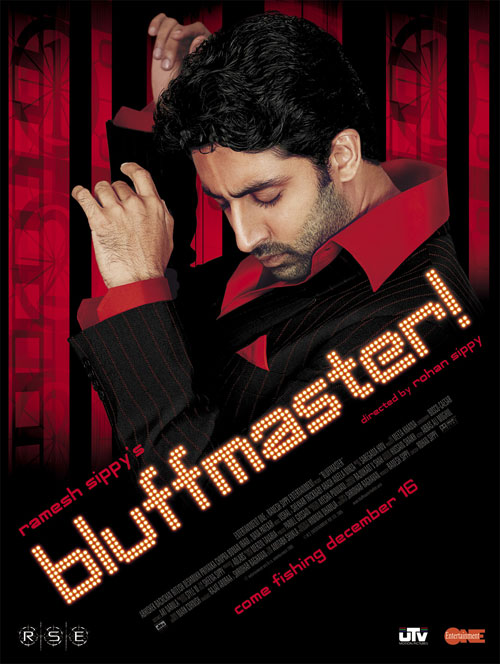
Movie Review: Bluffmaster! (2005)

3 Stars (out of 4)

Buy or rent the movie at iTunes
Buy the DVD at Amazon
Buy the soundtrack at Amazon

After being disappointed by Dum Maaro Dum, I decided to check out the first collaboration between Abhishek Bachchan and director Rohan Sippy: Bluffmaster! The pair’s first effort is clearly the superior of the two.

Bachchan stars in Bluffmaster! as conman Roy Kapoor. His heists have netted him loads of cash, and he has a sweet girlfriend named Simi (Priyanka Chopra) who thinks he’s a stockbroker. Simi learns the truth about him when a movie producer Roy conned shows up at their wedding.

Six months later, as Roy mourns his failed relationship with Simi, he watches a pair of small-time con artists trick a doctor out of his wallet. Roy retrieves the wallet and earns the friendship of the doctor, Bhalerao (Boman Irani). One of the cons, Dittu (Ritesh Deshmukh) is so impressed with Roy’s skills that he asks to become Roy’s student.

While Roy contemplates Dittu’s offer, he begins experiencing blackouts. Dr. Bhalerao discovers an inoperable brain tumor and gives Roy just months to live. Given Roy’s history of untruths, Simi assumes Roy’s brain tumor story is a trick and slams the door on him.

Dittu, unaware of Roy’s condition, explains that a prominent hotelier tricked his father out of his life savings. Roy decides to spend the little time he has left helping Dittu get his father’s money back. It’s the first time in Roy’s life that he’s ever put someone else’s needs above his own.

What distinguishes Bluffmaster! from Dum Maaro Dum is the former’s superior plot structure. While Dum Maaro Dum is mired in flashbacks and sideplots, Bluffmaster! moves forward at a steady clip. Just as it appears Roy may have a chance to win Simi back after all, his scheme with Dittu becomes more complicated than he expected. All the while, the threat of imminent death hangs over Roy’s head.

Bluffmaster! is based on the Argentine movie Nine Queens, which was also remade in America as Criminal. Additionally, Bluffmaster! shares similarities with Hollywood films like The Game and Matchstick Men. All of these movies directly or indirectly supply the template for Bluffmaster!. Meticulous continuity is the only way to make such a complex story work, and it does so in Sippy’s sophomore directorial effort.

The acting is uniformly good. Bachchan brings charm to a character who is initially a selfish crook. Irani is stellar as an elder who sees potential in Roy and has great affection for him. Chopra and Deshmukh are solid as the skeptic and the sidekick, respectively.

Links

DVD Review: 3 Idiots

Buy the DVD at Amazon

After taking Bollywood by storm in the waning days of 2009, the superb Hindi comedy 3 Idiots was finally released on DVD last week. Given the quality of the DVD, I think it was worth the wait.

I was so fond of 3 Idiots when I saw it in the theater that I named it my Best Bollywood Movie of 2009. It’s in many ways a movie from another time, a throwback to the days when a comedy featuring adult characters could be family-friendly and didn’t rely entirely on crude scatological or sexual humor.

25 years or so ago, studios could count on moviegoers to turn out for light comic fare starring adult characters. In 1984, Police Academy, Romancing the Stone and Splash were among the top ten highest-grossing films of the year in the U.S. All three of those comedies featured adult protagonists. Films with older teen protagonists like Gremlins, The Karate Kid and Footloose also made the Top Ten that year.

1984 wasn’t an aberration. 1985’s Top Ten included Cocoon, Jewel of the Nile and Spies Like Us, while 1986’s had Crocodile Dundee, Back to School and Ruthless People.

Fast-forward to the 21st century and you’ll see a box office dominated by big-budget action films and animated kids’ movies. Top-ten performances by grown-up comedies are rare: Meet the Fockers in 2004, Wedding Crashers in 2005, The Hangover in 2009. As a result, this type of movie is no longer a high priority for Hollywood studios.

That’s why 3 Idiots was so refreshing when it came out. The road trip comedy about two pals searching for their long-lost college chum is universal in its appeal. It’s funny and sweet, something that you can turn on any time you need a little pick-me-up.

20th Century Fox produced the DVD and made it especially accessible for American viewers who don’t understand Hindi. Dialog is subtitled in English automatically without having to change any menu settings. Within the setup menu, subtitle options include Spanish and French, as well as English for the deaf and hard of hearing — which adds descriptions of other audible noises (yawns, coughs, chuckles, etc.).

Sadly, the bonus features are inconsistently subtitled. Since they were shot on location and impromptu, the audio isn’t always clear. Though the actors and crew often speak in English, the poor sound quality makes it hard to understand.

Of the four bonus features, “Idiots in Ladakh” is the best, because it’s the most visual. The short film chronicles weather problems that beset the crew as they filmed in Ladakh, a picturesque mountain town in northern India near the Tibetan border. The brutal conditions nearly left some crew members stranded in a blizzard and delayed the film schedule for a year.

The other three bonus features are amusing, but not required viewing. “Making of Miss Idiot” shows the costume selection process for Kareena Kapoor’s nerdy character, which mostly boiled down to convincing glamorous Kareena to wear glasses. “Aal Izz Well” looks at the making of the dance number that accompanies the song of the same title, and “100% Idiots” reveals that the actors weren’t faking it during the movie’s drunk scene.

3 Idiots is one of the rare films that I feel confident in recommending to anyone, so go check it out.

Links

Movie Review: Dum Maaro Dum (2011)

1 Star (out of 4)

Buy the DVD at Amazon
Buy the soundtrack at Amazon

Copious amounts of sex, drugs, rock n’ roll, fights, chases and torture fail to liven up the dull and disorganized Dum Maaro Dum.

An opening shot of a dead body, accompanied by a voiceover by Abhishek Bachchan about the deadly drug trade in Goa, suggest a riveting tale of murder and corruption in a beachfront paradise. As soon as the opening credits finish, boredom sets in.

The movie is immediately mired in the backstory of one of the side characters, a teen named Lorry (Prateik Babbar). Lorry can’t afford to join his girlfriend at college in America, so he accepts a job as a drug mule, in order to earn the money for tuition. What I just summarized in one sentence takes up 25 minutes of screentime.

Twitchy-looking Lorry gets busted at the Goa airport by Kamath (Bachchan), a formerly corrupt vice cop trying to redeem himself after the accidental deaths of his wife and son. Kamath sends Lorry to jail, but the kid won’t reveal the whereabouts of the mysterious drug kingpin “Michael Barbosa.”

Kamath gets help from a musician name Joki (Rana Daggubati) in exchange for leniency for Lorry. Joki’s ex-girlfriend, Zoe (Bipasha Basu), is currently seeing another major drug dealer, Lorsa Biscuta (Aditya Pancholi). If anyone knows where Barbosa is, it’s Biscuta.

The plot isn’t nearly as straightforward as the above recap. There are flashbacks to pointless backstory, which prevents giving the characters enough time to grow (and grow on us) as events unfold in the modern-day.

This presents a serious problem, as Kamath — the presumptive, though not explicitly defined, lead character — is a monster. In addition to Kamath’s corrupt past and his penchant for beating up suspects, he sodomizes a drug runner with a pistol in order to make the guy confess. The movie’s villains may rack up a higher body count, but Kamath’s methods are more brutal and vile.

Substituting backstory for character development brings the action of the film to a crawl. Boring exposition about events not germane to the current situation is punctuated by party scenes, sex scenes and fight scenes. If you spend most of the film rudely texting on your cell phone, only to look up when the music cues something exciting on-screen, you might be fooled into thinking Dum Maaro Dum is an exciting movie.

The climax of the movie is actually pretty clever — so much so that the producers canceled the gala premiere in order to preserve the secret ending. But it seems as though writer Shridhar Raghavan started with the climax and struggled to craft the story that leads up to it.

Perhaps the poster tells us everything we need to know about Dum Maaro Dum. The poster features the svelte torso of Deepika Padukone, who makes a special appearance in a performance of the title track. Padukone is onscreen for all of five minutes, in a dance number that happens one hour and 45 minutes into the film. It is the best part of the movie.

Links

Movie Review: Crook (2010)

2.5 Stars (out of 4)

Buy the DVD at Amazon
Buy the soundtrack at Amazon

There’s a lot going on in the subtext of Crook regarding the different facets of racism and the immigrant’s struggle to balance integration with tradition. With a different structure– one that allowed the subtext more time to develop — Crook could’ve been a truly memorable movie.

The hero of Crook is Jai (Emraan Hashmi), a small-time video pirate in India. His adoptive father sends him to Australia under a false identity in order to give Jai a fresh start. Jai starts his new life in Melbourne as Suraj, a taxi driver working his way to permanent residency (unless he can find a cute Australian woman to marry first).

Two Aussie women catch Jai’s eye: a blonde stripper named Nikki (Shella Alan) and a student of Indian descent named Suhani (Neha Sharma). Nikki quickly falls for Jai, but Suhani’s strict brother, Samarth (Arjan Bajwa), intends to marry her to someone else.

Further complicating matters is a series of racially motivated attacks on Indian-Australians by white Australians. Suhani tries to bring Australians of all colors together and is frustrated by Jai’s unwillingness to get involved. Jai fears attracting police attention by participating in protests. If the police discover his true identity, he could be sent back to India.

Crook portrays racism as a two-way street. The white Australians who attack Indians are villains, but so are traditionalists like Samarth, who rejects Australian culture in the hopes of recreating India on a new continent. The only innocents are people like Suhani, who respects the values of her family as much as the values that dominate her adopted homeland.

Such nuance presents a problem in that it makes Jai’s decision not to take a stand look decidedly unheroic. He spends most of the movie running away from trouble. While it makes sense given his false identity, the threat of deportation isn’t as imminent or thrilling as, say, the threat of death.

Further, since the audience knows that eventually Jai has to get involved, he needs to take a stand much earlier in the film than he does. It takes more than half of the movie before Jai finally tells Suhani the truth about his past. Even then, he still insists that the racial tension inflaming the city isn’t his problem. A film hero needs to take charge of his destiny in a more definitive way than Jai does.

While the set up of the love story is fine, it doesn’t leave enough time for the action in the second half of the movie to unfold. When violence breaks out, characters undergo abrupt personality changes and plot points feel rushed.

Overall, Crook is a fun ride with some interesting moral observations. It just falls a bit short of its potential.

Links

Movie Review: Thank You (2011)

1.5 Stars (out of 4)

Buy or rent the movie at iTunes
Buy the DVD at Amazon
Buy the soundtrack at Amazon

The more I think about Thank You, the more confused I become. The first two-thirds of the comedy are enjoyable enough, but a serious and preachy third act unravels the entire story that precedes it.

Thank You centers on the womanizing exploits of Raj (Bobby Deol), Vikram (Irrfan Khan) and Yogi (Suniel Shetty). Yogi’s already been caught cheating by his wife, Maya (Celina Jaitley). Suspicious of the other louts’ extramarital activities, Maya introduces Vikram’s wife, Shivani (Rimi Sen), and Raj’s wife, Sanjana (Sonam Kapoor), to her “best friend”: a private eye named Kishan (Akshay Kumar).

Kishan develops a crush on cute, trusting Sanjana and aims to expose her husband for the cheater he is. Raj and his buddies aren’t able to continue their deception for long, and all their secrets are revealed. Maya and Shivani are prepared to move on with their lives, but Sanjana isn’t. She wants Raj back.

Here’s where things get confusing, in retrospect. Kishan agrees to help Sanjana reunite with Raj. His plan is to make Raj jealous by pretending to be Sanjana’s new boyfriend. Presumably, Kishan’s real intention is to show Sanjana how much better he is than Raj and win her for himself.

Without giving anything away, the third act seems to indicate that a potential romance between Kishan and Sanjana was never really an option (or something that either of them even desired). The tension in the second act, at the time, appears to be whether Sanjana will pick Raj or Kishan. Without that tension, the whole second act is, in retrospect, just a big waste of time.

Perhaps sensing the shoddy construction of his parable, writer-director Anees Bazmee has Kishan explain the moral of the story with a condescending speech in the final scene. But the message as delivered by Kishan runs counter to the one that the movie had conveyed to that point. I liked the story that Bazmee actually told better than the one he apparently thought he was telling.

The real shame of Thank You‘s narrative collapse is that most of the movie is pretty funny. The set pieces are good, and the jokes translate well cross-culturally.

Particularly deserving of praise are Shetty and Sen for their performances as Yogi and Shivani, respectively. Yogi, having been previously outed as a cheater, revels in watching his two buddies get caught for the same crime. Shivani is the most put-upon wife and therefore the most eager to take revenge on her husband. Shetty and Sen take full advantage of their opportunities to ham it up.

The weakest member of the cast is Kapoor. Still a relatively new actress, everything about her performance — from her physical presence to her voice — lacks gravity. She’s pretty and stylish, but that’s not enough to make her a lead that an audience cares about.

Links

Movie Review: Game (2011)

2 Stars (out of 4)

Buy the DVD at Amazon
Buy the soundtrack at Amazon

The murder mystery genre is a well-established one — so much so that audiences have internalized the genre’s rules, whether consciously or not. Game breaks a number of rules that the genre demands must be followed, ruining what is otherwise a great-looking and well-acted movie.

Game starts with a promising contrivance. Billionaire Kabir Malhotra (Anupam Kher) summons four people to his private Greek island right at the moment they are most in need of rescue. Tisha (Shahana Goswami) is caught driving drunk, O.P. (Boman Irani) is about to lose his political career, Neil (Abhishek Bachchan) is on the run from Colombian drug dealers, and Vikram (Jimmy Shergill) has a suitcase with a dead body stuffed inside.

Malhotra’s generous offer isn’t quite what it seems. He holds the three men responsible for the untimely death of a daughter he never knew he had. And Tisha is his dead daughter Maya’s fraternal twin sister. Malhotra has enough dirt on the men to ruin their lives, dirt which he plans to turn over to international authorities in the morning.

The circumstances of Maya’s death are divulged within the first 30 minutes of a 135 minute movie, so that’s clearly not the movie’s real mystery. Instead of moving the story forward from that point, the plot is interrupted by Neil flashing back to Maya (Sarah-Jane Dias) performing a burlesque dance number, ruining the flow of the film.

At the fifty minute mark, the true mystery is finally revealed. Malhotra dies alone in his office — presumably by his own hand — and all of his evidence on the men is destroyed. The international authorities arrive, but lead inspector Sia (Kangana Ranaut) is forced to let the four invitees go home. Her primary suspect, for no apparent reason, is Neil, and she begins trailing him to uncover his guilt.

There’s a lot to like about Game. Bachchan and Ranaut are compelling leads, and veterans Kher and Irani deliver as always. Goswami and Shergill make the most of their supporting roles. The movie is beautifully shot in gorgeous locations in India, Turkey, Thailand, England and Greece. There are a few great action sequences and one painful jogging chase scene that ends when the pursuers succumb to sprained ankles and side cramps.

But the film’s plot has some issues that are too large to be glossed over. To paraphrase a familiar axiom about mysteries, the outcome must, in retrospect, feel unpredictable but inevitable. There’s nothing about the ultimate outcome of Game that is any way inevitable, despite a few half-hearted attempts at retroactive continuity.

The introduction of new major characters, illogical plot twists, and ludicrous revelations dominate the last 30 minutes of the movie. Plot twists can’t exist independently for the sake of shock value alone; they must exist in service of the larger story (or else they’d just be called “twists”).

The filmmakers didn’t understand that, after a good mystery, the audience should leave saying,  “I can’t believe I didn’t see that coming.” Instead, Game‘s audiences will exit theaters wondering, “Where the hell did that come from?”

Links

Movie Review: Baiju Bawra (1952)

3.5 Stars (out of 4)

Buy the DVD at Amazon
Buy the soundtrack at Amazon

On the advice of Ken Patel, owner of Wilma’s Cafe in Naperville (one of my favorite local hangouts), I sought out Baiju Bawra, Ken’s favorite movie when he was a kid. Thank goodness it’s available on Netflix, because Baiju Bawra is a real gem. This black-and-white classic is renowned for its amazing soundtrack, but its story is as epic and dramatic as a Greek tragedy.

Baiju Bawra tells the story of a singer named Baiju (Bharat Bhushan). As a young boy, he witnesses his father’s murder by guards at the palace of Emperor Akbar. His father made the mistake of singing on palace grounds, an act forbidden by the royal singer, Tansen (Surendra). Before he dies, Baiju’s father begs his son to avenge his death and kill Tansen.

Baiju’s vengeance is delayed when a kindly man takes him in and teaches him music. In the man’s village, Baiju meets a little girl named Gauri who becomes his best friend and, eventually, his sweetheart.

The love between Gauri (Meena Kumari) and Baiju grows despite Gauri’s betrothal to another young man. That problem takes a backseat when the village is overrun by bandits. Baiju’s singing entices the bandit queen, who makes Baiju an offer: she’ll spare the village if he comes with her. Baiju agrees, leaving Gauri behind.

It’s only when he’s away from Gauri that Baiju remembers his promise to his dead father. He turns his attention from romance to revenge. All this before the movie’s even half over.

The story touches on broad themes such as the destructive nature of revenge and the pain that often accompanies love. But more than anything, the movie is about the bewitching power of music. Baiju and Tansen are both magicians of a sort, able to hypnotize crowds and make the gods weep with their songs.

The classical Indian style of music that dominates the soundtrack differs greatly from typical Western music, yet Baiju Bawra is organized like a typical Hollywood movie musical. Many of the songs are about the events onscreen, and there is at least one dance number. While the music may sound different from what American audiences are used to, the format feels familiar.

Because of the dramatic nature of the story, the actors’ performances feel overdone at times. Baiju’s Pavlovian response to hearing Tansen’s name — which causes him to clench his fist and grumble, “Tansen, Tansen,” repeatedly — is a bit much. And the amount of vigorous, affectionate shoulder rubbing Baiju endures at the hands of his male mentors is comical.

That said, Baiju Bawra is terrific. I understand exactly why it captivated Ken in his youth. I’m also not surprised that plans are underway to remake the movie. Producers reportedly offered the role of 20-something Baiju to 46-year-old Aamir Khan. Do they plan on calling the remake Baiju Grandpa?

Links

Movie Review: Paathshaala (2010)

0.5 Stars (out of 4)

Buy the DVD at Amazon
Buy the soundtrack at Amazon

The first scene in Paathshaala contains a closeup of a boy’s crotch as he pees himself. Need I write more, or is that sufficient evidence that this is a terrible movie?

Paathshaala (“School”) strives to be the after school special version of Taare Zameen Par, a movie which itself is drearily on-the-nose in its critique of the Indian school system. Paathshaala lacks sophistication in its storytelling and bores as it attempts to make a statement.

Nana Patekar plays Aditya Sahay, principal of an elite private boarding school that’s low on funds. Shortly after the arrival of a new English teacher named Rahul (Shahid Kapoor), the well-respected principal announces bizarre changes at the school.

Sahay turns control of the school over to a management firm who want to increase the school’s profile and cash flow by entering all of the students in reality TV competition shows. Rather than studying, students spend the day auditioning for singing competitions and arranging themselves in human pyramids in the hot sun.

Why Sahay allows his school to be turned into a joke isn’t explained until the last ten minutes of the movie. The explanation is ludicrous: the school board demanded more revenue and, out of other options and not wishing to burden the staff and students with the problem, Sahay allowed the board to implement changes.

This is stupid for a number of reasons. First, there’s no reason for Sahay to keep the board’s demands secret. It would’ve been a more interesting movie had he explained the problem and the students themselves came up with the plan to compete on reality shows.

The second issue with Sahay quietly acceding to the board’s wishes is that it turns him into a villain. He assumes responsibility for the changes even as his students pay the price in injuries, exhaustion and missed educational opportunities. If Sahay loves his school as much as he claims to in a tedious speech at the end of the film, he never would’ve put his students at risk.

Sahay, however, isn’t even the focal point of the movie; Shahid Kapoor is front and center on the movie poster. Rahul is supposed to be the cute, cool new teacher. He wears jeans in class, high fives his students and plays guitar for them (though Kapoor doesn’t bother to strum the guitar as he “plays” it).

Rahul’s attempts to befriend his pupils would have the opposite effect in reality. The kids would think he was trying too hard to be one of them and dismiss him as a dork.

The rest of the teachers are mere caricatures. The nutritionist/lunch lady played by Ayesha Takia is there to look pretty. The kids are supposed to be cute but wind up as annoying screen fillers. In every respect, Paathshaala fails to make the grade.

Links

Movie Review: Chak De India (2007)

4 Stars (out of 4)

Buy or rent the movie at iTunes
Buy the DVD at Amazon
Buy the soundtrack at Amazon

My niece isn’t old enough for movies with subtitles yet, but I want Chak De India to be the first foreign film she sees. It’s a touching parable about the virtues of tolerance, set within a familiar sports movie format. A second viewing on Netflix streaming confirmed that it’s just as good as I thought it was when I first saw it in the theater.

Shahrukh Khan stars as Kabir Khan, the former captain of India’s national men’s field hockey team. He left the sport in disgrace after missing a penalty shot that awarded victory to Pakistan, India’s archrival on and off the pitch. In a gesture of sportsmanship, Khan shook the hand of a Pakistani player, leading the media to accuse him of having thrown the match.

After seven years in exile, Khan returns to coach the Indian national women’s field hockey team, a team which exists only to fulfill federal gender equality requirements. No one else wants the job, but Khan sees it has his last chance to participate in the game he loves and prove his loyalty to his country.

The team comprises young women from most of India’s 28 states. All of the women are used to being the biggest fish in their comparatively small ponds, and none are willing to accept less than a starring role on the team. Before Khan can even contemplate getting the girls to the world championships, he must find a way to get them to work together.

First and foremost, Chak De India is a really well-executed sports movie. The first hour of the film follows the team through training, and the second covers the international tournament. In-game shots from the tournament are exciting and beautifully filmed, giving a sense of the speed and ferocity of the game. Shots from the training sessions give a sense of the physical demands placed on players, which is helpful for viewers unfamiliar with the sport.

What elevates Chak De India is its depiction of diversity. The actresses in the cast represent the wide array of Indian women: big and small, dark-skinned and light-skinned, urban and rural. Two team members from states bordering Myanmar (on India’s far-eastern border) are mistaken for Chinese or Nepalese and lament being treated like foreigners in their own country.

Chak De India also asserts the fundamental equality of women. The team not only has to fight to be taken seriously, but individual players have to fight for the right to play. Little Komal (Chitrashi Rawat) defies her father to join the team, and goalkeeper Vidya (Vidya  Malvade) joins against the wishes of her husband and his family. Goalscorer Preeti’s (Sagarika Ghatge) fiance, himself a captain on the men’s national cricket team, doesn’t see the irony in asking her to quit the team because “it’s just a game.”

Throughout, Khan encourages his players to focus their frustration with a society that considers them inferior to men into success on the pitch. He knows from experience that nothing is more satisfying than proving one’s detractors wrong.

Links