Tag Archives: Arjun Kapoor

Opening January 9: Tevar

The first Bollywood film to hit Chicago area theaters in 2015 is Tevar, opening January 9. The action drama stars Manoj Bajpayee, Arjun Kapoor, and Sonakshi Sinha.

Tevar opens on Friday at the AMC River East 21 in Chicago, Regal Gardens Stadium 1-6 in Skokie, MovieMax Cinemas in Niles, AMC South Barrington 30 in South Barrington, and Regal Cantera Stadium 17 in Warrenville. It has a listed runtime of 2 hrs. 30 min.

PK carries over for a fourth week at all of the above theaters (except for the River East 21), plus the AMC Loews Woodridge 18 in Woodridge.

Other Indian movies playing at MovieMax this weekend include Gopala Gopala (Telugu), Nagaravaridhi Naduvil Njan (Malayalam), Mukunda (Telugu), Chinnadana Nee Kosam (Telugu), and Lingaa (Tamil).

New Trailer: November 11, 2014

Sonakshi Sinha is imperiled yet again in Tevar, which releases theatrically on January 9, 2015. This time, she needs to be saved from Manoj Bajpayee by Arjun Kapoor. Kudos to Subrat Dutta for landing roles in seemingly every movie these days: Bheera in Roar, the eccentric director in The Shaukeens, and now one of Manoj’s henchmen in Tevar. Check out the trailer:

Movie Review: Finding Fanny (2014)

Finding_Fanny_Theatrical_release_poster3 Stars (out of 4)

Buy the DVD at Amazon
Buy the soundtrack at Amazon

“No one deserves an incomplete love story.” Finding Fanny humorously and thoughtfully explores the ways that waiting for an answer suspends us in time.

The above quote is spoken by the film’s narrator, Angie (Deepika Padukone), a 26-year-old widow living in Pocolim, a tiny town in Goa. Life’s forward progress stopped for Angie when her husband (Ranveer Singh) choked to death on their wedding cake, though she’s serene about her situation. She lives with her mother-in-law, Rosie (Dimple Kapadia), the queen bee of Pocolim.

Angie’s best friend is Ferdie (Naseeruddin Shah), the town’s mailman. His forward progress stopped forty-six years ago when he wrote a letter proposing marriage to a girl named Fanny Fernandez, but never received a response. He’s the only boy in the church choir with white hair.

One night, the letter Ferdie mailed to Fanny is slipped under his door, unopened and undelivered. Angie organizes a trip to help Ferdie find Fanny and discover what her answer would have been. She enlists the help of her mother-in-law, her recently returned childhood sweetheart, Savio (Arjun Kapoor), and Don Pedro, (Pankaj Kapur), a visiting artist obsessed with voluptuous Rosie and owner of the town’s only car.

Of course the brief road trip winds up far more complicated than expected, and tensions flare within the group. Ferdie reveals to Savio the reason why his formerly close friendship with Rosie ended, and Savio fights with Angie about what would’ve happened had he married her instead. Don Pedro’s lecherous ogling of Rosie doesn’t help matters.

Finding Fanny is a beautiful looking film, thanks to cinematographer Anil Mehta. There are lots of wonderful individual shots — Angie’s face as she stares pensively out the open car window, for example — as well as wide shots showing the vastness of the world outside of Pocolim that never before interested Rosie, Ferdie, or Angie. The visual beauty is enhanced by Mathias Duplessy’s vibrant score.

The actors keep their performances subdued. Much is communicated non-verbally, especially by the expressive faces of Padukone and Shah. At the same time, the characters are all funny, none more so than Kapadia’s Rosie. The members of the traveling party are eccentrics, not outrageous goofballs or weirdos.

The glaring exception to the subtly rule is a Russian man who now owns Fanny’s childhood home. His delivery is so loud and exaggerated in comparison to the other performances that it feels out-of-place.

Perhaps the film’s biggest fault lies in the development of Angie’s character (though that’s not a slight on Padukone’s terrific portrayal). It’s obvious what every other character wants: Savio wants Angie; Don Pedro wants Rosie; Ferdie wants the Fanny of his memories; and Rosie wants to live a dignified life that she controls.

It’s never clear what Angie wants, other than to reunite Ferdie with Fanny. She speaks in important-sounding vagaries that don’t really mean anything. Is the point that she’s still too young to know what she wants? That we should be at peace with what we have? I was never sure. That’s a letdown for a character who’s not only the film’s narrator, but also the most important person in the lives of Ferdie, Rosie, and Savio.

Still, Finding Fanny is one of the more intriguing movies to come out of Bollywood this year. The fact that the dialogue is in English just adds to the intrigue. It’s unique, enjoyable, and worth a watch.

Links

Movie Review: 2 States (2014)

2states3.5 Stars (out of 4)

Buy or rent the movie at iTunes
Buy the DVD at Amazon
Buy the soundtrack at Amazon
Buy the book at Amazon

As a woman who’s lived her entire life in Illinois, I would never have expected to find a movie about the cultural differences between families from North and South India so personally relevant. But those cultural differences are only the hook in 2 States. The real story is about alcoholism and the effects it can have across multiple generations.

The majority of the problems for the characters in 2 States (based on the novel by Chetan Bhagat) stem from the warped style of communication that Krish Malhotra (Arjun Kapoor) developed in order to deal with his abusive alcoholic father, Vikram (Ronit Roy) and his martyr mother, Kavita (Amrita Singh).

Krish — a Punjabi guy from Delhi — meets and falls in love with Ananya (Alia Bhatt) — a Tamil Brahmin gal from Chennai — in graduate school. They want their parents’ approval before they get married, but an introductory meeting goes terribly wrong. Vikram doesn’t even show up, and Kavita spews slurs against South Indians. Ananya’s mother, Radha (Revathy), calls Kavita classless and drags her husband, Shiv (Shiv Kumar Subramaniam) as far away as she can get.

Krish and Ananya persist in trying to win their parents’ approval, but their efforts are hampered by Krish’s evasiveness and conflict avoidance. Because he knows it will upset his mother, Krish doesn’t tell her in advance that Ananya is coming to visit, making Kavita even angrier. Krish also doesn’t tell Ananya the truth about his troubled relationship with his father until Ananya fruitlessly tries to make small talk with him.

I’m a couple of generations removed from the alcohol abuse on both sides of my family, but its effects still linger in the way we all communicate. Listening to Krish’s family evade, pacify, generalize, and blow up over little things felt familiar.

The characters feel so authentic because they are portrayed as damaged human beings, not monsters. Even in Vikram’s worst moments, Roy gives him an air of fragility. Singh plays Kavita as a woman whose hurtful words come from a place of fear.

Kapoor infuses Krish with an air of desperation. He’s as desperate not to lose Ananya as he is not to upset his mother. Part of his character development is choosing which he fears most. Krish is a relatable alternative to the typical cocksure, big-man-on-campus type of Bollywood hero.

Bhatt is terrific as Ananya: a woman with much more confidence than Krish, despite having challenging parents of her own. Revathy and Subramaniam find the right balance, making their characters chilly but not stony. At least with them, Krish knows he stands a chance.

Certain aspects make 2 States a good starter Bollywood film, not least of which are the well-written, well-acted characters. There aren’t an overwhelming number of songs, but those that exist are placed appropriately. The biggest song-and-dance number — “Locha-E-Ulfat” — is a kind of dream sequence when Krish is in the first throes of love. It features a cool single-take shot in which the camera weaves around, following Krish as he dances through the library stacks. (Watch the video of “Locha-E-Ulfat” here.)

Where the movie loses a lot of non-Indian viewers — especially those new to Bollywood — is in its jokes and stereotypes about North and South India. Some jabs are explained, but jokes about regional food and drink preferences are glossed over. I had to turn to Wikipedia to learn that “Madrasi” — the term Kavita uses to describe Ananya and her family — is an ethnic slur. Kavita also makes many, many cringe-worthy comments about the differences in skin tone between North and South Indians.

Nevertheless, the point is sufficiently made: the two families hate each other. It’s up to Krish to overcome his fear of conflict to win the woman he loves.

Links

Opening April 18: 2 States

One of the most hotly anticipated Bollywood films of the year opens in the Chicago area on April 18, 2014. 2 States stars Arjun Kapoor and Alia Bhatt as a pair of young people trying to build a relationship despite the objections of their parents.

2 States opens on Friday at the AMC River East 21 in Chicago, AMC Showplace Niles 12 in Niles, AMC South Barrington 30 in South Barrington, and Regal Cantera Stadium 17 in Warrenville. It has a listed runtime of 2 hrs. 15 min.

It’s worth noting that the Big Cinemas Golf Glen 5 in Niles — one of two local theaters to carry Bollywood movies virtually every week — is no longer managed by Phoenix Big Cinemas, and its present closure may be permanent. If so, that makes the South Barrington 30 the most reliable place to find Hindi films in the Chicago area, followed by the Cantera 17 and River East 21.

Despite a tepid opening weekend, Bhoothnath Returns carries over for a second week at the Cantera 17 and South Barrington 30, which is also carrying over Main Tera Hero and Queen.

The Lunchbox gets another week at Landmark’s Renaissance Place Cinema in Highland Park.

The only other Indian movie playing in the Chicago area this weekend is Race Gurram (Telugu with English subtitles) at the Muvico Rosemont 18 in Rosemont and Cinemark at Seven Bridges in Woodridge.

Streaming Video News: April 9, 2014

The family crime drama Aurangzeb is now available for streaming on Netflix. This is one of my favorite movies of 2013, and it’s a far better showcase for Arjun Kapoor’s talent than his most recent release, Gunday.

I like the changes Eros Now made to their homepage, which now highlights free movies and films recently added to the streaming service.

Box Office: February 14-16

Gunday turned in a fine performance in North America in its first weekend of release. The Yash Raj Films production got a relatively wide roll-out in 150 theaters in the U.S. and Canada, and it earned $548,350 (according to Bollywood Hungama) for a per screen average of $3656.

Though stars like Priyanka Chopra and Irrfan Khan feature in supporting roles, Gunday‘s success rests on the shoulders of the two lead actors: Arjun Kapoor and Ranveer Singh. Kapoor’s two previous films — Ishaqzaade and Aurangzeb — didn’t make a splash in U.S. theaters, so it’s best to compare Gunday‘s opening week in the U.S. and Canada to the opening weekends of Singh’s earlier films.

Like Gunday, Singh’s first two movies were released by Yash Raj Films (as were Kapoor’s). 2010’s Band Baaja Baaraat earned $43,820 from 32 theaters ($1369 average), while 2011′s Ladies vs Ricky Bahl, collected $222,019 from 80 theaters ($2775 average) in its opening weekend .

2013 was a better year for Singh, when he ventured out from under the Yash Raj banner. Lootera took in $314,958 from 100 theaters ($3150 average) its opening weekend, going on to earn a total of $581,813.

Goliyon Ki Raasleela Ram-Leela was an even bigger hit, earning $1,449,174 from 204 theaters ($7,104 average), with a total haul of $2,738,863.

Ignoring the incredible U.S. performance of Ram-Leela, Gunday‘s opening week returns look right in line with the upward trajectory of Singh’s career.

The other Hindi movie still in theaters is Hasee Toh Phasee. In its second week, the romantic comedy took in $152,284 from 76 theaters ($2003 average) for a total of $554,534 so far. That average is still more than 50% of its opening weekend average of $3,829, which is good for a Bollywood film in the U.S.

Movie Review: Gunday (2014)

Gunday2.5 Stars (out of 4)

Buy or rent the movie at iTunes
Buy the DVD at Amazon
Buy the soundtrack at Amazon

Editor’s note: So, a lot of people have been coming to this review via IMDb, because Gunday is — after just one week in theaters — already the lowest-rated movie of all time. Lower than The Hottie and the Nottie, Birdemic, and even Manos: The Hands of Fate. As of February 22, it’s at 1.2/10, a full .8 ahead of its nearest competitor.

Is Gunday really that bad? As a movie, no. You can read below how I thought it was problematic, but passable.

Then why is it ranked as IMDb’s worst movie ever? It looks like the movie’s portrayal of the Bangladesh Liberation War has angered a lot of people, who have coordinated to give it as many 1/10 reviews as possible. Look at the IMDb user reviews, and several of them have the exact same title: “Manipulating Bangladesh’s Liberation War history.”

Unfortunately, I’m not familiar with the true events that Gunday references. So while I still think it’s okay as a film, I certainly wouldn’t vouch for it being historically accurate!

Abrupt changes in tone and an abundance of slow-mo keep Gunday (“The Outlaws“) from establishing its own voice or finding a rhythm.

The story begins in 1971 at the end of the war that established Bangladesh as an independent nation. 14-year-old orphans Bikram (Darshan Gurjar) and Bala (Jayesh V. Kardak) survive the deprivation of a refuge camp by working as gun runners. When Bala shoots an army officer to save Bikram’s life, the boys flee to Calcutta.

Fast-forward ten years, and Bikram (Ranveer Singh) and Bala (Arjun Kapoor) are the unofficial kings of Calcutta, controlling all of the city’s black market commodities. The buddies do everything together, while savvy Bikram keeps Bala’s temper in check.

As soon as the guys’ present-day circumstances are established, an anchor drops onto the plot in the form of a love interest: a cabaret dancer named Nandita (Priyanka Chopra).

The premise that two guys are such good buddies that they decide to share the same girl could be cute in a more lighthearted movie than this one. But Gunday starts out grim, and it returns to being so once Nandita chooses one guy over the other. The thirty-minute wacky romantic-comedy interval doesn’t fit.

That’s not the only aspect of Gunday that doesn’t make sense tonally. Action sequences vary from dramatic and realistic to outright loony. Bala causes an earthquake before shooting up through the ground, as though propelled by a geyser. A fish is wielded as a deadly weapon.

The goofy action sequences are pretty entertaining, but again, they don’t feel right in the context of the movie. Gunday would’ve been better had writer-director Ali Abbas Zafar established surreal action as the dominant tone of the movie.

Such a tone would’ve also explained the volume of slow-motion used in the film. Walking, running, dancing: seemingly every form of motility is presented in slow-motion. The impact of the two scenes in the movie that actually benefit from the treatment is dulled by its application to so many mundane activities.

There is a ridiculous amount of skin on display in Gunday, and not just by Chopra’s cabaret dancer. In the movie’s funniest fight scene, Bikram and Bala exchange blows, ripping off each other’s shirts in the process. The shirts come off in slow-mo (of course), exposing Singh’s and Kapoor’s hairless, tanned, greased-up, muscular torsos. It’s not supposed to be as hilarious as it is.

As much attention as is given to the guys’ muscles — with special attention paid to Singh’s perky buns — Irrfan Khan wins for Best Body, and he gets to keep his clothes on.

Khan’s star power is on full display as the police inspector tasked with bringing down Bikram and Bala and returning order to Calcutta. Saurab Shukla’s understated role as the lawyer who watches over Bikram and Bala is also notable.

Chopra is fine as Nandita, though she’s not given much to do besides look sexy, early on. Her performance improves as Nandita realizes the consequences of having strained the friendship between the two gangsters.

It almost seems as if the role of Bikram was written with Singh in mind, and his charisma is undeniable. Kapoor is very good at playing edgy anti-heroes, and it’s a shame when Bala gets turned into a mindless beefcake goofball during the romance portion of the movie. His hair-trigger is shelved for the sake of song-and-dance numbers and out-of-place comedy bits.

As a surreal dark comedy or action flick, Gunday could’ve been really interesting, but there’s no place for light romantic tomfoolery in such a film. A clear vision rather than a please-all approach would’ve done wonders.

Links

Movie Review: Aurangzeb (2013)

Aurangzeb3.5 Stars (out of 4)

Buy or rent the movie at iTunes
Buy the DVD at Amazon

Aurangzeb should not work. The premise is silly: a long-lost twin impersonates his brother to take down their father’s criminal empire. Yet writer-director Atul Sabharwal executes his vision with such sincerity that the movie succeeds. I unapologetically love this action soap opera.

Sabharwal worked in television before this, his feature film debut, and it shows. There are so many twists and turns in the plot that it feels like a full season of a TV series condensed into one 140-minute movie. Aurangzeb: The Series would fit right in alongside The Vampire Diaries on The CW.

Arya (Pritviraj Sukumaran) — the film’s narrator — has a troubled relationship with his father, a disgraced police officer played by Anupam Kher in a moving cameo. Because of his father’s emotional distance, Arya was primarily raised by his uncle, Ravi (Rishi Kapoor), a crooked cop.

On his deathbed, Arya’s father confesses that he has a secret wife and son that Arya is now obligated to take care of. Arya resentfully breaks the news to the woman, Veera (Tanvi Azmi), only to realize that her son looks exactly like the son of the criminal mastermind, Yashwardhan (Jackie Shroff).

Uncle Ravi realizes that Veera and her son, Vishal (Arjun Kapoor), are Yashwardhan’s wife and son, presumed dead for the last 25 years after a “botched” police shootout that cost Arya’s father his job. In order to clear his father’s name, Arya and Ravi conspire to kidnap Yashwardhan’s son Ajay (also played by Arjun Kapoor) so that Vishal can impersonate his identical twin brother while acting as a police informant. Ravi explains that Vishal must act like Aurangzeb, the Mughal emperor who gained his throne by defeating the brothers ahead of him in the line of succession.

The soapiness of the story is enhanced by an amazing soundtrack. Heartrending musical themes accompany Veera’s confessions to her sons. Bombastic rock blares when Ajay (or Vishal) strides into a room, ready to bust some heads. Thankfully, the soundtrack album includes several of the great instrumental songs by Amartya Rahut and Vipin Mishra.

As with any good soap opera, the film is really about family conflicts: brothers turned against one another, children resentful of their parents’ favoritism, and parents who feel they can’t express their feelings to their hot-headed sons. Arya hates Vishal because of the love his own father showed the gangster’s son. Vishal hates his mother for robbing him of a relationship with his biological father. Ajay hates everybody.

As in his debut, Ishaqzaade, Arjun Kapoor plays a scumbag, and he’s great at it. Ajay is loathsome almost beyond the point of sympathy, yet the hurt behind his lashing out is always obvious. Vishal undergoes some real character growth as he, too, as his timidity gives way to aggression.

Pritviraj puts Arya in a similarly precarious position to Ajay’s. One of Arya’s early scenes has him belittling his dying father, so it’s hard to love him. However, it does give him room to grow when he’s forced to choose between his father’s “family first” approach to morality or his uncle’s belief in success at any cost.

Rishi Kapoor is compelling as the head of a family of corrupt cops. Ravi’s son, Dev (Sikander Kher), is involved in the family business, too, and gets to do some sleazy stuff.

Jackie Shroff plays the most sympathetic of the movie’s flawed father figures. Yashwardhan is old enough that he’s not the fearsome thug he once was, making it hard for Vishal to reconcile the man before him with the villainous image he was sold.

The movie isn’t all emotional turmoil. There are plenty of cool fight scenes to keep things entertaining, and it’s impressive how well they integrate with the melodrama. This kind of action-soap opera can’t succeed if it’s done halfway, and Sabharwal goes all out. Aurangzeb is exciting, touching, and totally engrossing.

Links

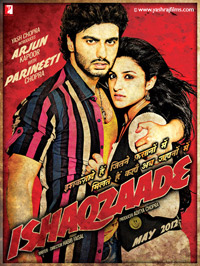
Movie Review: Ishaqzaade (2012)

3.5 Stars (out of 4)

Buy or rent the movie at iTunes
Buy the DVD at Amazon
Buy the soundtrack at Amazon

Unlike most movies produced by Yash Raj Films, Ishaqzaade (“Love Rebels”) didn’t get a major roll-out in North American theaters when it released in India in May. Instead, YRF waited to show Ishaqzaade — rechristened as “Born to Hate…Destined to Love” — at the Toronto International Film Festival, where its global sales rights were acquired by Shoreline Entertainment.

Even though the film is already available on DVD in the U.S., I hope the new acquisition means greater theatrical exposure for Ishaqzaade. It’s a tremendous movie.

Ishaqzaade is a Romeo & Juliet-type romance set in the terrifying world of local politics in Uttar Pradesh. It’s election season in the town of Almore, and the reigning politician, Qureshi, is challenged by the patriarch of the Chauhan family. Besides political animosity, the families are divided by religion as well: the Qureshis are Muslim, the Chauhans are Hindu.

Parma Chauhan (Arjun Kapoor) is the youngest of his grandfather’s grandsons. He’s marginalized in the family hierarchy in part because of his age, but also because his mother is a widow (not that she was responsible for her husband’s death). Parma is desperate to get in his grandfather’s good graces, but Parma’s attitude makes him a liability.

Parma has the devastating combination of a short temper and a sense of entitlement. When a merchant mentions selling diesel fuel to the Qureshis, Parma burns the merchant’s warehouse “to teach him a lesson.” He fails to consider that abusing the common folk hurts his grandfather’s election prospects.

The youngest member of the Qureshi family is Zoya (Parineeti Chopra), herself something of a firebrand. She’s responsible for coordinating her father’s campaign on her college campus, but is eager to do more. When Parma and his goons kidnap a dancer performing at a Qureshi party, Zoya chases after him in her jeep while firing her newly acquired pistol. However, her father’s plans for her are limited to marrying Zoya off to a banker from London, and he laughs at her political ambitions.

Zoya and Parma’s story really begins with an on-campus encounter. He urinates on her father’s campaign poster. She slaps him. He points a gun at her. Parma is impressed that Zoya doesn’t flinch at the loaded gun. She’s impressed when he sneaks into the girls’ bathroom to apologize.

This story is not Romeo & Juliet, however. When Parma starts pursuing Zoya, he’s still the same deplorable person who burned the merchant’s warehouse. Zoya is immature in her own right, in that she allows her feelings to override her awareness that her father would never allow her to marry a Hindu, let alone a member of the Chauhan family.

Ishaqzaade never lets romantic film conventions obscure the social norms of the region in which the film takes place. Religious differences are not something to be toyed with and are not easily overcome. Politics can be a similarly deadly enterprise, with seemingly no offense too minor to be greeted with gunfire.

I was most fascinated with the role of women in the film. Zoya’s headstrong personality makes her a fine mascot within her family, but doesn’t lend itself to a quiet life as a wife and mother, the only future her father sees for her. Zoya’s mother and Parma’s mother are sympathetic to her but pragmatic as well. Undersized and out-gunned, the women in both families have little choice but to submit to the will of the men.

The only other women in Ishaqzaade outside of the two families are prostitutes. The kidnapped dancer, Chand Baby (Gauhar Khan), is admired for her beauty and dancing skills, but it’s always clear where she ranks in the social order. Chauhan refers to her as “the whore.”

When men place so much emphasis on controlling women (and their sexuality in particular), it makes women a natural target for exploitation. From a practical standpoint, it seems a squandering of resources. Zoya’s brothers are good for carrying out simple orders, but they lack her cleverness and passionate commitment to the cause.

Chopra does a great job making Zoya feisty, yet vulnerable and naive. After all, she’s essentially still a kid. Kapoor has a swagger that makes Parma loathsome while simultaneously betraying the insecurity fueling the bravado. Parma is not a loveable character, but he is fascinating to watch. The lead actors’ performances are well-executed in a movie that demands much from its cast and its audience.

Links