Tag Archives: Saif Ali Khan

Movie Review: Cocktail (2012)

3.5 Stars (out of 4)

Buy the DVD at Amazon
Buy the soundtrack at Amazon

An attractive cast and raucous party scenes are the lure Cocktail uses to draw the audience into an exploration of modern romance and female friendship. It’s a frothy concoction that packs a punch.

Country girl Meera (Diana Penty) arrives in London to reunite with her husband Kunal (Randeep Hooda), only to learn that the marriage was a scam to cheat her out of her dowry money. Alone in an unfamiliar city, Meera meets Veronica (Deepika Padukone), a party girl. Veronica’s decadent lifestyle is financed by her wealthy absentee father, and she offers Meera a place to stay without a second thought. Though opposites in temperament, the women become best friends.

During a night on the town, Veronica plays a prank on Gautam (Saif Ali Khan), a serial flirt who hit on Meera when she first arrived in London. Veronica and Gautam become romantically involved, and he moves into Veronica’s house as well, forming a truce with Meera.

In order to get his mother (Dimple Kapadia) to stop pressuring him about marriage, Gautam admits that he’s in a relationship. When Mom arrives unexpectedly from India, Gautam says that prim, proper Meera is his girlfriend, not drunk, half-naked Veronica. The charade continues on a South African vacation where things get predictably complicated.

The story is organized as a classic Bollywood tale-of-two-halves. The first half of the film is lighthearted as the friends get to know each other. Some of the best laughs come courtesy of Gautam’s uncle, played by Boman Irani.

The second half of the film becomes an interesting character study with meaningful dialog. Writers Imtiaz Ali and Sajid Ali offer insightful commentary on modern, hook-up culture through the characters of Gautam and Veronica.

As soon as Gautam starts his sham relationship with Meera, everyone in the audience knows that things will end badly, but Gautam honestly doesn’t. He thinks he can say sweet things to Meera and that she won’t fall for him, and that he can do this in front of Veronica without making her jealous. He treats his “no strings attached” status with Veronica as a contract, a shield from future emotional attachment. Khan is very good in the scenes when Gautam finally realizes that this is not the case.

Padukone is likewise captivating when Veronica finally appreciates the hollowness of her party lifestyle. “I know what everyone thinks of me,” she says, heartbreakingly. Veronica fights dirty for the life she thinks she wants, a life that seems destined for Meera but not her. As misguided as she is, Veronica is very relatable.

Debutant actor Penty jumps into the deep end with Cocktail. Khan and Padukone are talented and sexy and have an established rapport, having worked together as romantic leads in Imtiaz Ali’s Love Aaj Kal. Even Hooda, Irani, and Kapadia are superb in their supporting roles. Penty’s performance isn’t quite as nuanced as those of her fellow cast members — she needs to learn to emote with her eyes and work on her dance moves — but she’s not a distraction. Meera isn’t as flashy as Veronica or Gautam, and Penty’s restrained performance suits her character.

The few complaints I have about the movie have to do with the sound design. There’s a paucity of background music in the first half, making it feel as though the scenes lack a connective thread. Also, the music that is there gets mixed very loud relative to the dialog, like when television commercials are significantly louder than the shows they interrupt.

If you watch enough movies, it becomes easy to predict how a plot will progress. With about thirty minutes remaining in Cocktail, I wrote the note: “How will this end?” It’s a lot of fun to be taken along for the ride for a change.

Links

Opening July 13: Cocktail

The romantic comedy Cocktail — starring Saif Ali Khan, Deepika Padukone, and newcomer Diana Penty — is the only new Hindi movie opening in Chicago area theaters the weekend beginning July 13, 2012.

Cocktail opens on Friday at the Big Cinemas Golf Glen 5 in Niles, AMC South Barrington 30 in South Barrington, and Regal Cantera Stadium 17 in Warrenville. It has a runtime of 2 hrs. 28 min.

After posting solid opening weekend returns of $561,996 in the U.S., the comedy Bol Bachchan gets a second weekend at all of the above theaters.

Other Indian movies showing at the Golf Glen 5 this weekend include Billa 2 (Tamil), Diamond Necklace (Malayalam), Eega (Telugu), and Thattathin Marayathu (Malayalam).

Though it isn’t opening in any Chicago area theaters yet, the Frieda Pinto starrer Trishna opens on a handful of U.S. screens on July 13 as well. Based on the Thomas Hardy novel “Tess of the D’Urbervilles,” Trishna takes place in India but features English dialog.


Movie Review: Agent Vinod (2012)

3 Stars (out of 4)

Buy the DVD at Amazon
Buy the soundtrack at Amazon

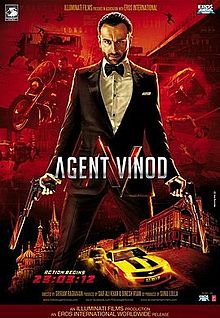
Nothing in Agent Vinod makes any logical sense. It’s all crazy action that couldn’t possibly happen the way it does. Yet Agent Vinod is so fun and so totally committed to its insanity that I don’t care. I really, really liked this movie.

In simplest terms, Agent Vinod is a spy movie. A suitcase-sized nuclear device is stolen from Russia, and Indian spy Agent Vinod (Saif Ali Khan) follows the clues to Morocco. There, he poses as a courier to gain access to David Kazan (Prem Chopra), an international arms dealer with a suspicious personal physician named Ruby (Kareena Kapoor).

Vinod’s search for the nuclear device takes him all over the world: India, Pakistan, Russia, Latvia, England, even South Africa, just for kicks. Why the nuke was stolen is unimportant. What is important is that Vinod gets to fight a lot of people.

There are some spectacular set pieces and moments that are truly startling. For example, a car brakes to a stop, only to be immediately smashed into by another vehicle from out of frame. The effect is akin to a “gotcha” moment in a horror movie, and it’s delightfully effective.

Without a doubt, the film’s best scene is a shootout in the lobby of a fleabag motel in Latvia that is shot in a single take. The technical impressiveness of the scene is topped when an unlikely participant joins the shootout at the end of the scene. It was so unexpected, I laughed out loud.

In fact, I laughed out loud from sheer joy a number of times during Agent Vinod. It’s a great throwback to ’70s-era spy movies, right down to the garish interiors and the catchy “wakka chikka” guitar score that punctuates crucial events.

The special effects are also decidedly low-tech, but very well-executed. Most of the action is hand-to-hand combat or shootouts from close range. The only noticeable computer-generated effect involves a helicopter flying low over Delhi, and it stands out for looking fake.

Khan and Kapoor do an admirable job playing their roles completely straight. The costumer designer and tailors deserve an appreciative nod for making Khan look dashing in his perfectly fitted Oxford shirts.

Khan produced Agent Vinod, in addition to starring in it, which convinces me of one thing: I think this is exactly the film he set out to make. Yes, Agent Vinod is campy and preposterous, and it’s surely not for everyone. But I respect the fact that Khan and director Sriram Raghavan had a vision and executed it. If that relegates it to cult-film status, so be it. If it works for you (as it did for me), it really works.

Links

Opening March 23: Agent Vinod

This weekend’s new Bollywood release is the thriller Agent Vinod, which is not a remake of the 1977 film of the same name. Saif Ali Khan plays the titular secret agent alongside Kareena Kapoor.

Agent Vinod opens in the Chicago area on Friday, March 23, 2012, at the Big Cinemas Golf Glen 5 in Niles, AMC South Barrington 30 in South Barrington, and Regal Cantera Stadium 17 in Warrenville. It has a listed runtime of 2 hrs. 37 min.

Another Hindi thriller, Kahaani, gets a third week at the South Barrington 30 and Golf Glen 5, which is also carrying the Malayalam film Second Show.

Movie Review: Aarakshan (2011)

1.5 Stars (out of 4)

Buy the DVD at Amazon
Buy the soundtrack at Amazon

As a general rule, a movie should only have one main idea or theme; anything more complex than that, and the messages can get muddled. Filmmaker Prakash Jha overreaches with Aarakshan (“Reservation”), his meditation on the failings of the Indian education system.

The title refers to the Indian government’s version of affirmative action, by which a percentage of government jobs and spots at public universities are held for members of the lowest caste. The policy aims to level the playing field for people denied such opportunities in the past, to the chagrin of some in the middle and upper classes who feel the policy denies them opportunities in the present.

In Aarakshan, the policy pits two college friends against one another: Sushant (Prateik), who opposes it, and Deepak (Saif Ali Khan), himself a member of the lowest caste. Caught in the middle is Deepak’s girlfriend, Poorbi (Deepika Padukone), whose father, Professor Anand (Amitabh Bachchan), runs the college they attend.

When Anand expresses his belief that the policy of reservation could have some merit, it gives his opponents on the school board a chance to oust him. He’s replaced by his slimy vice principal, Mithilesh (Manoj Bajpayee), who’s gotten rich by running a chain of tutoring centers on the side. Mithilesh doesn’t show up to teach his college courses, which forces kids to pay to go to his tutoring centers if they want any hope of passing the class. Evil genius.

Despite the title’s nod to the more emotionally charged social issue, Aarakshan is primarily about education’s change from a right to a marketable commodity. Reservation is hardly brought up during the second half of the film, as Anand wages a personal battle against those who would turn his college into a diploma factory.

This is where Jha gets in to trouble. Aarakshan tries to be too many things. It’s a drama about a friendship riven by a controversial policy. It’s a warning against the diminishing quality of education. It’s a story of one man struggling against a corrupt system.

There’s no way to successfully shoehorn so many themes into one movie. Characters are reduced to giving long-winded speeches defending their positions, accompanied by dramatic music. (Wayne Sharpe’s background score is one of the film’s few highlights.) It’s an artless way of making a point, and it inflates the movie’s runtime to a boring 2 hours and 45 minutes.

What’s more unforgivable is that, during all that time, only one character undergoes any development. Sushant realizes that belittling Deepak’s heritage has cost him his two best friends, so he relents his opposition to reservation. Had the movie focused on the three friends, the development would be significant.

But, because of the sweeping societal criticism Jha invokes, it’s notable that none of the movie’s bureaucrats or officials have a change of heart by film’s end. All remain steadfast in their opposition to reservation and their support of for-profit education.

During the climactic showdown, Anand emerges victorious simply because his supporters outnumber those of his opponents on that particular day (and thanks to a little help from a deus ex machina). He gains no converts, and all of the bureaucrats with their bulldozers and eviction notices live to fight another day. The system doesn’t change, nobody has learned anything, and there are no consequences for being on the right or wrong side of the issue.

With significant editing, Jha might have been able to make a statement with Aarakshan. But the movie is too dense and ponderous to provoke any meaningful consideration of educational policies. If the characters within the movie aren’t prompted to change their minds, why should the audience?

Links

Opening August 12: Aarakshan

Amitabh Bachchan, Saif Ali Khan and Deepika Padukone star in Aarakshan, a socio-political drama opening in Chicago area theaters on August 12, 2011.

Aarakshan debuts on Friday at the Big Cinemas Golf Glen 5 in Niles, Regal Cantera Stadium 17 in Warrenville and AMC South Barrington 30 in South Barrington, which lists the movie under its English title, “Reservation.” Theater chains list the film’s runtime as either 2 hrs. 15 min. or 2 hrs. 45 min.

Zindagi Na Milegi Dobara continues to draw crowds, earning $2,855,673 during its four weeks in U.S. theaters. It hangs around for another week at the Golf Glen 5, South Barrington 30 and Cantera 17. Singham carries over at the Golf Glen 5.

The Golf Glen 5 is also carrying Dhada (Telugu), Kandireega (Telugu) and Rowthiram (Tamil) this weekend.

Movie Review: Being Cyrus (2005)

Zero Stars (out of 4)

Buy the DVD at Amazon

Rarely do I wish that an Indian film was longer, given that the majority are nearly two-and-a-half hours long. But Being Cyrus, which runs only 89 minutes, seems far too short to give its damaged characters time to develop. Or maybe the characters and story were poorly conceived to begin with, and no amount of time would’ve allowed them to develop.

The presumptive lead character of the film is the titular Cyrus (Saif Ali Khan), an adult orphan who answers an ad for an artist’s assistant. The artist is Dinshaw Sethna (Naseeruddin Shah), a recluse so stoned that he doesn’t recall placing the ad. Dinshaw’s horny, attention-starved wife, Katy (Dimple Kapadia), insists that Cyrus move in with them and be their errand boy.

Early on, the film relies heavily on Cyrus’ narration (in English) to explain the complex relationships within the Sethna family. The withered patriarch, Fardounjee (Honey Chhaya), lives in squalor under the care of Dinshaw’s cruel and cheap industrialist brother, Farrokh (Boman Irani), and Farrokh’s meek young wife, Tina (Simone Singh). Dinshaw, again, is too stoned to care what’s happening to his dad.

Katy gives Cyrus a stack of cash and sends him to the city to bring treats to poor old Fardounjee. This angers Farrokh. However, Farrokh and Katy are carrying on a romantic affair over the phone. I’m not sure why she’d want to intentionally piss off her beloved, but there’s an awful lot about Being Cyrus that doesn’t make sense.

Following the introduction of an annoying police inspector played by Manoj Pahwa, Cyrus goes on a killing spree before the film culminates in an unforeseeable twist ending. (Damn you, The Usual Suspects, for spawning a generation of inferior twist endings!) There’s no possible way events could’ve been managed to work out the way they did, despite the claims of Cyrus’ accomplice to have controlled everything. There’s not even an attempt at retroactive continuity.

For a twist ending to work, there need to be clues to the ending sprinkled throughout the story. Being Cyrus doesn’t have any of those clues, nor even a narrative thread to speak of. Rather, the film jumps from scene to scene randomly. Most of the notes I wrote while watching the DVD consist of: “How did we get here?” and “Why is this happening?”.

Things would be different if Being Cyrus was a sophisticated or complex movie, but it’s not. It’s the messy first effort of director-screenwriter Homi Adajania, whose debut is light on context and character motivation.

Watching the loathsome, anemic characters of Being Cyrus bumble through the disjointed plot is a grim, unpleasant experience I wouldn’t wish upon anyone, no matter how brief the punishment may be.

Links

Retro Review: Dil Chahta Hai (2001)

4 Stars (out of 4)

Buy or rent the movie at iTunes
Buy the DVD at Amazon
Buy the soundtrack at Amazon

I’m a Farhan Akhtar fan, whether he’s working as an actor-producer in movies like Rock On!!, Luck By Chance and Karthik Calling Karthik or writing and directing action flicks like 2006’s Don. If there’s any filmmaker who could parlay Bollywood success into Hollywood success, it’s Akhtar. After watching the first film he wrote and directed, Dil Chahta Hai, I’m more convinced than ever.

Akhtar’s debut effort is part buddy comedy, part coming-of-age drama about three friends fresh out of college. Sameer (Saif Ali Khan) falls in love fast and gets his heart broken easily. Akash (Aamir Khan) is a cynic who only believes in brief flings. Sid (Akshaye Khanna) has a view of love that’s somewhere in between.

The plot gives equal amounts of time to all three of the guys, making it hard to tell if there’s really a main character in Dil Chahta Hai. The honor probably goes to Akash, as he goes through the most profound character transformation, but it’s nice to see a buddy movie that’s really about buddies, not just a main character and his sidekicks.

The story follows the three pals as they reluctantly begin their adult lives. On a road trip to Goa, they pledge their undying friendship to one another, but things change when they return home.

Sameer balks at his parents’ plans to choose a bride for him — until he meets the bride-to-be. Pooja (Sonali Kulkarni) is pretty and independent, but she already has a boyfriend. Sameer sets about trying to win her for himself.

Sid’s love story is unconventional. He befriends an older, divorced woman who moves into the neighborhood and takes an interest in Sid’s paintings. Tara (Dimple Kapadia) is no seductress, but Sid becomes captivated by both her beauty and her tragic life story.

When Sid discloses his feelings for Tara to his friends, Akash and Sameer initially react with surprise. When Akash jokes that Tara — an experienced divorcee with her own house — is the perfect woman for all of them, Sid punches him. Sid leaves the next morning to study at an artist’s colony, and Akash leaves for Australia a few days later. On the plane, Akash runs into a girl he’d once flirted with at a nightclub (played by Preity Zinta), thus beginning his own love story.

The charm of Dil Chahta Hai is its realism. Akhtar made a point of writing dialog that sounds authentic, rather than the flowery exposition or lengthy speeches typical of a lot of movies. It’s predictable, but in a way that allows the emotions of the story to come through organically.

Akhtar’s careful to balance the melodrama with humor. True friendships thrive on a diet of laughs, so Dil Chahta Hai is often very funny. Some of the numerous song-and-dance numbers are even a bit surreal, further lightening what could be a heavy movie.

I’d say that Dil Chahta Hai is a great Bollywood movie, but it doesn’t even need the qualifier: it’s just a great movie. One of these days, some Hollywood studio is going to notice Farhan Akhtar and throw millions of dollars at him to make movies for a global audience. The world will be better for it.

Links

Retro Review: Omkara (2006)

3.5 Stars (out of 4)

Buy the DVD at Amazon
Buy the soundtrack at Amazon

There’s something compelling about director Vishal Bhardwaj’s movies: the dark atmosphere, the impending sense of doom, the heroes who are just barely heroic. I just wish I understood Hindi well enough to fully appreciate them.

More accurately, I’d need to understand Hindi and a handful of colloquialisms from Uttar Pradesh, where Bhardwaj grew up. A knowledge of U.P. politics and the associated gangster culture would also be useful. My cultural and linguistic deficiencies hampered my enjoyment of the first Bhardwaj film I watched, 2009’s Kaminey.

Cultural differences troubled me less in Bhardwaj’s 2006 movie Omkara, an adaptation of Shakespeare’s Othello. Prior familiarity with the story certainly helped, as did an English-language book that was written about the movie’s development.

The book — Stephen Alter’s Fantasies of a Bollywood Love Thief — is essential for appreciating the film’s dialogue. English subtitles are often translated in a way that compromises the subtleties of the original words. Alter, who speaks Hindi, explains the true meaning of the words and gives context for the dialogue, making sense of the movie’s otherwise confusing opening scene.

According to the scene’s subtitles, Langda (Iago in Shakespeare’s play) discusses with Rajju (Roderigo) the difference between a “fool” and a “moron.” The two words are used somewhat interchangeably in American English, so the conversation seems odd and not very insightful.

Alter explains that the Hindi words translate more accurately to “fool” and “fucking idiot.” The scene — and the message Langda is conveying to Rajju — makes more sense with the uncensored translation; it ends with Landga explaining that, while they were talking, Rajju’s fiancee, Dolly (Desdemona), ran off with Omkara (Othello). Rajju realizes too late that he’s not a mere fool, but a fucking idiot.

The rest of the story follows the original, even though the setting has changed. Instead of a soldier in the Venetian army, Omkara is a gangster working in the service of a U.P. politician. The action takes place in the modern-day, as evidenced by the fact that the gangsters carry cell phones. Yet the town at the center of events is small and rural, evoking the story’s timeless quality.

Omkara (Ajay Devgan) and Dolly (Kareena Kapoor) are happy together, even though she’s defied her father to be with the illegitimate son of a village leader and his servant. During the course of their wedding planning, Omkara is promoted to a political position. When picking his successor as gang leader, he defies expectations and chooses Kesu (Vivek Oberoi) — a college-educated city kid — over his childhood friend, Langda (Saif Ali Khan).

Langda commences an attack on Kesu’s character, subtly trying to convince Omkara that Kesu is having an affair with Dolly. He’s aided by Dolly’s spurned suitor, Rajju (Deepak Dobriyal). Langda’s wife, Indu (Konkona Sen Sharma), inadvertently gives him the piece of physical evidence to validate his lie, and the tragedy unfolds.

The acting in Omkara is as nuanced as Langda’s machinations. Dolly and Kesu are youthful, charming, and utterly bewildered by Omkara’s suspicion. Rajju is twitchy and eager to reclaim his stolen bride. Omkara’s authoritative facade only breaks in front of Dolly, who coaxes smiles out of him with a glance.

Saif Ali Khan’s Langda walks a thin line. He’s vengeful, but not without cause; devious, but not totally malicious. His only interest is ousting Kesu from the position he wants. However, he fails to consider the toll this will take on Dolly and, by extension, Omkara, his benefactor.

Konkona Sen Sharma’s Indu is the film’s most relatable character. She’s caring, funny and smart enough to figure out that something is wrong. She probably could’ve solved the problems between Dolly, Kesu and Omkara, if only her husband weren’t secretly working against her.

Another highlight of Omkara is the music, especially the sexy dance tune “Beedi.” Bhardwaj got his start in Bollywood as a composer, and the music he’s written for Omkara sets the mood perfectly.

It’s hard to recommend a movie that requires further reading to really understand, but Omkara is worth it. The acting, atmosphere and music are of such high quality that American film fans should just enjoy the ride, knowing that Stephen Alter’s book will clear up some of the confusion. Vishal Bhardwaj is a director of such talent that it would be a shame to overlook his work because of a few cultural differences.

Movie Review: Kurbaan (2009)

3.5 Stars (out of 4)

Buy the DVD at Amazon
Buy the soundtrack at Amazon

Kurbaan, India’s most suspenseful and compelling drama of 2009, stars real-life lovebirds Kareena Kapoor and Saif Ali Khan as Avantika and Ehsaan, a pair of professors who fall in love in India. After Avantika gets a teaching job in America, where she has citizenship, the couple marry and buy a house in a New York suburb on a cul-de-sac with other Indian families.

Their new life isn’t as ideal as it first seems. Hindu Avantika (husband Ehsaan is a Muslim) doesn’t fit in with the conservative Muslims in the neighborhood. None of the women have jobs, and some are even forbidden from using the phone.

When one of the women tells Avantika that she’s afraid of her abusive husband, only to go missing the next day, Avantika searches for answers. In the missing woman’s basement, Avantika discovers a horrible secret: her neighbors are terrorists. Worse, Ehsaan is involved.

After her discovery, Avantika’s life becomes a daily fight for survival. She’s forced to question whether she can trust Ehsaan and whether he ever really loved her.

During its most intense moments, such as when Avantika realizes she is surrounded by terrorists (and may be married to one), Kurbaan is heart-poundingly suspenseful. Om Puri is menacing as Bhaijaan, the elder statesman among the terrorists. Because Kirron Kher usually plays doting mothers on screen, she’s especially chilling in her role as Bhaijaan’s wife, Aapa, whose duty it is to keep the women in line.

Kurbaan is also brutal. Deaths are graphic, and there’s a surprising amount of gore for an Indian film. But the violence only serves to make the terrorists, well, terrifying.

It’s important that Kurbaan illustrates that the bad guys are really bad, because the movie explores the issue of why one becomes a terrorist. Instead of religious fanaticism or the vague desire to destroy freedom, Kurbaan‘s characters chose their deadly path in response to personal loss. From this perspective, terrorism looks a lot like vigilantism, only on a massive scale.

But the core of Kurbaan is the relationship between Avantika and Ehsaan. Kapoor is spectacular as a woman whose life has been shattered by lies, but who still feels a need for the man who once made her so happy. And Khan is just as good, playing Ehsaan as a man torn between his love for his wife and his commitment to a cause.

If there’s a weak point in Kurbaan, it’s the subplot involving a reporter named Riyaaz (Vivek Oberoi). Seeking revenge upon the terrorists, he does that which only happens in the movies: he decides not to call the authorities so that he can bring the group down himself, from the inside.

It’s a common plot device, but it’s completely unrealistic. Plus, it works against Kurbaan‘s beliefs about terrorism. Riyaaz opts for vigilante justice, so what makes him more heroic than the men he’s trying to stop? Further, he’s indirectly responsible for more bloodshed than if he’d done what any actual person would have done in his position: called the cops.