Tag Archives: Movie Review

Movie Review: Ra.One (2011)

3 Stars (out of 4)

Buy the DVD at Amazon
Buy the soundtrack at Amazon

After heavily promoting the most expensive movie in Indian cinematic history, the makers of Ra.One created high expectations for their film. Even if it’s not the instant classic it aspired to be, Ra.One is exactly what it should be: a fun action flick with some great special effects.

The film stars Shahrukh Khan as a nerdy programmer named Shekhar. He lives in London with his wife, Sonia (Kareena Kapoor), and their son, Prateek (Armaan Verma), a preteen fascinated by the dark side. In order to improve his image in his son’s eyes, goody-two-shoes Shekhar creates a video game in which the villain is all but indestructible.

The virtual villain, Ra.One — whose name is a play on Raavan, the demon in the Ramayana — is programmed with an artificial intelligence that takes umbrage at being beaten by young Prateek, who plays under the gamer handle “Lucifer.” Ra.One accesses a prototype technology created by Shekhar’s company that imbues holograms with physical substance, allowing Ra.One to materialize in the real world and hunt Lucifer.

When Prateek figures out what has happened, he realizes his only hope is to make the game’s hero, G.One (a play on the Hindi word for “life”), corporeal as well. G.One looks exactly like Shekhar, only buffer and cooler. Will G.One be able to protect Prateek from the world’s ultimate villain?

$40 million — a monstrous budget for a Hindi movie — pales next to the hundreds of millions spent on Hollywood action films. But director Anubhav Sinha uses his resources wisely and gets great results. A chase through the streets of London is heart-stopping, as is a thrilling showdown between Ra.One and G.One in a junkyard.

It’s only when Sinha relies too much on computer-generated images do the limits of the budget show. G.One fights a gang of thugs with a CGI soccer ball that looks phony and insubstantial.

3-D is deployed in a satisfying way throughout, adding depth to scenes rather than projecting images out into the audience. It enhances the movie’s pleasing aesthetic. An early dream sequence and the final battle are stunning, with a high-contrast style reminiscent of director Tarsem Singh.

The film’s dance numbers are well-executed and full of energy. Khan and Kapoor genuinely look like they enjoy dancing together; they have a nice rapport off the dance floor as well. Shahana Goswami and Tom Wu round out the likeable cast of heroes as Shekhar’s coworkers, Jenny and Akashi.

At times, the movie’s ultimate message — that one should always, as my mom says, “do good and avoid evil” — gets muddled. Prateek isn’t just a moody preteen; he’s also somewhat of a bully, making jokes at the expense of an overweight classmate. I’m not sure he’d be so quick join the good guys if his life weren’t in danger, and Verma’s bland performance didn’t convince me otherwise.

Prateek’s not the only one with a nasty streak. Jokes that depict gays as uncontrollable sex addicts and make fun of Akashi for being Chinese (everyone calls him “Jackie Chan”) are, if not mean-spirited, then ill-considered.

Based on the number of prints distributed internationally and the inclusion of American rapper Akon on the soundtrack, the makers of Ra.One clearly hoped to expand the reach of the film beyond India. By that metric, were they successfully in creating a globally appealing action film?

Almost. Ra.One is undoubtedly entertaining, visually appealing and easy to understand for viewers who must rely on subtitles. But, at 155 minutes, it’s just too long. It’s hard to sustain an appropriate level of tension for that much time, and Ra.One falters during a dull 25-minute-long section in the middle in which nothing much happens besides the newly corporeal G.One clumsily navigating his surroundings.

Eliminate that 25-minute interlude and some of the insider Indian movie references, and Ra.One becomes a taut, 2-hour thriller with universal appeal. In that format, there’s no reason why it — or future Indian event films — can’t compete with East Asian martial arts flicks for fans of action films made outside of Hollywood.

Links

Movie Review: Dil Toh Baccha Hai Ji (2011)

2.5 Stars (out of 4)

Buy the DVD at Amazon
Buy the soundtrack at Amazon

Watching Ajay Devgn’s terrific performance in Dil Toh Baccha Hai Ji (“The Heart Is But a Child”) gave me insight into why I hated Rascals so much. Devgn is a great comic actor, and to see his talents squandered in something loud and stupid like Rascals is infuriating.

Dil Toh Baccha Hai Ji (DTBHJ, henceforth) follows the exploits of three single guys. Neran (Devgn), in the midst of a divorce, moves into his parents’ old house. To help with the rent and to stave off loneliness, Neran places an ad for a couple of roommates. He gets a nerdy poet named Milind (Omi Vaidya) and a gigolo named Abhay (Emraan Hashmi).

Unlike other Bollywood movies featuring a trio of guys learning about love — such as Zindagi Na Milegi Dobara and Dil Chahta Hai — the relationships between the male characters are secondary. They get along fine, but they don’t know each other well enough for their friendship to ever be at stake.

What the guys do offer one another is differing views on love. Milind is so hopelessly optimistic that he falls for Gungun (Shraddha Das), a radio DJ who’s way out of league. He refuses to believe that she’s stringing him along for his money.

Cynical Abhay sets his sights on Anushka (Tisca Chopra), an older ex-model in need of a boy toy. He lets her shower him with gifts until a beautiful, young philanthropist named Nikki (Shruti Haasan) makes him consider settling down.

Both Abhay and Milind give their questionable advice to Neran, who’s nervous about reentering the dating scene. Neran finds himself drawn to June (Shazahn Padamsee), a 21-year-old intern at his office (he’s 38, which is middle-aged in Bollywood). He pursues her, failing to notice that she only calls him “Sir.”

DTBHJ, in an attempt to portray relationships realistically, avoids many of the shortcuts in logic other romantic comedies take. The women don’t fall for the men simply because the guys love them. Likewise, they don’t undergo radical personality changes to fit the needs of the plot. Part of the point is that Neran, Milind and Abhay aren’t seeing the women for who they are, but for who they’d like them to be.

Accordingly, it’s up to the men to change. Abhay is set up for the most dramatic transformation, but Neran’s is the most satisfying (though a little more backstory on why his marriage failed would’ve been nice). He has to come to terms with being a single dad on the verge of turning forty, before he can think about being someone’s husband again. Devgn’s deadpan facial expressions are the high points of the film.

The biggest disappointment is that Milind remains essentially unchanged throughout the movie. He’s also irritating, as is Gungun, who’s much nastier than she needs to be to drive home the point that she’s not interested in Milind.

DTBHJ falters in a few other areas as well. Jokes early on are punctuated with annoying “wacky” sound effects that mercifully diminish as the story progresses. Director Madhur Bhandarkar, as he did in Fashion, includes a gay character who is nothing more than a flamboyant, horny stereotype. It’s an unfortunate misstep in an otherwise enjoyable film.

Links

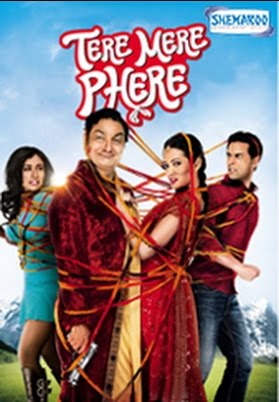
Movie Review: Tere Mere Phere (2011)

2 Stars (out of 4)

Buy the DVD at Amazon
Buy the soundtrack at Amazon

I don’t buy the premise that all married couples must fight. And when they do, I assume it’s usually over important stuff like money or child-rearing. Tere Mere Phere assumes that, not only do all married couples fight, but that even the pettiest of arguments can bring a couple to the brink of divorce. So much for the power of love.

Tere Mere Phere (“Our Wedding Vows”) begins several days into the unhappy honeymoon of Rahul (Jagrat Desai) and Pooja (Sasha Goradia). Flying home from their prematurely aborted road trip, they cause such a ruckus that their flight is forced to return to its departure airport.

Seeing Rahul and Pooja climbing in to their honeymoon camper van, fellow passenger Jai (Vinay Pathak) pulls a gun on them, demanding to be driven to the plane’s original destination. He has to make it to Shimla before his fiancée’s disapproving family can marry her to someone else. A few hours with incessantly bickering Rahul and Pooja convince Jai that marriage might not be worth it after all.

By introducing Rahul and Pooja at their most annoying, writer-director Deepa Sahi denies the audience the opportunity to relate to the couple. Rather than listening to them argue and thinking, “I’ve been there,” one looks at them and thinks, “Good grief, I’ve never been that obnoxious.”

There’s also something off about Sahi’s sense of what is funny. Not only are Rahul and Pooja unbearably irritating, but they don’t react appropriately to perceived slights. They blow up at each other over sitcom gender-role clichés — he’s messy; she’s too strict — but it’s played to comic effect when Rahul flirts with another woman to deliberately anger and humiliate Pooja.

It would be one thing if the bickering over inconsequential things were symptomatic of deeper problems, but flashbacks show the couple’s relatively smooth courtship. They’re actually cute as they joyously celebrate their perfect score on a magazine compatibility test. Sahi needed to show a lot more sweetness and a lot less combativeness between Rahul and Pooja to make them into a couple who deserve a happy ending.

Debutants Desai and Goradia don’t do their awkwardly-written characters any favors. Both actors seem to have studied at the School of Inappropriate Facial Expressions. When Rahul’s face is shown in a close-up, supposedly staring lovingly at Pooja, Desai’s intense grimace makes him look more like he’s planning to kill her.

Tere Mere Phere gets better performances from its more experienced actors. Vinay Pathak’s calm presence as Jai offsets Rahul & Pooja’s shrieking hysteria. Sushmita Mukeherjee is funny as Rahul’s overbearing mother, Seema.

But the real star of the film is the scenery. Shot in Himachal, Sahi wisely includes lots of shots of the region’s gorgeous mountains and rivers. For all their faults, at least Rahul and Pooja picked a nice place to honeymoon.

Links

Movie Review: Rascals (2011)

Zero Stars (out of 4)

Buy the DVD at Amazon
Buy the soundtrack at Amazon

Director David Dhawan is responsible for my worst Bollywood movie of 2009: Do Knot Disturb. Dhawan looks on track to reclaim the title this year with Rascals, a movie that exemplifies filmmaking at its laziest.

Let me start with a small example of the laziness that permeates Rascals. Early in the film, a tough guy named Anthony (Arjun Rampal) walks into a bar to watch a soccer game, and he places a bet on Brazil. Cut to the TV for a shot of the game, and it’s a game between Germany and Argentina.

A mistake like that wouldn’t have been a big deal if the movie was otherwise competently made. But here’s what it tells me about Dhawan’s level of respect for the audience: he has none. He thinks that moviegoers will be happy to spend two hours watching Ajay Devgn and Sanjay Dutt slap each other while Kangana Ranaut struts around in a bikini.

The problems stem from the crap story at the heart of Rascals. The plot is essentially a dumbed-down version of Bluffmaster!, but without a moral compass. Devgan and Dutt play Bhagat and Chetan (respectively), a pair of thieves who each independently steal from Anthony on the same day. Both flee to Bangkok, where they become rivals for the affections of Khushi (Ranaut).

Bhagat and Chetan spend the bulk of the film trying to thwart each other’s advances on clueless Khushi. Anthony doesn’t reenter the story until the last twenty minutes or so.

Rascals feels much longer than its two-hour runtime. Scenes are introduced without any set-up, and frequently without narrative purpose. Despite having two action stars as its leads, there are few action scenes, but lots of boring conversations between characters. Ranaut’s shrill delivery makes these scenes almost unbearable.

It’s not entirely Ranaut’s fault that her character so irritating. Khushi isn’t written to have any sort of depth or personality: she’s a dumb sex object, as is the only other major female character in Rascals, an escort named Dolly (Lisa Haydon).

A reliance upon stereotypes is another example of creative laziness in Rascals. Women are stupid and only good for sex; white women are particularly slutty (as evidence by the suspiciously high number of scantily clad, blonde backup dancers in Thailand); men are sex-crazed.

Not wanting to let an opportunity for casual racism slip by, Dhawan includes a scene in which Bhagat and Chetan are caught up in a bank robbery. The robbers are all black Africans. In Thailand.

I won’t go so far as to say that Dhawan is racist or sexist (though I can’t figure out why he thought it was cool to have Anthony vent his anger toward Bhagat and Chetan by slapping his innocent sister in the face). I just think he’s careless. Careless about the messages his movies send, not to mention careless about details.

Details like having the characters in Rascals celebrate Christmas just days after they celebrated Valentine’s Day.

Links

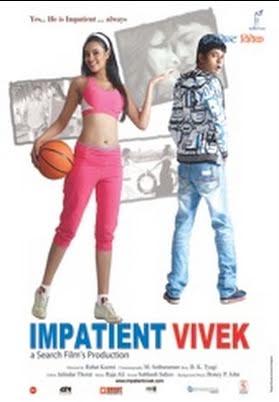
Movie Review: Impatient Vivek (2011)

Zero Stars (out of 4)

Buy the DVD at Amazon
Buy the soundtrack at Amazon

I’ve wracked my brain for something nice to say about Impatient Vivek. The best I’ve got is that writer-director Rahat Kazmi must be a talented pitchman, since he convinced someone to produce such a stupid movie. Impatient Vivek is so laughably bad that it nearly achieves so-bad-it’s-good status, thanks in large part to the most poorly translated English subtitles I’ve ever seen.

Impatient Vivek‘s problem stems from the fact that it has no plot, or at least not a plot in the traditional cinematic sense. It jumps right into the action without introducing the characters. Thus, it’s just confusing as the film begins with the titular Vivek (Vivek Sudershan) stealing money from his parents to take his nerd buddies on vacation to Goa, where they break into song.

What exactly is the audience supposed to feel at this point? All we know about the main character is that he’s a thief. Are we supposed to be happy for him?

Vivek falls for a girl named Shruti (Sayali Bhagat), who has no interest in him, likely because he attempts to woo her by communicating via a hand puppet. Two years pass, they meet again and she’s still not interested (probably because of his persistent interest in amateur puppetry).

In fact, Shruti’s engaged to some American guy. Her estranged older half-brother, Anu (Rannaoq Ahuja), returns to India from Canada to celebrate.

Suddenly, Anu becomes the focal point of the story. He tries to romance one of Shruti’s friends, and there’s a subplot involving Anu’s jealous half-brother. Shruti doesn’t reappear until Vivek kidnaps her on her wedding day, in yet another anti-heroic blunder.

When Shruti falls for Vivek — despite his being an immature criminal jackass — it just makes sense. It’s the natural conclusion to a movie in which a bunch of unlikeable characters behave in ways contrary to the ways real people behave.

The story isn’t the only problem in Impatient Vivek. The acting is uniformly terrible; the feeble attempts by the lead actors to muster tears are hilarious. Dance numbers are lame, sets look cheap and the editing is awkward.

But the highlights of Impatient Vivek are its nonsensical subtitles. The dialogue transcriber is clearly not fluent in English — and maybe not Hindi, either — as is evidenced by innumerable grammatical errors, misspellings and a general failure to convey meaning. For example:

“Anu become hero here to came from foreign.”

Huh? Given the amount of translation needed from broken English into actual English, I might’ve had an easier time figuring out what was being said if I’d ignored the subtitles and just used my own Hindi-English dictionary, instead.

Links

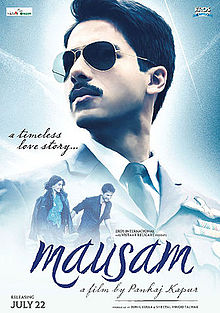
Movie Review: Mausam (2011)

1 Star (out of 4)

Buy the DVD at Amazon
Buy the soundtrack at Amazon

In the film industry, a “logline” is a single sentence that summarizes a movie’s plot. It’s an effective way to pique an audience’s interest or pitch a story to investors. Take Die Hard, for example: A cop’s attempt to reconcile with his ex-wife is derailed when her office building is taken over by terrorists.

Loglines aren’t unique to Hollywood; many great Indian movies can be succinctly summarized as well. Chak De India: The Indian Women’s Field Hockey team must overcome their own internal struggles before they can take on the rest of the world.

I’ve tried to craft a logline for Mausam, and I can’t do it. I don’t know what Mausam is about. Okay, I obviously know that it’s about two young people whose fondness for each other spans decades. So what?

In my example loglines for Die Hard and Chak De India, the conflicts that fuel the plots of both films are contained within the sentences. John McClane is at odds with both his ex-wife and the terrorists. The women’s hockey team fights internal and external battles.

Mausam‘s biggest problem is that it has no conflict. There’s no reason why the lead characters, Harry (Shahid Kapoor) and Aayat (Sonam Kapoor), can’t be together. Their parents don’t object, they’re not engaged to other people, they’re not driven apart by war or culture. Rather, their budding romance is stymied by minor obstacles and a lack of communication.

Harry and Aayat begin falling for one another in Harry’s village in Punjab, where Aayat has moved to escape violent riots in Kashmir. Then Aayat leaves in the middle of the night, without so much as leaving a note for Harry.

Seven years later (in 1999), Aayat and Harry meet again in Scotland. Actually, she spots him first but doesn’t say anything. She waits for him to notice her among all the women in Edinburgh, even though he has no reason to suspect she’d be there.

Her explanation for why she fled so suddenly years earlier? Her dad phoned and asked her to join him in Mumbai. No emergency, and she wasn’t in danger, she just moved house in the matter of a few hours on a moment’s notice.

The couple appear to be on their way to marriage when, this time, Harry is abruptly called away without time to contact Aayat.

Aayat’s excuse for not contacting Harry is difficult to believe, but Harry has no excuse at all. He has Aayat’s cell phone number, her home phone number and her home address. Rather than call Aayat to tell her why he had to leave, he phones his sister in Switzerland and tells her to go to Scotland (without calling first) and meet Aayat in person to explain what happened. Of course, Aayat has herself moved to parts unknown by then.

Harry and Aayat meet several times in subsequent years before they finally commit to a future together during a preposterous action-packed climax. The finale is so stupid, I laughed out loud.

What makes the silliness of actor Pankaj Kapur’s directorial debut such a shame is that Mausam is a great-looking movie. Harry’s hometown is a charming village out of time. There are a number of breathtaking set pieces, as when Harry races on his bicycle to catch Aayat’s departing train. Closeups of Sonam Kapoor — who’s plenty cute on her own — make her look angelic.

Kapur might yet have great success as a director, so long as someone else writes the screenplay.

Another problem that will only affect international audiences is that Mausam‘s English subtitles are translated too literally, something that doesn’t work given the different sentence structures of Hindi and English. Consequently, the jokes aren’t funny, and one must spend so much mental energy reconstructing the words into meaningful sentences that it distracts from the action on screen.

Overall, Mausam proves that style doesn’t trump substance. As gorgeous as it looks, Mausam is too boring and silly to warrant the nearly three hours of attention it requires.

Links

Movie Review: Chalo Dilli (2011)

2 Stars (out of 4)

Buy the DVD at Amazon
Buy the soundtrack at Amazon

Chalo Dilli is a road trip comedy in which a mismatched pair of strangers are forced to rely upon each other to reach their destination. It’s basically Planes, Trains and Automobiles, only with Steve Martin’s uptight character played by a woman.

That woman is Lara Dutta, who also produced the movie. Dutta plays Mihika, a picky investment banking executive used to getting things her way. She heads to the airport in Mumbai wearing a tight skirt and high heels that look as uncomfortable for air travel as they will be for her inevitable trek through the hinterlands.

Mihika’s journey is disrupted by Muna (Vinay Pathak), a crude cloth merchant with a chivalrous streak. His incessant yammering on the plane prompts Mihika to put on headphones, causing her to miss the announcement that the flight to Delhi has been diverted to Jaipur.

What should be a six-hour drive back to Delhi turns into an overnight adventure for Mihika and Muna, who assumes the role of chauffeur when the driver Mihika has hired falls asleep. The car breaks down, and the odd couple spend many hours together making their way to Delhi any way they can.

This premise should work particularly well in India, with its stark contract between urban and rural environments. The contrast sets up plenty of fish-out-of-water scenarios for city-bred Mihika, who starts the movie disgusted at the thought of flying on a “budget” airline instead of in first class.

But the movie never takes full advantage of its opportunities for comedy. None of the situations Mihika and Muna find themselves in are especially unusual or outrageous. The people they encounter are generally normal and helpful. It makes for a boring trip.

Mihika does get to wake up to a beautiful sunrise in the country and meet friendly locals, which is supposed to open her eyes to Muna’s somewhat odd life wisdom: Don’t sweat the small stuff, because there’s probably something much more serious in your life that you should be worried about.

As much as Chalo Dilli fancies itself an uplifting film, it isn’t really. Manu’s happy-go-lucky demeanor masks an inner pain that manifests itself in cruel jokes at his wife’s expense. The final scene between Mihika and Manu is uncomfortable to watch.

Rather than ending there, the movie tacks on an epilogue montage voiced-over by Mihika detailing the ways the lives of the villagers she and Muna encountered were improved by the experience. The movie gives the contradictory message that the simple life is beautiful, but not so perfect that it can’t be improved by a little attention from some city dwellers.

Chalo Dilli also takes a conflicted view of gender equality. Mihika and Muna argue after he wonders why so many men would be willing to work for her. She accuses him of believing that women should stay home and have babies. So what does Mihika decide to do in the epilogue? Stay home and have babies.

If Mihika had expressed career or life dissatisfaction earlier in the movie, perhaps the choice would’ve made sense. But it’s quite a leap from Mihika making a small gesture, such as delaying a business trip in order to attend a party, to her chucking her whole career to have kids. Axe the unnecessary epilogue and this mixed message isn’t an issue.

Links

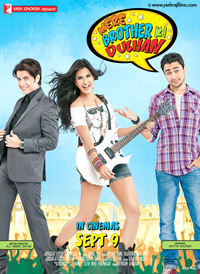
Movie Review: Mere Brother Ki Dulhan (2011)

3.5 Stars (out of 4)

Buy or rent the movie at iTunes
Buy the DVD at Amazon
Buy the soundtrack at Amazon

Katrina Kaif and Imran Khan have been established Bollywood stars for years, but this has been something of a breakout summer for both of them. Kaif scored big at the box office with Zindagi Na Milegi Dobara, and Khan showed serious comedy chops in Delhi Belly.

Headlining Mere Brother Ki Dulhan (“My Brother’s Bride”), Kaif and Khan seem their most at ease in front of the camera. Not only do they share a charming chemistry, but they give two of their strongest individual performances to date.

Khan anchors Mere Brother Ki Dulhan (MBKD, henceforth) as Kush, an aspiring director in India who gets an odd request from his brother in London, Luv (Ali Zafar). Having broken up with his longtime girlfriend, Piali (Tara D’Souza), Luv decides to entrust his romantic future to Kush. Luv asks his younger brother to find a nice Indian girl for him to marry.

Kush enlists his parents and friends to scour Dehradun for a bride for Luv. The ideal candidate turns out to be a reformed party girl named Dimple (Kaif), whom Kush met years earlier during her wilder days. She describes her qualifications thusly: “I am correctly beautiful and appropriately sexy.” She gets the gig.

Predictably, Kush and Dimple fall for each other as they make wedding preparations. Only after Luv arrives do they acknowledge the problem: she’s about to marry the wrong brother.

The fact that MBKD feels a bit like something we’ve seen before is actually its strength. Debutant filmmaker Ali Abbas Zafar (who’s not the Ali Zafar who plays Luv) clearly set out to make a feel-good romantic comedy, and he achieved his goal.

To play up the familiarity, the opening dance number pays homage to some famous Bollywood routines of the recent past. There are plenty of dance numbers, and all of them are entertaining and well-integrated into the plot.

A few slightly unexpected tweaks to the formula are a nice surprise. While Kush is the film’s main character, Dimple does more to drive the story forward. She’s not a passive damsel in distress, but rather an impatient problem solver whose impulsiveness gets her into trouble.

In another unexpected twist, MBKD doesn’t have a villain. I kept waiting for Luv to reveal himself to be an oaf, or for Piala to turn into a “crazy ex-girlfriend,” but all of the characters are nice people. The situation — not the characters — provides the conflict. It’s tricky to pull off, but Abbas Zafar handles it well.

The advantage of this approach is that the story doesn’t get bogged down in maudlin montages of Kush and Dimple staring forlornly into the rain as a singer laments the cruelty of fate. Rather, the lovebirds recognize a problem and set about fixing it.

The lone complaint I have about the movie is that several jokes depend on cultural references that American audiences likely don’t share. There are repeated references to Complan, which I learned after the movie is a British nutritional supplement. (See Ricky’s comment below for a more complete explanation of the Complan references.) This isn’t a reason to avoid the film, but American moviegoers should know in advance that they won’t get all the jokes.

Links

Movie Review: That Girl in Yellow Boots (2011)

3.5 Stars (out of 4)

Buy the DVD at Amazon

Note: This movie has no MPAA rating, but it is most definitely for adults only.

Ruth, the title character in That Girl in Yellow Boots, is a puzzle. She’s brave and forthright, yet she subjects herself to conditions unimaginably grim — embarking on a humiliating, painful quest in search of a goal that, were it not so personal, would hardly seem worth pursuing.

Ruth (Kalki Koechlin) leaves England for India to search for her father, a man she doesn’t remember and who her mother has painstakingly erased from their lives. A letter written to Ruth by her father expressing a desire to meet her proves unusually difficult to trace.

Unable to get an official Indian work permit, Ruth works in a disreputable massage parlor performing sex acts, using the proceeds to bribe officials to extend her travel visa. Being a white woman alone in India makes Ruth both a novelty and an object of desire. Her growing knowledge of Hindi puts her in the odd position of being neither a local nor a tourist.

The lone bright spot in Ruth’s life is not her druggie boyfriend, Prashant (Prashant Prakash), but Diwakar (Naseeruddin Shah), the only client who actually comes to Ruth just for the massage. He’s the father figure she’s been looking for, if only she could put aside her quest.

As the conditions of Ruth’s life go from bad to worse, it’s hard not to ask: Why? Why not give up the search? Why not go home, make some money doing something more dignified and resume the search later? But by the time we meet Ruth, she’s sacrificed so much that she seems unable to stop.

There’s also the question of why her father hasn’t made more of an effort than just writing a letter. If Ruth succeeds in finding him, can he possibly be worth the effort it took?

Koechlin is amazing as Ruth. The camera (behind which sits her real-life husband, director Anurag Kashyap) lingers on Ruth’s face, her blank expression showing the price she’s chosen to pay, shutting off her emotions while she seeks the one person she believes will love her without wanting anything in return.

Koechlin co-wrote the screenplay with Kashyap and used experiences from her own life to flavor Ruth’s world. Raised in India by French parents, Koechlin says she remembers being treated at times as though her skin color indicated an amoral character. Note that, in the movie, the other masseuses at the parlor are blonde.

That Girl in Yellow Boots is not fun, but Koechlin’s performance and Kashyap’s tense and thoughtful directing make watching it a worthwhile experience.

Links

Movie Review: Bodyguard (2011)

2 Stars (out of 4)

Buy the DVD at Amazon
Buy the soundtrack at Amazon

If a film’s quality was measured by the delighted shrieks of women in the audience, Bodyguard would be the greatest movie of all time. The women at my screening went bonkers every time Salman Khan flexed a bicep or busted a dance move. When a firehose blasted Khan’s shirt off his body, I feared a riot.

Sadly, there’s little else going for Bodyguard besides Khan’s buff physique.

It’s not fair to compare all of Khan’s movies to last year’s hit, Dabangg, but that movie showed just how good Khan can be when he’s allowed to play a character who’s in on the joke: no one is as honest, charismatic or freakishly strong as the characters Khan normally plays.

Bodyguard feels like a step back. It’s as though the filmmaker, Siddique, didn’t trust the audience enough to buy Khan as more than the super-heroic caricature he’s played countless times before. Either that, or Siddique didn’t know any other way to write for the superstar.

Khan plays Lovely Singh, Mumbai’s best bodyguard. He’s so devoted to his work that he doesn’t have a personal life. Right off the bat, he saves a bunch of girls from human traffickers, causing a large amount of carnage in the process. An over-reliance on CGI effects makes the fight less impressive than it could have been.

The traffickers Lovely stops have it in for benevolent rich guy Sartaj (Raj Babbar) and put a hit on his daughter, Divya (Kareena Kapoor). Lovely agrees to serve as Divya’s bodyguard until she finishes college and moves to London. Sartaj’s only condition is that Lovely not tell Divya she’s in danger.

Lovely’s stern manner embarrasses Divya and her best friend, Maya (Hazel Keech), and the girls try to get him to loosen up. Divya invents an alter-ego, “Chhaya”, and sets about wooing Lovely over the phone. He falls for his pretend paramour and begins to let his guard down, potentially endangering Divya in the process.

For the first hour and forty-five minutes, Bodyguard is an amusing — if uninspired — action movie with a romantic subplot. But, after the bad guys have been vanquished, the attempt in the final half hour to wrap up the romance storyline comes out of left field.

While I’m all for breaking with tradition, it has to be done with an understanding of why the tradition exists in the first place. For example, when two characters fall in love, it has to be for reasons other than the fact that the movie would end on a down note if they didn’t. The ending to Bodyguard tries to buck tradition and just winds up absurd and tacked-on.

Though the music and dance numbers are pretty good (especially “Teri Meri”, the video of which I’ve embedded below), the rest of Bodyguard feels stale. Jokes at the expense of dwarves, gays and the morbidly obese are crude and tired. As usual, Khan beats up the bad guys and Kapoor looks beautiful and stylish; there’s nothing to stretch them as actors. A shame, since there’s a lot of talent between them.

Links