Tag Archives: Movie Review

Movie Review: Ek Main Aur Ekk Tu (2012)

3 Stars (out of 4)

Buy or rent the movie at iTunes
Buy the DVD at Amazon
Buy the soundtrack at Amazon

It’s a bad sign when the words “The Beginning” appear on screen at the end of a movie, just before the closing credits roll. If this is only “the beginning,” what was I watching for the last two hours? It’s a cop-out.

Ek Main Aur Ekk Tu (“One of Me and One of You”) ends with “The Beginning.” It’s disappointing because the first 95% of the movie is really, really good. I enjoyed myself so much while watching it that the lame way the story concludes made it feel like I had the rug pulled out from under me.

Let me focus on the good first, which is nearly every part of the movie. The protagonist in Ek Main Aur Ekk Tu (EMAET, henceforth) is Rahul (Imran Khan), the average son of snobby parents who routinely make it clear that he is a disappointment. When he loses his job at a Las Vegas architecture firm, he elects not to tell them.

Rahul meets fun-loving Riana (Kareena Kapoor), a similarly unemployed hairstylist. Since they are both alone on Christmas Eve, Rahul reluctantly agrees to let Riana take him out on the town. They get drunk and get married.

The next morning, they amicably agree to get their marriage annulled. Again reluctantly, Rahul lets broke, disorganized Riana stay in his meticulously clean apartment. Friendship blossoms as Rahul finally finds in Riana someone who does not think he’s a failure.

There’s little conflict in Rahul and Riana’s relationship, but that’s a good thing. They are both nice people, their only faults being that Rahul is overly fearful of making mistakes and Riana a bit oblivious to her more annoying habits. From Raina, Rahul gets the validation he’s never gotten from his parents, and Raina is happy to make him happy.

Khan and Kapoor are completely charming and succeed in making Rahul and Riana realistic characters. Their restraint adds to the movie’s humor: Khan gets more laughs out of a single raised eyebrow than any of the frantic, screaming characters in the Housefull 2 promo that preceded EMAET. Debutant director Shakun Batra gets the tone exactly right for a romantic comedy.

As much as I appreciate a movie that resists the urge to force conflict into a story, about three-fourths of the way into EMAET, I started to wonder, “What’s the catch?” Rahul and Raina can’t just stroll into their happily ever after, can they? Is she hiding something? Will he compromise his new self-confidence to placate his parents?

When the hiccup in Rahul & Riana’s otherwise perfect relationship finally arises, it does so without enough time left in the film to adequately deal with it. Hence “The Beginning.” It’s a profoundly unsatisfying conclusion, especially since all of the signs pointed to the adorable couple getting their tidy “happily ever after.”

I admire filmmakers who take risks with their storytelling — though audiences do have certain expectations of rom-coms released in time for Valentine’s Day — but the risks have to feel warranted. The ultimate resolution to Rahul & Riana’s story feels unrealistic and unfair. I wanted a better ending for characters I’d come to like so much.

Links

Movie Review: Ghost (2012)

Zero Stars (out of 4)

Buy the DVD at Amazon

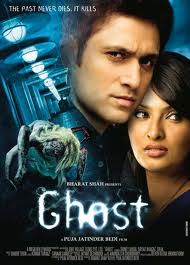
Rare is the movie that manages to get everything wrong, lacking a single attribute of a successful film. Ghost is that movie: a film so pathetically executed as to be an object lesson in how not to make a movie.

Ghost is a horror movie (not a remake of the American film), though what kind of horror movie is unclear. Supernatural thriller? Monster movie? Spiritual lesson? Torture porn?

Of course a single film can use elements of all the above horror sub-genres, but debutant writer-director Puja Jatinder Bedi is so unfocused in her storytelling style that I’m not even sure she knows what kind of movie she’s making. There’s no consistency of theme or message, no continuity, and it’s not even clear who the main character is.

Ghost opens with the grisly murders of a doctor and a nurse initially seen having sex in a hospital lavatory. When they are discovered by pious Dr. Suhani (Sayali Bhagat), it seems likely that the film is meant to be a spiritual parable about the dangers of sin.

In case that message isn’t clear enough, the opening credits are subtitled with the following text: “Christ represents the divine life power that illuminates and liberates the soul from the evil powers of Satan. O SONS OF ADAM AWAKEN AND EMBODY CHRIST WITHIN YOU.”

The divine punishment angle quickly falls apart, as it becomes clear that the two deaths (and the ones to follow) are the work of a vengeful spirit, not acts of divine judgment.

Freelance detective Vijay (Shiney Ahuja) investigates the murders and discovers that the spirit is likely that of a murdered hospital intern, the subtly-named Mary Magdallen (Julia Bliss).

Mary is Vijay’s wife, of whom he has no memory thanks to a mild head injury, of which he also has no memory. In fact, he seems unaware of having a memory gap of however long it took him to fall in love, get married, and have his wife die. Apparently, he has no friends either, because I’d wager that one of them might have let slip at some point that Vijay has (or had) a wife.

Since everything about Ghost stinks, I’m going to focus on a few of its worst offenses. First is a pet peeve of mine: casting actors with inappropriate accents. Mary is supposed to be Australian, but Bliss is Russian and sounds it. Either make the character Russian, or cast a different actress.

Next is the way the movie fetishizes violence against women. The whole movie is gory, but flashbacks of Mary’s murder-by-torture and her body’s subsequent dismembering are shown in almost loving detail. As a woman, director Bedi should have exercised better judgement and not pandered to the base desires of misogynists.

The most egregious offense in Ghost is its silly perversion of religion for tawdry thrills. Christian imagery pervades the film: Mary’s name and the details of her murder (hint: a cross is involved), “plagues” of frogs and locusts at various crime scenes, a computerized artist’s rendering of Hell, etc. The imagery symbolizes nothing and makes little sense in the context of the film. I think it’s just there to show that the filmmakers have read the Bible — or, more likely, stopped by a Sunday School class once or twice.

At the scenes of two murders, Monster Mary is accompanied by a cryptic figure, whose left half resembles Jesus and right half resembles a devil. The figure’s significance is unclear and is never discussed. The film ends with a shot of Mary in her appealing mortal form, hugging Jesus (regular Jesus, that is; not the half-Jesus-half-devil guy).

Are we supposed to believe that Jesus — Mr. Forgiveness — is cool with one of his acolytes exacting bloody revenge from beyond the grave? Wasn’t one of the whole points of Jesus’ existence to convey that revenge is God’s domain and that forgiveness is a path to salvation?

If I were a Christian, I might be offended. But Ghost is so stupid and inept that taking its offenses seriously gives it more credit than it deserves.

Links

  • Ghost is available for free on Mela‘s iPad app until February 10
  • Ghost at Wikipedia
  • Ghost at IMDb

Movie Review: Agneepath (2012)

2 Stars (out of 4)

Buy or rent the movie at iTunes
Buy the DVD at Amazon
Buy the soundtrack at Amazon

Revenge thrillers seem easy to make because of the assumption that everyone can relate to the desire to avenge a loved one’s wrongful death. But being able to relate is not the same as caring, and writer-director Karan Malhotra doesn’t give the audience a reason to care whether the protagonist gets his revenge.

The story in Agneepath (“Path of Fire,” a remake of a 1990 film by the same name) centers on Vijay (Hrithik Roshan), who, as a 12-year-old boy, witnessed the murder of his pacifist father at the hands of Kancha (Sanjay Dutt), a drug lord intent on turning their quiet island of Mandwa into a hub of cocaine production.

Fifteen years later, Vijay is the right-hand man of Mumbai drug lord Rauf Lala (Rishi Kapoor). The unusual career move is part of Vijay’s convoluted long-term plan to acquire enough power to challenge Kancha and kill him, though it estranges him from his mother and young sister.

Agneepath is wonderfully atmospheric and beautiful to look at. Kancha lives in a dilapidated, evil-looking mansion decorated in deep blues and greys. Vijay’s sweetheart, Kaali (Priyanka Chopra), is depicted surrounded by vivid reds and cheerful colors. But the stunning visuals can’t distract from a story and characters that feel underdeveloped.

I’m willing to accept that Vijay chooses a method of revenge more complicated than 1) return to Mandwa, 2) shoot Kancha, in order to relay a parable about not abandoning one’s principles. But, for the parable to be effective, Vijay has to be a good guy at his core. I’m not convinced that he is.

Sure, he donates money to the impoverished residents of his neighborhood, but so does Rauf Lala. It’s an easy way for mafia dons to ensure that folks ignore their nefarious activities, and Lala is worse than most.

In addition to peddling drugs, Lala runs a sex-trafficking operation, selling young girls to the highest bidder. Not until Lala is hospitalized — and after Vijay has made himself Lala’s heir-apparent — does Vijay set the captive girls free. So, for fifteen years, Vijay turned a blind eye, as girls younger than his own sister were sold into prostitution. Not exactly the actions of a hero.

A bigger problem than whether Vijay really is Robin Hood at heart is that there’s not much character development to speak of. We just don’t know much about him. What does a sweet girl like Kaali see in Vijay? Why does righteous police inspector Gaitonde (Om Puri) have a soft spot for him?

Despite the movie being nearly three hours long, it feels as though the characters — especially Kaali and Kancha — have little to do. It’s an unfortunate waste of a talented cast. All of the emotional scenes are reserved for the final hour of the movie, well after the window for character development has closed.

The movie on the whole is terribly violent, particularly a machete killing spree performed by transvestite prostitutes. There are a couple of vibrant and entertaining dance numbers, including a cameo by Katrina Kaif, but they aren’t worth enduring the rest of Agneepath‘s overly-long story.

Links

Movie Review: Soundtrack (2011)

2 Stars (out of 4)

Buy the DVD at Amazon

During the closing credits for Soundtrack, a note onscreen reads: “Inspired by the movie It’s All Gone Pete Tong.” Reading the plot summary for It’s All Gone Pete Tong at Wikipedia reveals that Soundtrack is more of a beat-for-beat imitation.

When a book is turned into a film, the credits typically read “Based on a novel by…”, thereby acknowledging that someone else deserves credit for writing the original story.  I’m not suggesting that there’s anything nefarious in Soundtrack‘s appropriation of another movie’s plot, but there’s something unsavory about acknowledging it in such an offhand way.

The good thing about writer-director Neerav Ghosh basing Soundtrack on a previously successful movie is that he has a solid structure to work with. As a result, Soundtrack is watchable. It’s reasonably well-paced, and plot points occur when we instinctively want them to occur.

Where Soundtrack falls short is in the construction of the main character, Raunak Kaul (Rajeev Khandelwal). Raunak is a DJ who moves to Mumbai hoping to strike it rich. He quickly does, thanks to his uncle’s contacts at a popular nightclub. Soon, Raunak is up to his eyeballs in booze, drugs and women eager to sleep with him.

After a period of debauchery, a combination of lifestyle factors and genetics causes Raunak to go completely deaf. He breaks down, only to gain a new purpose in life, with the help of his lip-reading instructor, Gauri (Soha Ali Khan).

Soundtrack‘s effectiveness depends entirely upon the degree to which the audience sympathizes with Raunak, and there’s little reason to care about him. He’s an angry ingrate who’s already an alcoholic before he gets to Mumbai. He gets the life of sex, drugs, and rock n’ roll that he wants and enjoys it while he’s able, even though his addictions make him unreliable.

It’s hard to feel bad for a character who is both unlikable and the cause of his own problems. Ghosh never gives Raunak his “save the cat” moment: an action that lets the audience know that the character is really a good guy, in spite of appearances.

Gauri’s character is also underdeveloped. She serves as a plot device to get Raunak back on the right moral track. Her character is supposed to have been born deaf, but she merely speaks with a lisp, not the way those born deaf actually talk. It’s a missed opportunity to add realism to her character.

Links

Movie Review: Luv Ka The End (2011)

1 Star (out of 4)

Buy or rent the movie at iTunes
Buy the DVD at Amazon
Buy the soundtrack at Amazon

Luv Ka The End (“The End of Love”) is the first movie released by Y-Films, a subsidiary of the venerable Yash Raj Films aimed at producing youth-oriented movies. In its style and content, Luv Ka The End appeals to a generation of kids more interested in films from Hollywood than from Bollywood. But the movie has such a dismissive view of sexual violence toward women that it can’t be recommended.

The teen sex comedy opens on the final day of junior college for Rhea (Shraddha Kapoor) and her best friends, Jugs (Pushtiie Shakti) and Sonia (Sreejita De). Rhea intends to consummate her relationship with her boyfriend, Luv (Taaha Shah), that night, which happens to be the eve of her eighteenth birthday.

By chance, Rhea and her friends discover that Luv is the leading scorer in an online points-for-sex game. Taking Rhea’s virginity and posting video proof would cement Luv’s victory. The girls set about taking revenge on Luv before the night’s big end-of-the-school-year bash.

The predictable revenge story — where does one buy itching powder anyway? — takes up the bulk of the film and drags on longer than necessary. It’s not bad, just not as cool as the whimsically-named director Bumpy thinks it is.

Things quickly fall apart after the girls finish their mischief-making, and the tone of the film changes from light-hearted to sinister. Fair warning, spoilers ahead.

At the party, Rhea lures Luv into a bedroom rigged with video cameras, intent on humiliating him as the partygoers downstairs watch on monitors. Luv turns the tables on Rhea and ties her to the bed, threatening to broadcast her rape over the Internet.

The revolting scenario is interrupted so that a few of the side characters can make jokes. It’s appalling that the screenplay trivializes sexual violence against women by trying to lighten the mood with humor. Meanwhile, no one at the party besides Jugs and Sonia try to rescue Rhea, as everyone watches the horrifying scene on the monitors. Not even the local news crews that are on-hand to cover the party make an effort to prevent the potential rape that is occurring just upstairs from them.

Compounding the insult to women everywhere is that, within minutes of escaping Luv (to the tone-deaf cheers of the unhelpful partygoers and news crews), Rhea dances at a concert by her favorite singer. When that singer — played in a cameo by Ali Zafar — asks Rhea on a date, she says yes. That’s simply not the way someone who just survived an attempted sexual assault would react.

It’s a disappointing end to what is, for the most part, a pleasant enough film. It distracts attention from the talented cast of young actors, all of whom do a nice job with their narrow characters, and who outshine the adults in the cast.

*Luv Ka The End is currently available on Netflix streaming.

Links

Movie Review: Players (2012)

3 Stars (out of 4)

Buy the DVD at Amazon
Buy the soundtrack at Amazon

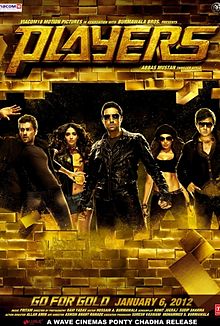
With source material as rich as not one, but two, versions of The Italian Job to draw from, Players should be a slam dunk. Wisely, filmmaking duo Abbas-Mustan take the best aspects from their inspiration and add enough new touches to make it an enjoyable Indian action flick.

My biggest fear before seeing Players was that it wouldn’t be able to hold interest for 2 hours and 47 minutes. But Players is about as well-paced as a nearly three-hour-long movie can be, hitting plot points at the right times so as not to let the action drag.

Abhishek Bachchan anchors the film as Charlie Masceranas, a career thief. He learns from a dying friend about the Russian government’s plans to transfer a large amount of gold bars to Romania. With the help of his imprisoned mentor, Victor (Vinod Khanna), Charlie assembles a team of experts to execute a daring heist.

The team includes Charlie’s sometimes girlfriend, Riya (Bipasha Basu), master of disguise Sunny (Omi Vaidya), explosives expert Bilal (Sikander Kher), illusionist Ronnie (Bobby Deol) and a hacker named Spider (Neil Nitin Mukesh).

So as not to appear to condone thievery, the filmmakers give the crew corny motivations for stealing the gold. Charlie wants to fulfill Victor’s dream of opening India’s largest orphanage. Ronnie, a former magician, wants to build a fully automated house for his daughter, who was accidentally paralyzed during one of his tricks.

Ronnie gets some unintentionally hilarious lines when he explains the end of his stage career: “Magic doesn’t do anything. It only ruins lives.”

Thankfully, Sunny, Bilal, Spider and Riya are just in it for the money. When the plan goes awry, Victor’s daughter, Naina (Sonam Kapoor), comes to Charlie’s aid.

There are some nice interactions between the team members. Sunny and Bilal are funny sparring partners, and Naina’s crush on Charlie creates tension between her and Riya. Charlie is the anchor, but this really is an ensemble film.

Besides the star cast, the movie’s main attractions are its action sequences. The gold-theft scene is tense, and the car chases are pretty good. Strange editing and artificially sped-up shots keep the fight scenes from looking their best, but interesting locales like Russia and New Zealand elevate the whole experience.

A tendency toward corniness pervades Players, to its detriment. It keeps the film from achieving the snappy sophistication of the films that inspired it. In addition to Charlie’s and Ronnie’s Robin Hood motivations, the score heavy-handedly tries to provoke emotions.

The most pandering element in Players is the needless inclusion of comic actor Johnny Lever, a regular feature in Abbas-Mustan films. I don’t find Lever funny, or more accurately, I don’t find the outrageous characters he always plays funny. That directors feel the need to pair his appearances with wacky sound effects just makes things worse. Any spell the movie could hope to cast is broken when Lever appears onscreen.

Another element that can’t be overlooked is how pointedly the movie targets a male audience. Basu and Kapoor both have a couple of forgettable dance numbers requiring to them to gyrate in skimpy dresses. Another female character is viewed through frosted glass as she showers. Almost every Anglo woman in the movie is kitted out in hot pants.

Yet the male stars aren’t required to doff their clothes, apart from a brief scene featuring Mukesh in a bubble bath. Bachchan and Deol are regular romantic leads, and Kher is clearly fit. Why not work in a shirtless shot of one of them, in the name of gender equality?

The thread of sexism isn’t limited to who’s asked to expose the most skin. Naina and Riya are both asked to play the role of seductress to aid the team, which features five men (six, including Victor) and only two women. Language denigrating women goes largely unchallenged by the male heroes.

That said, Players works as an action film. It hits the right notes often enough to sustain excitement for almost three hours, which is the primary objective of any action movie.

Links

Movie Review: Don 2 (2011)

2.5 Stars (out of 4)

Buy the DVD at Amazon
Buy the soundtrack at Amazon

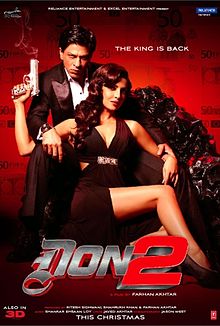
2006’s Don was the first Hindi movie I saw in a theater, so it has a special place in my heart. It is a fun thriller with a sense of humor. Don 2 doesn’t do its predecessor justice.

In fact, Don 2 hardly even acknowledges the movie that spawned it. Sure, the international supervillain/anti-hero Don (Shahrukh Khan) is back, as is his archrival, Vardhaan (Boman Irani), and the cops Malik (Om Puri) and Roma (Priyanka Chopra). But five years have passed since the audience last saw this group together.

A few lines of dialog explaining Roma’s desire for justice — in the last movie, Don tricked her into falling in love with him after killing her brother — would’ve been helpful reminders for the audience. The movie’s few indirect references to past events are meaningless to anyone who missed the first movie.

Don 2 opens with a European drug kingpin putting a hit on Don. This sets up a huge fight scene in Thailand, but the storyline is subsequently dropped until the very end of the film. Surely, there must have been a way to trigger a fight scene in a way that relates to the rest of the plot.

The story truly begins when Don gets himself thrown into a Malaysian jail in order to help the imprisoned Vardhaan escape. Don wants to steal some money-printing plates from a bank in Germany, and Vardhaan has information that can be used to blackmail one of the head bankers. The former enemies put aside their mutual hatred and work together.

The story of the heist is amusing enough, and the cast members act their parts well. But the whole affair feels underwhelming, due primarily to the film being presented in 3D.

3D has the effect of dimming the images on screen, so Don 2 lacks the vibrancy of recent Excel Entertainment productions like Game and Zindagi Na Milegi Dobara. It’s a shame not to be able to see Thailand, Switzerland and Germany in their usual splendor. The 3D also dims the tiny English subtitles to near illegibility.

Apart from one exciting car chase through Berlin, there aren’t enough scenes that warrant the addition of 3D. Fight scenes in close quarters feel muddled by the effect, and the gimmick doesn’t enhance the story.

More disappointing than the lackluster visuals is the lackluster story, specifically Roma’s role in it. The film emphasizes a lingering romantic tension between Roma and Don but drops the ball in regard to her real reason for being in the film: she’s foremost a police officer intent on catching a notorious criminal. As she’s written, she’s not a very good police officer.

Roma is not only a step behind Don at all times, she’s a step behind the audience. She struggles to discern the identity of a man in a police sketch so accurate it might as well have the guy’s name written on it. The two times she manages to “capture” Don, it’s not a result of her police work. The first time, he turns himself in. Later, he’s ratted out by a co-conspirator.

It’s a real disservice to Chopra that her character is so poorly written. In Chopra’s hands, Roma is tenacious yet likeable, and handy in a fight. Lara Dutta’s moll character, Ayesha, similarly could’ve been better developed.

The experience of watching Don 2 isn’t entirely unpleasant. It’s a mostly-competent heist movie that gives a nod to earlier films in the genre, particularly in terms of its evocative musical score. But it could have — and should have — been so much more.

Links

Movie Review: Ladies vs. Ricky Bahl (2011)

2.5 Stars (out of 4)

Buy or rent the movie at iTunes
Buy the DVD at Amazon
Buy the soundtrack at Amazon

There’s a decent romantic comedy buried within Ladies vs. Ricky Bahl. Unfortunately, one has to slog through the interminable opening hour of its 140 minute runtime to find it.

Briefly put, Ladies vs. Ricky Bahl is about three women who get revenge on a conman. Rather than get right to the revenge, however, the movie shows, in tedious detail, how each of the women is taken for various amounts of money by Ricky Bahl (Ranveer Singh), a grifter who goes by the aliases Sunny, Deven, Iqbal and Vikram.

In fact, the opening credits don’t even run until twenty minutes into the film, after “Sunny” tricks a naive, spoiled brat named Dimple (Parineeti Chopra) into falling for him. After he makes off with Dimple’s dad’s money, Sunny changes his name to Deven and tricks a businesswoman named Raina (Dipannita Sharma) into buying a bogus painting.

When Raina and Dimple are contacted by a third conned woman, textile shop owner Saira (Aditi Sharma), the three team up to get their money back. They hire a beautiful and uncommonly persuasive salesgirl, Ishika (Anushka Sharma), to trick Ricky into returning their stolen funds.

This is when the story finally gets interesting, but it’s an hour into the film. Up to this point, the plot is simultaneously predictable and directionless. It’s obvious how each of Ricky’s cons is going to end; the only mystery is why we need such a large volume of set-up material.

It’s also a huge mistake to keep the film’s biggest asset — Anushka Sharma — under wraps for so long. Sharma has an infectious smile and an undeniable charm. Her ease in front of the camera has elevated every film she’s starred in during the course of her brief career.

Singh is a perfectly suitable leading man, particularly for Yash Raj Films’ particular brand of light, popcorn fare. Singh’s got a killer smile as well, his hair looks great when a high-powered fan is directed at it, and his muscled torso is manscaped within an inch of its life. But that’s probably not enough to warrant anchoring a film when a legitimate superstar like Anushka Sharma is in the cast.

And let’s not forget that Ricky is a conman. We want to see him get his comeuppance at the hands of someone we like. That’s Ishika, someone who’s similarly clever but earns her paycheck legally. She enters a grey area by accepting the ladies’ job, but that makes her interesting, not a criminal. Ishika has the most room for growth, so she should be the main character, not Ricky.

The rest of the titular ladies carry off their somewhat narrow roles well. Notable is newcomer Chopra (actress Priyanka Chopra’s cousin), who successfully makes Pringle-chomping rich girl Dimple more amusing than annoying. Some of the most enjoyable scenes in the film feature the ladies working together to extract money from the thief.

The music and dance numbers are entertaining, thanks in large part to Singh’s impressive skills on the dance floor.

Had the backstory of how each woman was swindled been trimmed down to a total of twenty or thirty minutes, this might have been a pretty good film. But Ladies vs. Ricky Bahl has too many missteps early on to make it a “must see” movie.

Links

Movie Review: The Dirty Picture (2011)

3 Stars (out of 4)

Buy the DVD at Amazon
Buy the soundtrack at Amazon

2011 has been a great year for actresses in Bollywood. Relative newcomer Kalki Koechlin mesmerized in That Girl in Yellow Boots. Veteran stars Priyanka Chopra and Katrina Kaif gave some of their best performances in 7 Khoon Maaf and Zindagi Na Milegi Dobara, respectively.

Now the immensely talented Vidya Balan claims the spotlight in The Dirty Picture, the story of a sexually liberated screen vamp who pays a heavy price for bucking social convention. The movie is based on the life of 1980s South Indian film star Silk Smitha, though it’s not strictly biographical.

Balan stars as Reshma, a village girl who comes to the city with dreams of movie stardom. Reshma’s voluptuous figure is regularly ogled by men, but she isn’t supermodel beautiful enough to attract the attention of casting directors.

When a movie choreographer bemoans his inability to find a proper actress to perform a raunchy dance number, Reshma seizes the opportunity. The scene — in which Reshma writhes seductively while wielding a whip — sends male audience members into a frenzy, making the movie a hit.

A filmmaker named SelvaGanesh (Rajesh Sharma) sees Reshma’s money-making potential and renames her “Silk.” SelvaGanesh casts Silk opposite the aging screen star Surya (Naseeruddin Shah), and their racy films strike box office gold. Silk’s seeming willingness to do anything is fodder for gossip columnists and irks Abraham (Emraan Hashmi), a director of serious, art house films.

Silk’s life is a fascinating study in the way mens’ attitudes shapes the lives of women. If Silk is going to be treated as a sex object when she’s doing something as mundane as washing dishes, why not get paid to be ogled? Why is her dignity diminished by dancing provocatively, while the men who leer at her suffer no consequences?

Of course, that’s not the way female honor is perceived in the real world. Silk is typecast as a vamp, never able to get serious roles. When she tries to expand her range, the industry shuns her. It seems that, in the eyes of audiences and the producers catering to them, Silk has only one thing they want.

Balan is great in The Dirty Picture. She plays Silk with swagger, charm and humor. She’s a canny opportunist who asserts herself before she can be victimized. Her only real weakness, besides falling for a user like Surya, is that her ego leads her to think she’s bigger than a system that favors men over women.

The story construction of The Dirty Picture betrays Silk in the same way the men in her life do. The movie is sporadically narrated by Abraham, a character who doesn’t play enough of a role in Silk’s life to merit being its narrator. He’s present at the beginning of the film, but then disappears until the final act. His box office showdown with Silk is awkwardly inserted into the story just to elevate his importance.

Surya — who’s sleazy and comical in Shah’s hands — is the most important person in Silk’s personal life, but his self-involvement precludes him from narrating her story. Likewise, Surya’s brother, Ramakanth (Tusshar Kapoor),  doesn’t understand Silk well enough to be narrator, mistakenly believing he can make an “honest woman” out of her.

If Silk’s story must be framed using a man’s voice, that honor should have gone to SelvaGanesh. He’s the only man who looks at Silk without desire. Her cooperation and ingenuity is required in order for both of them to profit financially, so he treats her as a peer. He’s the only person who sees all of her potential and is willing to take a chance on her.

But I’m not sure that Silk’s story needs a narrator. I understand that it provides a point of view on a life cut short, but I think it distracts attention from the main character. Silk is larger than life. She’s both a product of male fantasy and the architect of that fantasy. A narrator just seems like another confining frame put on a spirit too big to be contained.

Links

Movie Review: I Am Singh (2011)

0.5 Stars (out of 4)

Hate crimes committed against Sikhs, Muslims and others deemed sufficiently “Arab-looking” in the wake of 9/11 are some of America’s greatest embarrassments. Yet I’m not sure I Am Singh is the movie the victims of those attacks would want to represent their side of the story.

I Am Singh is a boring, poorly acted sequence of lectures on Sikh history and American moral failings that insults the intelligence of those who watch it.

The movie is held together by a thin excuse for a plot, cobbled together from real-life examples of crimes committed against American Sikhs. The presumptive lead of the film is Ranvir (Gulzar Chahal), an Indian Sikh who flies to America after his family is attacked by a gang of skinheads in Los Angeles. One of his brothers is killed, the other falsely imprisoned, and their father seriously injured.

I say that Ranvir is the presumptive lead because he disappears entirely during the climax and is frequently benched in favor of subplots. Ranvir’s biggest competition for screentime comes from Fateh Singh (Puneet Issar, the film’s writer, director and producer), a member of the “U.S. Police Force” fired for wearing a turban.

Issar doesn’t seem to have enough confidence in his story’s ability to convey his moral message. He has characters deliver all of their important dialog looking straight into the camera, just so there’s no confusion about who the message is really directed at. The effect is comical.

It’s almost as a comical as the sheer volume of closeup shots of actors faces. I didn’t count, but it’s probably close to one hundred. Frequently, the camera zooms into closeup, making the movie feel like a Mexican soap opera. I couldn’t help but think of this:

The acting is horrible across-the-board, but kudos to the non-Indian actors for being especially bad. The two blonde human rights lawyers deliver their lines woodenly, while the skinhead leader with the eye patch that won’t stay in place insists on shouting at subordinates standing a few feet away.

The audio dubbing is frequently out of sync. For some reason, many of the white American actors have Australian or British accents despite the action taking place in L.A.

Laughably poor execution aside, I Am Singh runs into its biggest problems when it veers into hypocrisy. America is alternately characterized as beacon of morality that simply lost its way and as an irredeemable nation of hateful morons. Such generalization is exactly what the movie is trying to condemn.

Overall, I Am Singh represents a huge missed opportunity to introduce a wider audience to Sikhism.

Links