Tag Archives: 2012

Opening October 26: Ajab Gazabb Love

Two days after the opening of Chakravyuh, the Hindi romantic comedy Ajab Gazabb Love hits Chicago area theaters.

Ajab Gazabb Love opens on Friday, October 26, 2012, at the Big Cinemas Golf Glen 5 in Niles and AMC South Barrington 30 in South Barrington. It has a listed runtime of 1 hr. 59 min.

Chakravyuh continues the run it began on Wednesday at both of the above theaters, as well as the AMC River East 21 in Chicago and Regal Cantera Stadium 17 in Warrenville. Its runtime is listed as 2 hrs. 32 min.

After collecting $326,508 in its opening weekend in the U.S., Student of the Year gets a second week at all four of the theaters mentioned above. English Vinglish — with U.S. earnings of $1,670,773 so far — gets a fourth week at the Cantera 17 and South Barrington 30, which is also holding over OMG Oh My God for a fifth week.

Last weekend’s other new release, Delhi Safari, failed to earn a second week in theaters. After six weeks, Barfi! finally vacates area screens, with total U.S. earnings standing at $2,799,445.

Other Indian movies playing at the Golf Glen 5 this weekend include Trivandrum Lodge (Malayalam) and the Telugu films Cameraman Ganga Tho Rambabu and Dhenikaina Ready.

Opening October 24: Chakravyuh

The Hindi political drama Chakravyuh debuts mid-week, opening in four Chicago area theaters on Wednesday, October 24, 2012:

Chakravyuh starts its run on Wednesday at the AMC River East 21 in Chicago, Big Cinemas Golf Glen 5 in Niles, AMC South Barrington 30 in South Barrington, and Regal Cantera Stadium 17 in Warrenville. It has a listed runtime of 2 hrs. 30 min.

As of the time of this writing, most theaters haven’t posted their schedules for the weekend beginning Friday, October 26. I’ll update this post when the new showtimes are published. For now, the schedules for the rest of the week remain largely the same as those posted in last week’s theater update.

Movie Review: Student of the Year (2012)

3 Stars (out of 4)

Buy the DVD at Amazon
Buy the soundtrack at Amazon

If John Hughes had made a Bollywood movie, it would be Student of the Year (SOTY henceforth). Writer-director Karan Johar incorporates some of the best elements of ’80s teen romantic comedies into a film that feels current but familiar.

The film begins with some direct-to-camera monologues — a la Ferris Bueller — that I wasn’t initially in love with. The technique allows Sudo (Kayoz Irani, son of Boman Irani, who steals the show in a brief cameo) to introduce present-day circumstances and explain how past events influenced them.

The “present-day” I’m referring to is actually ten years in the future. The film isn’t especially clear on when “now” is, though there is a flashback to 2011 within the main flashbacks, so “now” is 2022 and “then” is 2012. Hang on to those ripped jeans, fellas, because they’ll be stylish again in ten years.

Sudo sets the stage as he and several of his former classmates gather at the hospital to attend to the ailing former dean of their prep school (played by Rishi Kapoor). The dean left the school in disgrace, and Sudo and his classmates feel responsible.

As in many Hughes films, economic class has a huge influence on the lives of the teens at the heart of the story. St. Theresa’s High School in India populated by the wealthy offspring of business tycoons and academically gifted scholarship students.

Chief among the rich kids is Rohan Nanda (Varun Dhawan), the younger son of one of India’s richest men. Friendship with Rohan is seen as the surest path to future wealth. The most popular girl in school, Shanaya (Alia Bhatt), is rich herself, yet her parents push her to date Rohan, just to be safe.

Little do the other students know that Rohan is the black sheep of his family. His musical ambitions embarrass his father, who doesn’t hide his feelings from his son.

The tension within the Nanda family becomes more pronounced when Rohan befriends the new kid in school. Abhi (Siddharth Malhotra) is a scholarship student who is academically and athletically every bit Rohan’s match, and Rohan likes having a real peer among a sea of suck-ups.

Ambitious Abhi knows just what to say to impress Mr. Nanda, who seems to wish that Abhi was his son instead of Rohan. When Abhi suggests to Shanaya that the way to cure Rohan of his wandering eye is to make him jealous — using Abhi as the new object of her affection — it becomes clear that his ambition may be more important than his loyalty to his friend.

Rounding out the Breakfast-Club-like motley crew are nerdy Sudo, Shanaya’s tomboy best friend Shruti, slutty Tanya, and Rohan’s right-hand-man Jeet. While they are peripheral players to the main love triangle, they all compete in the titular “Student of the Year” competition that takes up the second half of the film.

The competition itself is inherently unfair, which the film acknowledges. Given that the final stage of a four-part competition is a triathlon, one might as well skip the preliminaries and hand the trophy to Abhi, who’s about a foot taller than everyone else. Nevertheless, the second half of the film contains some entertaining interpersonal drama and a great dance competition, which Kajol crashes for no apparent reason.

Though the film unapolagetically uses its youthful cast of unknowns as eye candy — the lingering pans of Malhotra’s manscaped torso are practically pornographic — the actors show some real promise. Malhotra is able to pull off emotional scenes as easily as he pulls off his shirt. Bhatt does a fine job as her character grows beyond her spoiled rich-girl beginnings.

Of the three leads, Dhawan seems the most capable of establishing a real career as an actor. He’s a tremendous dancer, which is a plus. His character is arguably the hardest to execute in that he needs to become more than just a snobby a-hole. Rohan is Steff from Pretty in Pink, but with a conscience. It’s easy to root for a poor, orphaned underdog like Abhi, but by the end of the film, I was on Team Rohan.

Teenage struggles with developing friendships, a sense of identity, and self-worth have been around forever, and Johar is beholden to use those plot triggers. In another nod to Hughes, Johar includes an array of catchy song-and-dance numbers in the film. Apart from some continuity issues and the questionable direct-to-camera monologues, Student of the Year is a really successful film.

Links

Opening October 19: Student of the Year and Delhi Safari

Looks like my fears of a prolonged Bollywood drought were unfounded. Two new Hindi films open in Chicago area theaters on October 19, 2012. Getting the wider release of the two is director Karan Johar’s Student of the Year.

SOTY opens in five area theaters on Friday: AMC River East 21 in Chicago, Regal Gardens Stadium 1-6 in Skokie, Big Cinemas Golf Glen 5 in Niles, AMC South Barrington 30 in South Barrington, and Regal Cantera Stadium 17 in Warrenville. It has a listed runtime of 2 hrs. 30 min.

Also making its debut is the animated film Delhi Safari. Note that the version releasing this weekend is in Hindi, voiced by Indian actors like Akshaye Khanna and Boman Irani. Fandango‘s capsule description of the movie includes the information for the English-language version of the film releasing on December 7, featuring the voices of Jane Lynch and Cary Elwes.

Delhi Safari opens on Friday at the Golf Glen 5, South Barrington 30, and Cantera 17. It has a runtime of 1 hr. 50 min. If you need added incentive to see the film, take a picture of your Delhi Safari ticket stub and you can win a $50 Toys R’ Us gift card.

The charming English Vinglish continues to perform well at the box office, having earned $1,405,758 in its first two weeks in U.S. theaters. It carries over for a third week at the Golf Glen 5, South Barrington 30, and Cantera 17.

The South Barrington 30 also holds over OMG Oh My God for a fourth week and Barfi! for a sixth, with is total U.S. earnings standing at $2,779,172.

Other Indian movies playing at the Golf Glen 5 this weekend include Cameraman Ganga Tho Rambabu (Telugu), Damarukam (Telugu), Maattrraan (Tamil), and Trivandrum Lodge (Malayalam).

The subtitled trailer for Vishal Bhardwaj’s Matru Ki Bijlee Ka Mandola is out. The film — which stars Imran Khan and my girl crush, Anushka Sharma — releases theatrically on January 11.

Movie Review: Dangerous Ishhq (2012)

2 Stars (out of 4)

Buy the DVD at Amazon
Buy the soundtrack at Amazon

Dangerous Ishhq (“Dangerous Love”) looks like a good movie, but visually pleasing sets and costumes can’t make up for poor performances.

Karisma Kapoor returns from a nine-year acting hiatus to play Sanjana, a supermodel preparing to move to Paris. She cancels her trip when she senses that something bad is going to befall her boyfriend, Rohan (Rajneesh Duggal). Her premonition proves correct when Rohan is kidnapped the next day.

Sanjana, who suffers a concussion during the kidnapping, wakes up in the hospital. She sees Rohan laying on the floor in the hallway suffering from a stab wound to the abdomen, only Rohan appears to be wearing a wig and insists on calling her “Gita.” When a horde of torch-wielding villagers storm the hospital — then promptly disappear — Sanjana knows something strange is going on.

Neetu (Divya Dutta), a mutual friend of the couple and a doctor at the hospital, doesn’t attribute Sanjana’s hallucination to her serious head injury or the shock of the kidnapping. Dr. Neetu suggests that Sanjana is probably seeing visions from her past lives. A hypnotist who specializes in past-life regression assures Sanjana, “Modern psychiatrists have accepted reincarnation.” (No, they haven’t.)

A hypnotized Sanjana sees a vision of the Rohan she saw in the hospital. His name is Iqbal, and Sanjana’s is, of course, Gita. Neetu’s even there, as Gita’s sister, Chanda. Sanjana uses the information from her past-life regression to inform/muck up the investigation into Rohan’s kidnapping, lead by Detective Singh (Jimmy Shergill).

As she regresses further back through two other previous lives, Sanjana realizes how events from the past have shaped the present, fueled by a grudge hundreds of years old.

While I don’t believe in reincarnation and past-life regression, I don’t mind it as a storytelling device. However, the rules of reincarnation need to be applied consistently. Divya Dutta is present in three of the past lives, but not the fourth, when her role is usurped by actress Gracy Singh. Rohan’s brother plays an important part in one past life, but not the others. The rules change depending on the needs of the plot.

The past life gimmick allows the movie to utilize some cool sets and gorgeous costumes. Kapoor is decked out in everything from modern platform heels, to the garb of a village girl in 1947, to courtly attire from the 16th century. The temple and palace settings are beautiful, showcased by top-notch cinematography.

Still, great visuals and an intriguing storytelling device are overshadowed by lousy acting. Jimmy Shergill seems disinterested. Divya Dutta is good, but she isn’t given enough to do.

Rajneesh Duggal is in a tough position, because Rohan spends so much time kidnapped and off-screen. It’s hard to be concerned about him when we don’t know anything about him. The movie doesn’t bother to explain the motive for Rohan’s kidnapping in the modern day, or even what his job is. When we do see Rohan or his other incarnations, he bears a kindly but bland expression on his face.

Ultimately, the burden of carrying Dangerous Ishhq falls on Karisma Kapoor, who is clearly rusty after her hiatus. She gets better as the film goes on, but the early image of her emotionless good-bye scene with Rohan as Sanjana prepares to leave for Paris lingers. Even in  the film’s final scene, the tears roll down Kapoor’s cheeks, but there’s no emotion in her eyes.

Links

Movie Review: English Vinglish (2012)

3.5 Stars (out of 4)

Buy or rent the movie at iTunes
Buy the DVD at Amazon
Buy the soundtrack at Amazon

One of my favorite feelings is when I watch a new film that makes me think, “Now this is a movie. I wish more movies were like this.” Films that provoke that sensation for me aren’t necessarily perfect, but they are always well executed examples of the form that feel both familiar and fresh. Watching English Vinglish gave me that feeling.

This is writer-director Gauri Shinde’s first film, but you’d never know it. She gets how movies are supposed to be made. The pacing is excellent, and the characters are complex and grow throughout the story. English Vinglish is an impressive debut.

Shashi (Sridevi) is an Indian housewife unappreciated by her husband, Satish (Adil Hussain), and preteen daughter, Sapna. Her young son, Sagar (Shivansh Kotia), is still in the cuddly phase of childhood, and her live-in mother-in-law is sympathetic, but both require Shashi’s frequent attention, reducing her existence to that of a short-order cook. Satish even resents Shashi’s modest catering business selling her homemade sweets, insisting that cooking for her own family should give her satisfaction enough.

The real point of contention in the family is that Shashi doesn’t speak English. Her husband speaks it at his office and her children study it at school, so Satish and Sapna are able to make jokes at Shashi’s expense without her understanding. When Shashi’s sister asks her to fly to New York for a few weeks to help with preparations for her daughter’s wedding, Shashi is forced to confront her feelings of inadequacy regarding English. She enrolls in a language course that changes her perspective on everything.

Of course, Shashi’s linguistic problems are just part of a larger identity crisis. Is she more than just a cooking- and cleaning-machine? Should she even aspire to be more than that? Why does she need to know English if she never leaves the house without her husband or kids to act as translators?

Shashi’s search for self-worth is universal, but there are distinct feminine aspects to her problem. It’s expected that men define themselves by their jobs, but what metric should a homemaker and mother use to define herself? As Shashi tells one of her classmates, “When a man cooks, it’s art. When a woman cooks, it’s duty.” Defining a life by the execution of rote tasks seems insufficient.

The classmate Shashi discusses cooking with is a handsome French chef named Laurent (Mehdi Nebbou). They form a friendship based on their love of food as well as their sense of isolation as foreigners who don’t speak the dominant language. The relationship is also fueled by Laurent’s obvious crush on Shashi.

Laurent’s affection puts Shashi in a precarious situation. She doesn’t lead him on, but she’s pleased to finally have someone — let alone a good-looking younger man — make her feel like she’s beautiful, funny, clever, and talented. Laurent’s compliments are hard to resist when the alternative is being treated like a glorified servant by her husband.

The French chef’s crush is understandable because, at age 49, Sridevi still looks perfect. Her performance as Shashi is likewise flawless. She channels every mother throughout history when Shashi puts on a brave face in response to her daughter’s insults, determined to hide her emotions until she’s alone.

Sridevi’s subtlety gives Shashi an air of realism: her quick, birdlike movements as she tries to comprehend the ticket machine in the subway; her slight smile as she silently mouths one of her newly acquired English words; even her dance moves are small and slightly embarrassed, rather than the broad gestures of a seasoned performer.

Nebbou’s performance as Laurent is also perfectly restrained. Since he can’t say the words, Laurent shows his fondness for Shashi through glances that linger longer than is considered socially appropriate. He’s not pushy, but he is persistent. He’s charming, but not in a cartoonish way.

The members of Shashi’s family are well-drawn. Her niece, Radha (Priya Anand), is an enthusiastic co-conspirator who encourages Shashi’s personal growth. Satish and Sapna aren’t villains, but they seem to enjoy sharing knowledge that Shashi lacks. Little Sagar is adorable, and never annoying or distracting.

Shashi’s English class is populated with characters who all have their own motivations, though not all are successfully portrayed. Jennifer (Maria Pendolino), the language school receptionist, is so believable that, for all I know, they cast an actual language school receptionist to play the part. However, the class’s lone East Asian of unspecified national origin, Yu Son (Maria Romano), distracts with her indeterminate accent.

Also suffering from accent-related problems is David (Cory Hibbs), the teacher of the class who initially speaks with a quasi-British accent that fades as the movie progresses. What does not fade is David’s flamboyant gayness. His over-the-top affectations make him into a caricature who can’t even be humanized by Shashi’s “gays are people, too” speech late in the film.

If the only real problems in a movie relate to a couple of minor characters, it’s safe to declare the film a success. English Vinglish is a refined, adult coming-of-age story with a fantastic heroine at its heart. This is definitely a must-see.

Links

In Theaters October 12, 2012

Update: The Big Cinemas Golf Glen 5 in Niles finally posted its weekend schedule, and the theater will carry the new Hindi films Aiyyaa and Bhoot Returns. (Note: I don’t live anywhere near this theater, so I won’t be reviewing either of these movies, unfortunately.) The Golf Glen 5 is also carrying English Vinglish and OMG, as well as the Malayalam movies Molly Aunty Rocks! and Puthiya Theerangal, Maattrraan (Tamil) and its Telugu version, Brothers.

The steady stream of Bollywood movies flowing into Chicagoland has finally dried up. There are no new Hindi movies opening in Chicago area theaters on Friday, October 12, 2012. I’m especially disappointed that I won’t get to see Rani Mukerji’s Aiyyaa, but Ram Gopal Varma’s Bhoot Returns, Chittagong, and Makkhi seemed like potential candidates for screenspace as well.

Still, a few Bollywood options remain in local theaters. After posting impressive first-weekend earnings of $745,414 in the U.S., English Vinglish carries over at the AMC South Barrington 30 in South Barrington and Regal Cantera Stadium 17 in Warrenville. Both theaters are also holding over OMG Oh My God for a third week, while the South Barrington 30 gives a fifth week to Barfi!, which has earned $2,692,161 in the U.S. so far.

Starting on Friday, the South Barrington 30 will also carry the Punjabi movie Saadi Wakhri Hai Shaan.

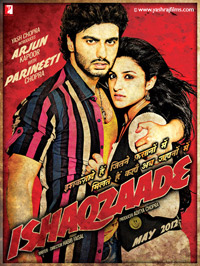
Movie Review: Ishaqzaade (2012)

3.5 Stars (out of 4)

Buy or rent the movie at iTunes
Buy the DVD at Amazon
Buy the soundtrack at Amazon

Unlike most movies produced by Yash Raj Films, Ishaqzaade (“Love Rebels”) didn’t get a major roll-out in North American theaters when it released in India in May. Instead, YRF waited to show Ishaqzaade — rechristened as “Born to Hate…Destined to Love” — at the Toronto International Film Festival, where its global sales rights were acquired by Shoreline Entertainment.

Even though the film is already available on DVD in the U.S., I hope the new acquisition means greater theatrical exposure for Ishaqzaade. It’s a tremendous movie.

Ishaqzaade is a Romeo & Juliet-type romance set in the terrifying world of local politics in Uttar Pradesh. It’s election season in the town of Almore, and the reigning politician, Qureshi, is challenged by the patriarch of the Chauhan family. Besides political animosity, the families are divided by religion as well: the Qureshis are Muslim, the Chauhans are Hindu.

Parma Chauhan (Arjun Kapoor) is the youngest of his grandfather’s grandsons. He’s marginalized in the family hierarchy in part because of his age, but also because his mother is a widow (not that she was responsible for her husband’s death). Parma is desperate to get in his grandfather’s good graces, but Parma’s attitude makes him a liability.

Parma has the devastating combination of a short temper and a sense of entitlement. When a merchant mentions selling diesel fuel to the Qureshis, Parma burns the merchant’s warehouse “to teach him a lesson.” He fails to consider that abusing the common folk hurts his grandfather’s election prospects.

The youngest member of the Qureshi family is Zoya (Parineeti Chopra), herself something of a firebrand. She’s responsible for coordinating her father’s campaign on her college campus, but is eager to do more. When Parma and his goons kidnap a dancer performing at a Qureshi party, Zoya chases after him in her jeep while firing her newly acquired pistol. However, her father’s plans for her are limited to marrying Zoya off to a banker from London, and he laughs at her political ambitions.

Zoya and Parma’s story really begins with an on-campus encounter. He urinates on her father’s campaign poster. She slaps him. He points a gun at her. Parma is impressed that Zoya doesn’t flinch at the loaded gun. She’s impressed when he sneaks into the girls’ bathroom to apologize.

This story is not Romeo & Juliet, however. When Parma starts pursuing Zoya, he’s still the same deplorable person who burned the merchant’s warehouse. Zoya is immature in her own right, in that she allows her feelings to override her awareness that her father would never allow her to marry a Hindu, let alone a member of the Chauhan family.

Ishaqzaade never lets romantic film conventions obscure the social norms of the region in which the film takes place. Religious differences are not something to be toyed with and are not easily overcome. Politics can be a similarly deadly enterprise, with seemingly no offense too minor to be greeted with gunfire.

I was most fascinated with the role of women in the film. Zoya’s headstrong personality makes her a fine mascot within her family, but doesn’t lend itself to a quiet life as a wife and mother, the only future her father sees for her. Zoya’s mother and Parma’s mother are sympathetic to her but pragmatic as well. Undersized and out-gunned, the women in both families have little choice but to submit to the will of the men.

The only other women in Ishaqzaade outside of the two families are prostitutes. The kidnapped dancer, Chand Baby (Gauhar Khan), is admired for her beauty and dancing skills, but it’s always clear where she ranks in the social order. Chauhan refers to her as “the whore.”

When men place so much emphasis on controlling women (and their sexuality in particular), it makes women a natural target for exploitation. From a practical standpoint, it seems a squandering of resources. Zoya’s brothers are good for carrying out simple orders, but they lack her cleverness and passionate commitment to the cause.

Chopra does a great job making Zoya feisty, yet vulnerable and naive. After all, she’s essentially still a kid. Kapoor has a swagger that makes Parma loathsome while simultaneously betraying the insecurity fueling the bravado. Parma is not a loveable character, but he is fascinating to watch. The lead actors’ performances are well-executed in a movie that demands much from its cast and its audience.

Links

Opening October 5: English Vinglish

The new Bollywood film opening in Chicago area theaters on October 5, 2012 — English Vinglish — marks the return of superstar actress Sridevi after a fourteen-year absence from the big screen. The film also has the worst theatrical trailer I’ve ever seen:

This alternate trailer — which never aired at my local cinema — is more substantive:

English Vinglish opens on Friday at the Big Cinemas Golf Glen 5 in Niles, AMC South Barrington 30 in South Barrington, and Regal Cantera Stadium 17 in Warrenville. It has a listed runtime of 2 hrs. 10 min.

Of last weekend’s two new Hindi releases, OMG Oh My God carries over at all three of the above theaters, while Kamaal Dhamaal Malamaal is deservedly booted from all local theaters except the South Barrington 30. The South Barrington 30 is also the only theater holding over Heroine, which has earned $560,285 in its first two weeks in U.S. theaters.

Barfi!, meanwhile, continues to perform phenomenally well at the box office, having earned $2,462,008 in three weeks in the U.S. It gets a fourth week at the South Barrington 30, Cantera 17, AMC River East 21 in Chicago, and Regal Gardens Stadium 1-6 in Skokie.

Other Indian movies showing at the Golf Glen 5 this weekend include Puthiya Theerangal (Malayalam), Rebel (Telugu), and Thaandavam (Tamil).

Movie Review: OMG Oh My God (2012)

3 Stars (out of 4)

Buy or rent the movie at iTunes
Buy the DVD at Amazon

Bollywood isn’t generally known for producing “high-concept” movies: films whose plots can be boiled down to a single, easy-to-understand sentence. The fertility comedy Vicky Donor comes close, as do horror films like Raaz 3, but the standard Bollywood tale-of-two-halves formula doesn’t usually lend itself to such simplicity.

OMG Oh My God is different. Here’s the plot: a disgruntled merchant sues God for damaging his shop. Simple, catchy, and easy to understand. That narrowness of focus allows OMG to tell an amusing story that’s accessible to everyone.

Kanji (Paresh Rawal) is a cynical shopkeeper who overcharges gullible devotees for the chintzy religious statues he sells in his shop. Kanji interrupts a religious festival, angering Siddeshwar Maharaj (Govind Namdeo), a short-tempered holy man who calls upon God to punish Kanji. An earthquake strikes, leaving everything in town untouched except for Kanji’s shop.

When the insurance company won’t pay for the damages to Kanji’s decimated shop under the “Acts of God” clause in his contract, Kanji sues God for compensation. If the divine being won’t show up in court himself, Kanji is happy to recoup his money from the temples his wife has donated to over the years. The religious establishment fights back, and Kanji gets help from an unlikely source: God himself, in the form of a handsome guy named Krishna (Akshay Kumar).

This sounds like the kind of film Jim Carrey might have starred in fifteen years ago (the courtroom setting brings Liar Liar to mind). That’s not a knock on OMG, but a compliment. The film has a concept that would be easy to make in any country, featuring representatives from any religions.

OMG moves along at a good clip and features a lot of strong performances. There are a couple of dance numbers, but they don’t slow down proceedings. Paresh Rawal is the perfect choice for Kanji. In Rawal’s hands, Kanji comes across as cynical and practical, but not mean. Kumar adds lightness and optimism to compliment Kanji’s realism.

If there’s any flaw to OMG, it’s that it gives away the conclusion in a director’s note that precedes the film. In an effort to thwart complaints from religious groups, the note states that the film is about a “non-believer who becomes a believer.” It’s the predictable conclusion to the film, but I didn’t appreciate the spoiler.

The circumstances of Kanji’s conversion are unsatisfying. If everyone experienced the kind of miracle Kanji does — with God on hand to claim responsibility — there would be no atheists. In fact, prior to his conversion, Kanji lays out a pretty good case for a world with no God.

The note at the beginning is ultimately unnecessary, as there seems to be little in the film that could be construed as disrespectful toward any religion. OMG takes shots at the idea of religion-for-profit and the lavish lifestyles of some church leaders. It’s akin to criticizing the wealthy televangelists of the 1980s. Corrupt religious hierarchy is the target, not those practicing the religion.

Kanji uses his public forum to suggest a more virtuous path for worship. Money spent on tithing would be better given as charity. The greatest expression of faith, he believes, is in the way we care for our fellow humans, seeing the essence of the divine in all people. There’s nothing offensive about a plea for a more compassionate world.

Links