Movie Review: Ishaqzaade (2012)

3.5 Stars (out of 4)

Buy or rent the movie at iTunes
Buy the DVD at Amazon
Buy the soundtrack at Amazon

Unlike most movies produced by Yash Raj Films, Ishaqzaade (“Love Rebels”) didn’t get a major roll-out in North American theaters when it released in India in May. Instead, YRF waited to show Ishaqzaade — rechristened as “Born to Hate…Destined to Love” — at the Toronto International Film Festival, where its global sales rights were acquired by Shoreline Entertainment.

Even though the film is already available on DVD in the U.S., I hope the new acquisition means greater theatrical exposure for Ishaqzaade. It’s a tremendous movie.

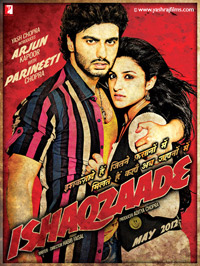
Ishaqzaade is a Romeo & Juliet-type romance set in the terrifying world of local politics in Uttar Pradesh. It’s election season in the town of Almore, and the reigning politician, Qureshi, is challenged by the patriarch of the Chauhan family. Besides political animosity, the families are divided by religion as well: the Qureshis are Muslim, the Chauhans are Hindu.

Parma Chauhan (Arjun Kapoor) is the youngest of his grandfather’s grandsons. He’s marginalized in the family hierarchy in part because of his age, but also because his mother is a widow (not that she was responsible for her husband’s death). Parma is desperate to get in his grandfather’s good graces, but Parma’s attitude makes him a liability.

Parma has the devastating combination of a short temper and a sense of entitlement. When a merchant mentions selling diesel fuel to the Qureshis, Parma burns the merchant’s warehouse “to teach him a lesson.” He fails to consider that abusing the common folk hurts his grandfather’s election prospects.

The youngest member of the Qureshi family is Zoya (Parineeti Chopra), herself something of a firebrand. She’s responsible for coordinating her father’s campaign on her college campus, but is eager to do more. When Parma and his goons kidnap a dancer performing at a Qureshi party, Zoya chases after him in her jeep while firing her newly acquired pistol. However, her father’s plans for her are limited to marrying Zoya off to a banker from London, and he laughs at her political ambitions.

Zoya and Parma’s story really begins with an on-campus encounter. He urinates on her father’s campaign poster. She slaps him. He points a gun at her. Parma is impressed that Zoya doesn’t flinch at the loaded gun. She’s impressed when he sneaks into the girls’ bathroom to apologize.

This story is not Romeo & Juliet, however. When Parma starts pursuing Zoya, he’s still the same deplorable person who burned the merchant’s warehouse. Zoya is immature in her own right, in that she allows her feelings to override her awareness that her father would never allow her to marry a Hindu, let alone a member of the Chauhan family.

Ishaqzaade never lets romantic film conventions obscure the social norms of the region in which the film takes place. Religious differences are not something to be toyed with and are not easily overcome. Politics can be a similarly deadly enterprise, with seemingly no offense too minor to be greeted with gunfire.

I was most fascinated with the role of women in the film. Zoya’s headstrong personality makes her a fine mascot within her family, but doesn’t lend itself to a quiet life as a wife and mother, the only future her father sees for her. Zoya’s mother and Parma’s mother are sympathetic to her but pragmatic as well. Undersized and out-gunned, the women in both families have little choice but to submit to the will of the men.

The only other women in Ishaqzaade outside of the two families are prostitutes. The kidnapped dancer, Chand Baby (Gauhar Khan), is admired for her beauty and dancing skills, but it’s always clear where she ranks in the social order. Chauhan refers to her as “the whore.”

When men place so much emphasis on controlling women (and their sexuality in particular), it makes women a natural target for exploitation. From a practical standpoint, it seems a squandering of resources. Zoya’s brothers are good for carrying out simple orders, but they lack her cleverness and passionate commitment to the cause.

Chopra does a great job making Zoya feisty, yet vulnerable and naive. After all, she’s essentially still a kid. Kapoor has a swagger that makes Parma loathsome while simultaneously betraying the insecurity fueling the bravado. Parma is not a loveable character, but he is fascinating to watch. The lead actors’ performances are well-executed in a movie that demands much from its cast and its audience.

Links

Opening October 5: English Vinglish

The new Bollywood film opening in Chicago area theaters on October 5, 2012 — English Vinglish — marks the return of superstar actress Sridevi after a fourteen-year absence from the big screen. The film also has the worst theatrical trailer I’ve ever seen:

This alternate trailer — which never aired at my local cinema — is more substantive:

English Vinglish opens on Friday at the Big Cinemas Golf Glen 5 in Niles, AMC South Barrington 30 in South Barrington, and Regal Cantera Stadium 17 in Warrenville. It has a listed runtime of 2 hrs. 10 min.

Of last weekend’s two new Hindi releases, OMG Oh My God carries over at all three of the above theaters, while Kamaal Dhamaal Malamaal is deservedly booted from all local theaters except the South Barrington 30. The South Barrington 30 is also the only theater holding over Heroine, which has earned $560,285 in its first two weeks in U.S. theaters.

Barfi!, meanwhile, continues to perform phenomenally well at the box office, having earned $2,462,008 in three weeks in the U.S. It gets a fourth week at the South Barrington 30, Cantera 17, AMC River East 21 in Chicago, and Regal Gardens Stadium 1-6 in Skokie.

Other Indian movies showing at the Golf Glen 5 this weekend include Puthiya Theerangal (Malayalam), Rebel (Telugu), and Thaandavam (Tamil).

Movie Review: OMG Oh My God (2012)

3 Stars (out of 4)

Buy or rent the movie at iTunes
Buy the DVD at Amazon

Bollywood isn’t generally known for producing “high-concept” movies: films whose plots can be boiled down to a single, easy-to-understand sentence. The fertility comedy Vicky Donor comes close, as do horror films like Raaz 3, but the standard Bollywood tale-of-two-halves formula doesn’t usually lend itself to such simplicity.

OMG Oh My God is different. Here’s the plot: a disgruntled merchant sues God for damaging his shop. Simple, catchy, and easy to understand. That narrowness of focus allows OMG to tell an amusing story that’s accessible to everyone.

Kanji (Paresh Rawal) is a cynical shopkeeper who overcharges gullible devotees for the chintzy religious statues he sells in his shop. Kanji interrupts a religious festival, angering Siddeshwar Maharaj (Govind Namdeo), a short-tempered holy man who calls upon God to punish Kanji. An earthquake strikes, leaving everything in town untouched except for Kanji’s shop.

When the insurance company won’t pay for the damages to Kanji’s decimated shop under the “Acts of God” clause in his contract, Kanji sues God for compensation. If the divine being won’t show up in court himself, Kanji is happy to recoup his money from the temples his wife has donated to over the years. The religious establishment fights back, and Kanji gets help from an unlikely source: God himself, in the form of a handsome guy named Krishna (Akshay Kumar).

This sounds like the kind of film Jim Carrey might have starred in fifteen years ago (the courtroom setting brings Liar Liar to mind). That’s not a knock on OMG, but a compliment. The film has a concept that would be easy to make in any country, featuring representatives from any religions.

OMG moves along at a good clip and features a lot of strong performances. There are a couple of dance numbers, but they don’t slow down proceedings. Paresh Rawal is the perfect choice for Kanji. In Rawal’s hands, Kanji comes across as cynical and practical, but not mean. Kumar adds lightness and optimism to compliment Kanji’s realism.

If there’s any flaw to OMG, it’s that it gives away the conclusion in a director’s note that precedes the film. In an effort to thwart complaints from religious groups, the note states that the film is about a “non-believer who becomes a believer.” It’s the predictable conclusion to the film, but I didn’t appreciate the spoiler.

The circumstances of Kanji’s conversion are unsatisfying. If everyone experienced the kind of miracle Kanji does — with God on hand to claim responsibility — there would be no atheists. In fact, prior to his conversion, Kanji lays out a pretty good case for a world with no God.

The note at the beginning is ultimately unnecessary, as there seems to be little in the film that could be construed as disrespectful toward any religion. OMG takes shots at the idea of religion-for-profit and the lavish lifestyles of some church leaders. It’s akin to criticizing the wealthy televangelists of the 1980s. Corrupt religious hierarchy is the target, not those practicing the religion.

Kanji uses his public forum to suggest a more virtuous path for worship. Money spent on tithing would be better given as charity. The greatest expression of faith, he believes, is in the way we care for our fellow humans, seeing the essence of the divine in all people. There’s nothing offensive about a plea for a more compassionate world.

Links

Movie Review: Kamaal Dhamaal Malamaal (2012)

0.5 Stars (out of 4)

Buy the DVD at Amazon
Buy the soundtrack at Amazon

Even after watching Kamaal Dhamaal Malamaal, I’m not sure what it’s about. Sure, I can tell you who the characters are and what happens to them, but what is the movie about? Kamaal Dhamaal Malamaal lacks a coherent narrative and, as such, is a boring, pointless waste of time.

Without a compelling story to drive the plot along, the burden of carrying the film falls on the shoulders of its lead character, Johnny (Shreyas Talpade). Few lead characters are so woefully unsuited for the task of carrying a film as Johnny is.

Johnny is a good-for-nothing 25-year-old. He has no job, hoping instead to get rich from playing the lottery (his girlfriend buys him his tickets). He refuses to help his ailing father with chores, instead berating his sisters into doing the work for him.

The girlfriend, Maria (Madhurima), must have incredibly low self-esteem to have settled for an irredeemable loser like Johnny. Maria’s father, Peter (Paresh Rawal), hates Johnny’s dad, David (Om Puri), for stealing his girlfriend when they were young and won’t allow Johnny to marry Maria. Her three beefy brothers regularly beat up Johnny to keep him away from Maria.

One day, a buff stranger (Nana Patekar) with a big appetite arrives in town. Johnny convinces his family that the stranger is his long-lost brother Sam. They feed the stranger, who acts as Johnny’s bodyguard, when he’s in the mood. Eventually, Johnny hears a rumor that “Sam” is a murderer and a rapist, and sets about trying to make Sam leave town.

That’s the story. As I said before, I know what happened in the movie, but I don’t know why. Why am I supposed to care about a doofus like Johnny? Where’s the conflict? Sam’s presence doesn’t help Johnny get any closer to marrying Maria, nor does Johnny learn any lessons about the value of hard work from his fake brother.

There’s really nothing to recommend this movie. It’s little more than long passages of overly explanatory dialog punctuated by fistfights. All of the characters are dullards, with actor-writer Neeraj Vora reserving the only mildly amusing character — an opportunistic coffin maker — for himself.

Leave it to Priyadarshan — the director responsible for the worst film I’ve ever seen, Khatta Meetha — not to let the opportunity for some casual sexual violence against women pass him by. Why does Sam have to be an alleged murderer and a rapist? Isn’t being a murderer bad enough?

The only worthwhile element of Kamaal Dhamaal Malamaal is the song “Dariya Ho” (which itself is derivative of “Chaiyya Chaiyya” from Dil Se). I’ve embedded the video of the song below to save you from wasting your money on an otherwise worthless film.

Links

Opening September 28: Kamaal Dhamaal Malamaal and OMG

Perhaps this speaks to the relative weakness of Hollywood fare currently on offer, but two new Hindi comedies open in Chicago area theaters on September 28, 2012. Kamaal Dhamaal Malamaal, directed by Priyadarshan, gets the wider release of the two new films.

Kamaal Dhamaal Malamaal opens on Friday at the Regal Gardens Stadium 1-6 in Skokie, Big Cinemas Golf Glen 5 in Niles, AMC South Barrington 30 in South Barrington, and Regal Cantera Stadium 17 in Warrenville. It has a runtime of 2 hrs. 20 min. Read my review here.

This weekend’s other new release, OMG: Oh My God, stars Paresh Rawal as a shopkeeper who takes god to court.

OMG opens on Friday at the Golf Glen 5, South Barrington 30, and Cantera 17. It also has a listed runtime of 2 hrs. 30 min.

After opening to an anemic $389,901 in U.S. theaters last weekend, Heroine carries over for a second week at all of the above theaters. By comparison, Barfi! netted $643,260 in the U.S. last weekend during its second week in theaters. Having just been named India’s official submission to the Oscars, I expect to see its earnings hold up well again this weekend. Barfi! carries over at all of the above theaters, plus the AMC River East 21 in Chicago.

Other Indian movies showing at the Golf Glen 5 this weekend include Rebel (Telugu), Thaandavam (Tamil), and Thappana (Malayalam).

Movie Review: Heroine (2012)

1.5 Stars (out of 4)

Buy the DVD at Amazon

Let me illustrate the failure of director Madhur Bhandarkar’s Heroine with an anecdote from the showing I attended. During a completely serious moment late in the film, Arjun Rampal’s character, Aryan, tells Kareena Kapoor’s Mahi tenderly, “You look beautiful.” The audience laughed.

Heroine is so overwrought and lacking in subtlety that it’s impossible to take seriously. Emotional switches are flipped on a dime, accompanied by dramatic musical cues that are unnecessary because Kapoor’s instantaneous turns from happy to sobbing, shaking fury make it impossible to misinterpret Bhandarkar’s intent.

Kapoor plays Mahi, a superstar actress whose position at the top of the Bollywood hierarchy is threatened by newcomers willing to bribe entertainment journalists with shopping vacations. Mahi’s personal life is on the fritz, too, as her married actor boyfriend, Aryan, dawdles on his way to divorce court.

The couple breaks up, Mahi abuses pills, goes through a PR makeover, dates an athlete (played by Randeep Hooda), and does an indie film to gain some acting chops. The indie film debacle results in a night of drunken lesbianism with a co-star (played by Shahana Goswami). Mahi cries a lot through the melodramatic course of her career, angrily smoking cigarette after cigarette, as if they are responsible for her personal and professional troubles.

Kapoor’s performance is all over the place. I don’t fault her, because I think it’s what Bhandarkar wanted. The problem is that, no matter what she does, Mahi is always wrong. Things always end badly for her. She’s a character with no control over her destiny. It’s hard to connect with a character in such a helpless position. The moral of the story seems to be, “Don’t become an actor.”

When not in emotional roller coaster mode, the film is too “inside baseball.” I’m interested in the film industry, and even I couldn’t care less about scenes in which Mahi discusses changes to the marketing budget with her production team.

The good elements of Heroine are limited to Goswami’s awesome cleavage and multiple shirtless shots of Hooda and Rampal. The dance number “Halkat Jawani” is entertaining, too.

There are two scenes from Heroine that will stick with me because I’m not sure how to explain them, both involving reading material. In one scene, a slimy co-star invites Mahi back to his hotel room, hoping to seduce her. Before she arrives, he places a James Patterson novel on a bedside table. What is this supposed to signify about him? “Hey, Mahi, I know nothing turns chicks on more than popular genre fiction.”

In another scene, an argument between Mahi and Aryan is observed with fiendish glee by up-and-coming actress pretending to be engrossed in an Archie comic. Why Archie? What’s the symbolism? What does it mean?!?!

Links

Opening September 21: Heroine

September 21, 2012, marks the opening of Heroine in four Chicago area theaters. Kareena Kapoor plays a superstar actress whose career is in decline. (Hopefully, she won’t resort to black magic, as Bipasha Basu did recently in Raaz 3.)

Heroine opens on Friday at the Regal Gardens Stadium 1-6 in Skokie, Big Cinemas Golf Glen 5 in Niles, AMC South Barrington 30 in South Barrington, and Regal Cantera Stadium 17 in Warrenville. It has a listed runtime of 2 hrs. 30 min.

All four of the above theaters are carrying over last weekend’s new release, Barfi!, as is the AMC River East 21 in Chicago. The film earned a very impressive $1,061,713 in its first weekend in U.S. theaters.

The South Barrington 30 also carries over Ek Tha Tiger for a sixth week.

Other Indian movies playing at the Golf Glen 5 this weekend include Husbands in Goa (Malayalam), Vennela 1 1/2 (Telugu), and Life Is Beautiful (Telugu), which is also showing at the River East 21.

Plenty of other Indian and South Asian films can be found at the Chicago South Asian Film Festival, which runs now through Sunday, September 23. The event closes with the world premiere of Shobhna’s Seven Nights. The film’s star, Raveena Tandon, will be on hand for a Q & A session following the film’s premiere.

Movie Review: Barfi! (2012)

4 Stars (out of 4)

Buy or rent the movie at iTunes
Buy the DVD at Amazon
Buy the soundtrack at Amazon

Like its namesake confection, Barfi! is certainly sweet. Not a frothy sweetness but a complex one with real depth and substance. Barfi! is not to be missed.

The film defies convention yet feels familiar. Flashbacks within flashbacks within flashforwards play with typical narrative format in a way that works better than it should.

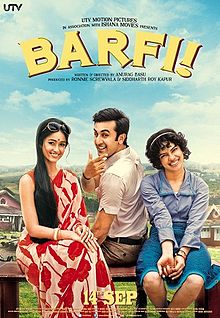
The bulk of the action alternates between two times and places — 1972 and 1978, Darjeeling and Kolkata — framed by scenes set in the present day. The film’s narrator, Shruti (Ileana D’Cruz), recalls how her life changed in 1972 when her family moved from Kolkata to Darjeeling and she met Barfi (Ranbir Kapoor).

“Barfi” is how the deaf young man pronounces his given name, Murphy, so everyone calls him by his nickname. Unemployed Barfi spends his days making mischief around town, to the consternation of police inspector Dutta (Saurabh Shukla). Though he has a crush on Shruti, Barfi settles for friendship with her, because she is engaged. The two spend their days racing bicycles and bumming rides on train cars, falling in love in the process.

In the hands of a writer-director less skilled than Anurag Basu, Barfi’s penchant for mischief could be a cheap way to substitute quirkiness for character development. That’s not the case here. Barfi acts like an overgrown child because no one expects anything from him. He’s the town’s beloved mascot, cared for by his doting father, but that’s it.

Barfi’s outsider status makes a romantic match with Shruti impossible, even if she didn’t have a perfect-on-paper fiance waiting for her back in Kolkata. There’s no way her parents would accept a deaf son-in-law, even if the reason they give is their desire to spare her from the harsh judgements of society.

Shruti herself fails Barfi’s loyalty test. She lets go of his hand and leaps from his side as a light pole falls toward them. Having doctored the light pole himself, Barfi knows they were never in any danger. Like others before her, Shruti abandoned Barfi at the first sign of danger.

The one person to pass the loyalty test is Jhilmil (Priyanka Chopra), the autistic granddaughter of a wealthy local man. Having spent most of her childhood at a sanitarium — so as not to embarrass her snooty parents — she’s summoned to the side of her ailing grandfather. Barfi’s father is the grandfather’s driver, and Barfi and Jhilmil were childhood friends.

Jhilmil’s parents are no less embarrassed by their now-adult daughter when she returns. Jhilmil shuns almost all physical contact, screams and panics when she gets mud on her shoes, and loudly sings along with the band at a society party. The only person in Darjeeling who warms to Jhilmil is Barfi. Caring for her gives him purpose, and he provides her with a sense of security.

These themes — security and purpose — are universal, and those are the main challenges for Barfi and Jhilmil, not their special needs. Basu writes the characters as real people, not as a collection of physical and mental issues to be triumphed over. Shruti — the “normal” character among the three — is actually the most flawed, in that she lacks courage.

D’Cruz, an actress who has predominantly worked in Telugu films thus far, is a fine avatar for the audience. She nicely portrays the conflict inside Shruti, who would like to follow her heart but lacks the will to do it.

Ranbir Kapoor is the only actor who could have played Barfi. He has great physicality, both in scenes where he runs from Inspector Dutta (Saurabh Shukla is also great in the film) and where he bares his soul to Shruti using only gestures, no words. Kapoor makes Barfi more than just a lovable rascal.

But the standout performance in the film is by Priyanka Chopra. I’ve long appreciated the risks she takes in the roles she chooses, even if they don’t always work out. Playing an autistic woman could have gone poorly, but Chopra is perfect.

Like Kapoor, Chopra has very little dialog in the film. Jhilmil spends most of the time staring at the ground or observing the action around her, yet Chopra makes it easy to read Jhilmil’s emotions. Chopra’s depiction of autistic characteristics is accurate and respectful. Despite having a condition that makes forming emotional connections with other people difficult, there’s a lot to love about Jhilmil.

Other things to love about Barfi! include the beautiful scenery and music. Transitions between scenes are frequently accomplished by a pan over the silhouettes of three musicians — a guitarist, a violinist, and an accordion player — who seem to follow the characters everywhere.

Barfi! is a really special film. I laughed out loud, I cried, and I would happily watch it again tomorrow.

Links

Opening September 14: Barfi!

One of my most anticipated Bollywood releases of the year, Barfi!,opens in five Chicago area theaters on September 14, 2012. Barfi! — which is the name of an Indian dessert and not a variation on a euphemism for vomit — tells the story of a deaf-mute man played by Ranbir Kapoor and his relationships with two women, played by Priyanka Chopra and Ileana D’Cruz.

Barfi! opens on Friday at the AMC River East 21 in Chicago, Regal Gardens Stadium 1-6 in Skokie, Big Cinemas Golf Glen 5 in Niles, AMC South Barrington 30 in South Barrington, and Regal Cantera Stadium 17 in Warrenville. It has a runtime of 2 hrs. 30 min.

Last week’s 3D Hindi horror film, Raaz 3, carries over for a second week at the Golf Glen 5, Cantera 17, and South Barrington 30, which is also holding over Ek Tha Tiger for a fifth week.

Other Indian movies showing at the Golf Glen 5 this weekend include Life Is Beautiful (Telugu), Run Baby Run (Malayalam), and Shirdi Sai (Telugu).

The trailer for the November 2 release Luv Shuv Tey Chicken Khurana hit theaters today:

Movie Review: Ekk Deewana Tha (2012)

Zero Stars (out of 4)

Buy the DVD at Amazon
Buy the soundtrack at Amazon

“Sachin, you’re such a selfish jerk.” This is told to the main character by his best friend, and it is the core problem in a movie full of problems. The hero of the romance Ekk Deewana Tha (“There Was a Crazy Guy“) is such an odious bastard that it’s frustrating to see him rewarded with his obligatory happy ending.

The film sets itself up as a modern-day Romeo and Juliet romance between a pair of star-crossed lovers: a Hindu guy and a Christian girl. Religious differences ultimately play little part in the film except as an excuse for her father to object to the marriage (the guy’s parents don’t care). There are plenty of other, better reasons for her parents to object, namely that the guy is a possessive whack-job.

Sachin — the above mentioned “selfish jerk” — is a 22-year-old Hindu, played by a perpetually flustered Prateik. The Christian girl is Jessie (Amy Jackson), a 23-year-old financial analyst who talks during movies. Sachin sees Jessie, falls immediately in love (lust, actually), and sets about wooing her. He isn’t put off by the potential objections of her parents on religious grounds, although he is really bothered by the fact that she’s a year older than him. Huh?

He’s also not put off by the fact that she’s not interested in him. Sachin waits outside their shared apartment complex for Jessie, follows her to work, even travels across the country to see her, despite her protests to leave her alone. On their train journey back to Mumbai from Kerela, he ignores his pledge to just be friends and forcefully kisses her as she tries to push him away.

Sachin offers this defense when Jessie gets upset over his unwanted physical contact: “We were friends, but then I saw you, and I forgot about it.”

Sachin’s feelings of lust for Jessie convince him that they are a sign of his destiny. Because he feels urges, it is divine will that they be satisfied. If Jessie objects, it’s just because he hasn’t sufficiently convinced her that his understanding of the cosmic order is the correct one.

That’s not the logic of a romantic hero. That’s the logic of a rapist.

Furthering the insult to women everywhere, Jessie eventually confesses that her protestations were really her way of masking the true love she instantly felt for Sachin. Take heart, spurned lovers! When a woman says, “No!”, she really means, “Yes! I love you!”

The pain of being subjected to the archaic attitudes toward women in Ekk Deewana Tha is compounded by the fact that the film is mind-numbingly boring for all of its 137 minutes. When not being sexist and offensive, the movie spends its time being long-winded and banal, as Sachin and Jessie talk about how much she likes math and how many movies she’s seen. Listening to them was more like being forced to overhear boring restaurant conversation from a nearby table than witnessing dialogue written by a professional screenwriter.

A strong background knowledge of Bollywood is required to understand the endless, pointless movie references in Ekk Deewana Tha. Likewise, references to language differences between Hindi and Malayalam are lost on English speakers reliant upon subtitles. McDonald’s and Gloria Jeans product placements aside, this is not a film made for an audience outside of India, and Indian audiences deserve better than this.

Links