Tag Archives: Ranbir Kapoor

Movie Review: Roy (2015)

Roy_film_poster1 Star (out of 4)

Buy or rent the movie at iTunes
Buy the DVD at Amazon
Buy the soundtrack on Amazon

Roy is full of so much talking and so little action that it should have been an audiobook instead of a movie. Then again, with such dull dialogue, who would listen to it?

Arjun Rampal plays Kabir, a celebrity film director. Kabir is the kind of narcissistic jerk who stomps out his cigarette butts on the floor of a hotel hallway and who uses a manual typewriter while flying on a plane.

After the success of Guns and Guns 2, Kabir is stymied by writer’s block while working on Guns 3. The first fifteen minutes of Roy consist of shots of Kabir sitting idly in front of the typewriter, brushing his teeth, feeding his fish, and fending off the concerned inquiries of his excessively patient producer, Meera (Shernaz Patel).

In the world of Roy, news reports consist entirely of details of Kabir’s romantic life and reports of art theft. A TV report about a painting stolen in Malaysia prompts Kabir to take his crew there to film Guns 3. There, Kabir becomes smitten with an independent movie director, Ayesha (Jacqueline Fernandez).

[Correction: In addition to art theft and Kabir’s romantic life, news reports in Roy also feature extensive coverage of indie film festivals. Just like real life.]

Kabir casts an actress who looks exactly like Ayesha to play the romantic interest in Guns 3, opposite his protagonist, Roy (Ranbir Kapoor). There is absolutely no explanation offered for Ayesha’s doppelgänger.

Action — such as it is — switches between Kabir and Ayesha in the real world and Roy and the lookalike, Tia, in the movie world of Guns. Both worlds are dominated by boring, pseudo-intellectual conversations, punctuated by languid song montages in which people drive around in cars or Roy rides a motorcycle.

Given that Kabir is an emotionally stunted pre-teen trapped in a 40-year-old body, nothing he or Roy says on the nature of being contains any kind of insight. There’s so much undirected angst in the dialogue, it’s like it was written by the guys from the ’90s band Bush.

An excess of ennui in their characters yields clunky, detached performances by Rampal and Kapoor. Fernandez — whose beauty is the best thing Roy has going for it — is better in scenes as Tia, in which she plays an heiress trapped in a 1960s time warp, at least as far as her teased hair is concerned.

Debutant writer-director Vikramjit Singh has a good sense for framing shots, and the movie is quite pretty. Sadly, the visual interest ends there, since Singh focuses all his attention on writing bland dialogue instead of considering what it would look like when delivered onscreen.

Without additional assistance on the script, Singh’s story feels hollow. Even after Kabir undergoes his supposed metamorphosis from spoiled man-child to emotionally mature adult, he still does something incredibly selfish.

Ayesha is on her way to a film festival in another country. For independent filmmakers, festivals provide opportunities to network and drum up publicity and funds for their next projects. Wealthy, connected Kabir stops Ayesha at the airport, telling her, in essence, “If you love me, you won’t get on the plane.”

Kabir puts his own desires ahead of Ayesha’s career, which is all the more selfish since Kabir’s got more than enough cash to buy his own plane ticket and go with her. Considering that Singh’s debut film features A-listers like Kapoor, Rampal, and Fernandez, it’s not surprising that he has an easier time identifying with a celebrity like Kabir rather than a struggling filmmaker like Ayesha.

Links

Opening February 13: Roy and MSG

The romantic thriller Roy — starring Ranbir Kapoor, Jacqueline Fernandez, and Arjun Rampal — hits Chicago area theaters on February 13, 2015.

Roy opens on Friday at MovieMax Cinemas in Niles, AMC South Barrington 30 in South Barrington, and Regal Cantera Stadium 17 in Warrenville. It has a listed runtime of 2 hrs. 26 min.

Also opening at MovieMax on Friday is MSG: The Messenger of God, which has a runtime of 3 hrs. 17 min.

Shamitabh carries over for a second week at MovieMax, Cantera 17 and South Barrington 30, which also holds over Baby for a fourth week.

Other Indian movies showing in the Chicago area this weekend include Temper (Telugu w/no subtitles) at MovieMax, Muvico Rosemont 18 in Rosemont, Century Stratford Square in Bloomingdale, and Cinemark at Seven Bridges in Woodridge, and Yennai Arindhaal (Tamil w/English subtitles) at MovieMax and Seven Bridges. MovieMax also carries Anegan (Tamil) and Malli Malli Idi Rani Roju (Telugu), as well as English-language coverage of the India vs. Pakistan Cricket World Cup match on Saturday night.

Streaming Video News: August 13, 2014

Two lackluster comedies from 2013 were just added to Netflix. Akshay Kumar’s Boss unsuccessfully tries to marry gory violence with lighthearted comedy, and it doesn’t work. Ranbir Kapoor’s Besharam also fails by trying to make a hero out of a reckless criminal.

For everything else new to streaming on Netflix, check out Instant Watcher.

Movie Review: Bhoothnath Returns (2014)

BhoothnathReturns2 Stars (out of 4)

Buy or rent the movie at iTunes
Buy the DVD at Amazon
Buy the soundtrack at Amazon

Bhoothnath Returns is only intermittently entertaining, because writer-director Nitesh Tiwari fails to take his target audience into account. Why does a film geared toward children have a runtime of 155 minutes? And why are so many of those minutes devoted to discussions of how to file paperwork?

2008’s Bhoothnath (“Lord of Ghosts“) starred Amitabh Bachchan as the titular not-so-scary ghost. The sequel finds Bhoothnath the target of jokes up in Ghost World — which looks a lot like Hogwarts — due to his inability to scare children.

Bhoothnath returns to earth to redeem his reputation, only to run into another fearless kid who can see him, even though no one else can. Savvy street urchin Akhrot (Parth Bhalerao) teams up with Bhoothnath, solving the problems of other earth-bound ghosts and earning money. As their friendship grows, Bhoothnath realizes that Akhrot’s future will never be secure while murderous thugs like Bhau (Boman Irani) run the government. Thus is born India’s first campaign to elect a ghost to political office.

For a while, the discussions of the bureaucratic technicalities surrounded Bhoothnath’s run are entertaining, aided by Sanjay Mishra’s funny performance as Bhoothnath’s lawyer. As the second half of the film rolls on, the story gets bogged down in heavy-handed patriotic speeches and lengthy montages depicting differing versions of what will happen on election day.

There is a surfeit of montages in Bhoothnath Returns. Instead of briefly panning the camera across the festively decorated grounds before Bhoothnath’s big rally, Tiwari devotes in excess of a minute to a sped-up version of the decoration of the rally grounds. When the movie is already so long, why devote more than a few seconds to something no one cares about?

The movie’s strangest sequence also takes place in montage form. As Bhoothnath comes to grips with depth of India’s problems, the song “Sahib” plays accompanied by a montage of photos of desperate, starving people. It’s very grim for a movie geared toward kids, especially since the impoverished state of Akhrot’s own neighborhood is already established.

It’s also hypocritical. Earlier in the film, Akhrot derisively mentions making money from foreign tourists looking to experience Slumdog Millionaire in person. How is turning images of peoples’ suffering into a music video in a major motion picture any different?

The film’s tedious heavy-handedness rankles because it detracts from an otherwise cute movie. Irani’s villain is the right mix of sinister and clownish. Bachchan is both grudging and caring as he puts up with his willful young friend.

Bhalerao does a terrific job as Akhrot, cracking wise but never coming off as a jerk. The young actor is great in a touching scene in which Akhrot tries to conceal the risks of their venture from Bhoothnath.

All the fine performances can’t keep Bhoothnath Returns from turning into a glorified public service announcement. Encouraging people to vote is a worthy goal, but it has to be done within the context of the story.

The pro-voting message comes across clearly through the story of Bhoothnath Returns, but Tiwari doesn’t leave well-enough alone, tacking on at least twenty minutes of condescending speeches. Jarring celebrity cameos by Ranbir Kapoor, Anurag Kashyap, and Shahrukh Khan — whose presence is the only one that makes a lick of narrative sense — just add to the feeling that Bhoothnath Returns is as much an overly long PSA as it is a movie.

Links

Movie Review: Besharam (2013)

Besharam2 Stars (out of 4)

Buy the DVD at Amazon
Buy the soundtrack at Amazon

Besharam (“Shameless”) was likely sold to investors using the following equation: Ranbir Kapoor + antics = super hit. The equation will probably prove correct, but that doesn’t mean that Besharam is a great movie.

Writer-director Abhinav Kashyap is so confident in Ranbir’s ability to charm audiences that he offers only the barest hint of a plot. The movie starts with a brutal scene of a gang led by Bheem Singh Chandel (Javed Jaffrey) blowing up a police van with a rocket launcher and siccing an attack dog on an officer. The gangsters disappear for forty-five minutes, until they hire Babli (Ranbir) to steal a car for them.

In the interim, we get to know Babli, a mechanic who supplements his income by fencing stolen automobiles with the help of his best friend, T2 (Amitosh Nagpal). Their profits fund the orphanage where they grew up and still reside as adults. The head of the orphanage, Masterji, knows that Babli and T2 are crooks, but he takes the money anyway, while expressing hopes that the younger boys will grow up to find legitimate jobs.

Babli meets a beautiful woman, Tara (Pallavi Sharda), who’s unimpressed with his sleazy come-ons. Spurred by the challenge, Babli pursues Tara, only to inadvertently steal her new Mercedes on Chandel’s behalf. Having hurt Tara, Babli finally discovers that other people are affected negatively by his actions.

From this point in the story, most movies would focus on Babli’s character development as he reforms his ways to impress the girl and right the wrongs he’s committed. Kashyap takes the opposite tactic. Babli is made into a hero, with everyone — including Tara — apologizing to him for having judged him too harshly and vowing to emulate his shameless ways.

This story turn just doesn’t work. Babli, through his self-centered carelessness, not only steals from Tara, he endangers the lives of everyone he cares about, including all the kids at the orphanage. Masterji, T2, and their friend, Bhura, are beaten and kidnapped because of Babli, yet no one is upset with him.

Kashyap tries to blame Babli’s flaws on classism. Tara is set up as an elitist who’s only interested in money and status and who looks down on a mechanic like Babli. First of all, why shouldn’t she be allowed to marry a peer who (like her) has a high-status job? Second, and more importantly: BABLI STOLE HER FRIGGING CAR!

Babli also claims that, because he’s an orphan, he had no one to teach him right from wrong. So, didn’t he pick up any sense of morality in school? And what the hell does Masterji teach the kids at the orphanage? “Here’s a roof over your heads and some food. Figure the rest out yourselves.”

Babli’s orphan status is used to shoehorn Ranbir’s real-life parents, Rishi Kapoor and Neetu Singh, into the movie as a pair of married police officers. As soon as they mention that they never had children, it’s obvious that Babli won’t be an orphan by movie’s end.

For what it’s worth, Ranbir is really darned charming. His charisma is the only thing that makes the movie watchable. Ranbir is at his best in scenes with Nagpal, as the friendship between Babli and T2 is the movie’s strongest relationship.

What I’ve always enjoyed about Ranbir is his ability to shine in a variety of roles, but Besharam may mark the start of Ranbir Kapoor: The Franchise. I fear that Ranbir has earned so much industry clout that he’ll be pigeonholed into “charming” roles, playing the role of Ranbir much in the way superstars like Salman Khan, Shahrukh Khan, and Akshay Kumar seem to play the same type of character in every movie. It’s a trap that can be avoided, but only if he’s careful.

Links

Opening October 2: Besharam

Ranbir Kapoor stars alongside his famous parents, Rishi Kapoor and Neetu Singh, in Besharam, which opens in the Chicago area on October 2, 2013.

Besharam (“Shameless”) opens on Wednesday in seven area theaters: AMC River East 21 in Chicago, Regal Gardens Stadium 1-6 in Skokie, Big Cinemas Golf Glen 5 in Niles, AMC Loews Crestwood 18 in Crestwood, AMC South Barrington 30 in South Barrington, AMC Loews Woodridge 18 in Woodridge, and Regal Cantera Stadium 17 in Warrenville. It has a listed runtime of 2 hrs. 23 min.

Movie Review: Yeh Jawaani Hai Deewani (2013)

YJHD2.5 Stars (out of 4)

Buy the DVD at Amazon
Buy the soundtrack at Amazon

Writer-director Ayan Mukerji’s debut movie, Wake Up Sid, was a nuanced coming-of-age film grounded in realism. While Yeh Jawaani Hai Deewani (“This Youth is Crazy”) is also a coming-of-age film, it plays out as a male fantasy in which selfishness is rewarded, and there are no consequences for bad behavior.

The regressive storyline that dominates the second half of Yeh Jawaani Hai Deewani (YJHD, henceforth) is a disappointment, given how much the film has going for it. It’s packed with blockbuster-caliber dance numbers, gorgeous scenery, and a strong first half, anchored by Deepika Padukone. But all that can’t make up for the inattention paid to the film’s core relationships and the lack of development of the ostensible lead character, played by Ranbir Kapoor.

YJHD‘s story structure is confusing because, until the mid-point of the movie, Padukone’s character, Naina, is the lead character. She narrates an extended flashback of a mountain trek vacation eight years earlier, when she was eager to ditch her nerdy image and have an adventure before starting medical school. On the trip, she reunites with some high school classmates — Aditi (Kalki Koechlin), Avi (Aditya Roy Kapoor), and Bunny (Ranbir Kapoor) — and falls in love with Bunny. The trip ends, and the friends go their separate ways.

When the action returns to the present day, Naina’s lead status ends with her mailing invitations to Aditi’s wedding. Bunny takes center stage when he accepts the invitation and returns to India after eight years abroad, having had minimal contact with his friends in the meantime (and apparently no contact with Naina whatsoever). The rest of the story is about Bunny finally realizing — at age 30 — that other people have feelings, too, and that perhaps he shouldn’t be so selfish.

There’s a great scene in Wake Up Sid in which slacker Sid (also played by Ranbir Kapoor) finally cleans the apartment he shares with Aisha (Konkona Sen Sharma), hoping to impress her. Instead, she chides him for expecting praise for something he should’ve been doing all along.

In YJHD, however, when Bunny admits that perhaps he should’ve called home more often — instead of ignoring his family and friends while enjoying his globetrotting lifestyle — Aditi, Avi, and Naina all but throw him a parade. Bunny’s stepmother assures him that it’s okay that he missed his father’s funeral, since all his father ever wanted was for Bunny to follow his dreams. As charming as Bunny is supposed to be, it’s hard to accept that there are no consequences for him spending thirty years as a self-interested jerk.

In contrast to Bunny’s virtual lack of moral development, Naina undertakes some serious soul-searching. On the trek, Naina forces herself to take risks, if only to confirm that she really is a homebody at heart, and that that’s okay. When she confesses to Bunny that socializing is more difficult for a nerd like her than it is for a popular guy like him, he responds, in essence, “Why? You’re fine the way you are.” It’s meant to be reassuring, but it speaks to the fact that Bunny can’t empathize with her feelings of social isolation.

During their eight years apart, Naina finishes med school and apparently has no other romantic relationships. It’s as if she put her life on hold until Bunny decides that he wants to grow up. When he does, she accepts him without reservations. Naina must work to become a better person, but Bunny is written as though his value is inherent and obvious. He just has to say the magic word, and he becomes a prize worth having. It’s lazy writing, and it’s a bit sexist.

YJHD also has trouble defining the friendships between the characters. The first half of the film is about Naina earning her spot as the fourth member of the group of pals, but she never interacts with all four of them together in the second half. When Aditi suggests to Avi and Bunny that they celebrate on the eve of her wedding, no one mentions including Naina. Naina gives a toast to her “best friend,” Aditi, but they have few scenes together where it’s just the two of them. Naina loses her status as a friend in the second half, reduced to the role of Bunny’s love interest.

The final shot of the film confirms Naina’s demotion from lead character in the first half to isolated love interest in the second. Naina and Bunny embrace, and the camera moves in to a closeup of Bunny’s beatific face, cropping Naina out of the frame entirely.

There are some really terrific dance numbers in YJHD — all in the first half of the film — including a show-stopping number featuring Madhuri Dixit. As talented an actor as Kapoor is, his performances in the dance numbers are where his star qualities really shine through. All of the four main actors do a nice job, and Kunaal Roy Kapur is funny as Aditi’s dorky fiance, Taran. The trekking scenes in Manali are lovely.

As one might ignore a lousy story for the sake of seeing the exciting stunts of a blockbuster action flick, it’s perfectly acceptable to see Yeh Jawaani Hai Deewani for the entertaining dance numbers and beautiful scenery alone. The film’s story is definitely not its selling point.

Links

Opening May 31: Yeh Jawaani Hai Deewani

Yeh Jawaani Hai Deewani makes a big splash in Chicago area theaters on May 31, 2013. The rom-com travelog stars Ranbir Kapoor and Deepika Padukone and features Kalki Koechlin and Aditya Roy Kapur in supporting roles.

Yeh Jawaani Hai Deewani opens on Friday at six area theaters: the AMC River East 21 in Chicago, Regal Gardens Stadium 1-6 in Skokie, Big Cinemas Golf Glen 5 in Niles, AMC South Barrington 30 in South Barrington, AMC Loews Woodridge 18 in Woodridge, and Regal Cantera Stadium 17 in Warrenville. It has a listed runtime of 2 hrs. 40 min.

Other Indian movies showing at the Golf Glen 5 this weekend include Iddarammayiltho (Telugu), Kutti Puli (Tamil), and Red Wine (Malayalam).

Movie Review: Barfi! (2012)

4 Stars (out of 4)

Buy or rent the movie at iTunes
Buy the DVD at Amazon
Buy the soundtrack at Amazon

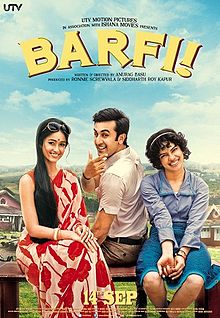
Like its namesake confection, Barfi! is certainly sweet. Not a frothy sweetness but a complex one with real depth and substance. Barfi! is not to be missed.

The film defies convention yet feels familiar. Flashbacks within flashbacks within flashforwards play with typical narrative format in a way that works better than it should.

The bulk of the action alternates between two times and places — 1972 and 1978, Darjeeling and Kolkata — framed by scenes set in the present day. The film’s narrator, Shruti (Ileana D’Cruz), recalls how her life changed in 1972 when her family moved from Kolkata to Darjeeling and she met Barfi (Ranbir Kapoor).

“Barfi” is how the deaf young man pronounces his given name, Murphy, so everyone calls him by his nickname. Unemployed Barfi spends his days making mischief around town, to the consternation of police inspector Dutta (Saurabh Shukla). Though he has a crush on Shruti, Barfi settles for friendship with her, because she is engaged. The two spend their days racing bicycles and bumming rides on train cars, falling in love in the process.

In the hands of a writer-director less skilled than Anurag Basu, Barfi’s penchant for mischief could be a cheap way to substitute quirkiness for character development. That’s not the case here. Barfi acts like an overgrown child because no one expects anything from him. He’s the town’s beloved mascot, cared for by his doting father, but that’s it.

Barfi’s outsider status makes a romantic match with Shruti impossible, even if she didn’t have a perfect-on-paper fiance waiting for her back in Kolkata. There’s no way her parents would accept a deaf son-in-law, even if the reason they give is their desire to spare her from the harsh judgements of society.

Shruti herself fails Barfi’s loyalty test. She lets go of his hand and leaps from his side as a light pole falls toward them. Having doctored the light pole himself, Barfi knows they were never in any danger. Like others before her, Shruti abandoned Barfi at the first sign of danger.

The one person to pass the loyalty test is Jhilmil (Priyanka Chopra), the autistic granddaughter of a wealthy local man. Having spent most of her childhood at a sanitarium — so as not to embarrass her snooty parents — she’s summoned to the side of her ailing grandfather. Barfi’s father is the grandfather’s driver, and Barfi and Jhilmil were childhood friends.

Jhilmil’s parents are no less embarrassed by their now-adult daughter when she returns. Jhilmil shuns almost all physical contact, screams and panics when she gets mud on her shoes, and loudly sings along with the band at a society party. The only person in Darjeeling who warms to Jhilmil is Barfi. Caring for her gives him purpose, and he provides her with a sense of security.

These themes — security and purpose — are universal, and those are the main challenges for Barfi and Jhilmil, not their special needs. Basu writes the characters as real people, not as a collection of physical and mental issues to be triumphed over. Shruti — the “normal” character among the three — is actually the most flawed, in that she lacks courage.

D’Cruz, an actress who has predominantly worked in Telugu films thus far, is a fine avatar for the audience. She nicely portrays the conflict inside Shruti, who would like to follow her heart but lacks the will to do it.

Ranbir Kapoor is the only actor who could have played Barfi. He has great physicality, both in scenes where he runs from Inspector Dutta (Saurabh Shukla is also great in the film) and where he bares his soul to Shruti using only gestures, no words. Kapoor makes Barfi more than just a lovable rascal.

But the standout performance in the film is by Priyanka Chopra. I’ve long appreciated the risks she takes in the roles she chooses, even if they don’t always work out. Playing an autistic woman could have gone poorly, but Chopra is perfect.

Like Kapoor, Chopra has very little dialog in the film. Jhilmil spends most of the time staring at the ground or observing the action around her, yet Chopra makes it easy to read Jhilmil’s emotions. Chopra’s depiction of autistic characteristics is accurate and respectful. Despite having a condition that makes forming emotional connections with other people difficult, there’s a lot to love about Jhilmil.

Other things to love about Barfi! include the beautiful scenery and music. Transitions between scenes are frequently accomplished by a pan over the silhouettes of three musicians — a guitarist, a violinist, and an accordion player — who seem to follow the characters everywhere.

Barfi! is a really special film. I laughed out loud, I cried, and I would happily watch it again tomorrow.

Links

Movie Review: Rockstar (2011)

3 Stars (out of 4)

Buy the DVD at Amazon
Buy the soundtrack at Amazon

The trailer for Rockstar presented the movie as a typical rom-com in which a dork melts an ice queen’s heart before the interval, only to have obstacles to their love thrown in their path for the second half of the movie. Rockstar is less conventional than that. At times, it’s an extended music video, at others a hypnotic tale of passion. It’s not always successful, but director Imtiaz Ali deserves credit for trying something different.

As in Ali’s two previous hits — Jab We Met and Love Aaj KalRockstar features a hero unable to articulate his feelings for his beloved, even if it means losing her to another man. This time the tongue-tied protagonist is Janardhan (Ranbir Kapoor), a dorky college kid with superstar ambitions.

Cafeteria-owner Khatana (Kumud Mishra) tells Janardhan that his life has been too easy, and that all musicians must suffer for their art. Janardhan’s real problem is a lack of charisma and a fondness for unflattering sweater vests, but that’s not much of a movie set-up.

Janardhan humiliates himself in a clumsy effort to woo the most popular girl in school, Heer (Nargis Fakhri), who’s already engaged to a rich guy from Prague. The two become pals, and she gives him the stage name “Jordan.” She also gives him an opportunity to express his feelings for her and perhaps forestall her marriage. He doesn’t take it, and Heer heads to Prague.

To this point — about the first hour of a 2-hour 40-minute movie — the story is laid out rather predictably: the kids have fun in seedy back alleys and amidst beautiful scenery in Kashmir, the setting for Heer’s wedding. The snowy mountain passes and gorgeous costumes are a real highlight.

Things veer from the expected during the film’s second hour. It begins not chronologically, but rather with a reporter investigating Jordan’s early career. It’s two years after Heer’s wedding, and Khatana recounts the emotion collapse that preceded Jordan’s rise to Indian rock stardom. An international music competition brings Jordan to Prague where he and Heer rekindle their interrupted romance, despite her now-married status.

Much of this storyline unfolds through A.R. Rahman’s incredible soundtrack. The second hour of Rockstar is primarily a string of music videos, the lyrics of Jordan’s music (voiced by Mohit Chauhan) providing insight into his emotional growth in way he can’t express in conversation. Thankfully, the lyrics are translated really well, allowing the story to unfold in an intriguing way.

Kapoor and Fakhri are terrific together. Their love scenes are sexy and passionate. Fakhri’s big screen debut is a promising one, as she plays Heer with the right mix of vulnerability and strength.

It’s unfortunate, then, that the movie ends the way that it does. While the movie’s main character is clearly Jordan, the second hour of the film gives equal weight to the choices both he and Heer must make. As the movie shifts into its third and final timeframe, Heer’s choices are taken from her, reducing her from a lead character to a mere catalyst for Jordan’s emotional growth.

That disservice to Heer’s character — along with an awkward bridge between the final shot of the movie and the closing credits, made up of scenes of Jordan and Heer in happier times — left me with mixed feelings about the movie. It’s uneven (and too long, of course), but the solid performances, beautiful scenery and intriguing story-telling mechanism make it worth a trip to the theater.

Links