Tag Archives: 4 Stars

Movie Review: Kai Po Che! (2013)

Kai_Poche_film_poster4 Stars (out of 4)

Buy or rent the movie at iTunes
Buy the DVD at Amazon
Buy the soundtrack at Amazon

Kai Po Che! gets its title from a Gujarati phrase shouted in celebration during the annual kite festival in Ahmedabad. There’s reason to celebrate, as this is a great movie.

If Kai Po Che! has any flaw, it’s in the way the film begins. The film opens with a man named Govi picking up another man, Omi, upon his release from prison. Omi asks where Ishaan is, and Govi explains that Ishaan will meet them at the cricket stadium. Then a subtitle reads “Ten Years Earlier” to signal the real beginning of the story.

Opening with present day footage only to flash back to the real story is the trendy way to start a movie these days, but I suspect the technique will seem dated in the years to come. Rather than watching the story as it unfolds, the audience is forced to ponder questions throughout the whole movie, such as when and how Omi is going to wind up in jail. It’s distracting. However, I’m willing to forgive the opening because the technique is currently so common and because the rest of the movie is essentially flawless.

The three disparate friends — Govi (Raj Kumar Yadav), Omi (Amit Sadh), and Ishaan (Sushant Singh Rajput) — are united in their struggle to figure out what to do now that they’re adults. Straight-laced Govi plans to open a sporting goods store and cricket academy, if only he can get his two layabout buddies to cooperate.

The plan hinges on Ishaan, a cricket player with enough talent to be a local hero, but not enough to play in the big leagues. Having sailed through life on his athletic prowess and his family’s wealth, Ishaan is not in a hurry to grow up.

Omi is the most intriguing of the three. He’s devoted to Ishaan and resents when Govi chastises the cricketer for being lazy and selfish. Omi demands respect but does nothing to earn it.

As the business takes off — thanks to a loan from Omi’s shady politician uncle, Bittoo (Manav Kaul) — the three friends undergo some major changes. Govi starts a clandestine friendship with Ishaan’s younger sister, Vidya (Amrita Puri). Ishaan devotes his attention to developing the talents of a promising young cricketer, Ali (Digvijay Deshmukh). That leaves Omi on the outside, making him easy prey for ambitious Bittoo.

The friends’ lives are also shaped by real-life events that occurred in Ahmedabad in the early 2000s, including a devastating earthquake. The city is rife with religious and political tension between Bittoo’s majority Hindu party and the Muslim-favored party, lead by Ali’s father.

All of the circumstances allow for tremendous character growth, and the actors perform brilliantly. Yadav and Rajput get to have the most fun, with Govi growing (slightly) more rebellious just as Ishaan becomes more responsible.

Sadh is fascinating as Omi. Early in the film, while Omi is still firmly in Ishaan’s thrall, there’s a dimness in Omi’s eyes. While it’s obvious that Ishaan isn’t living up to his potential, it seems like Omi has reached his: Ishaan’s toady for life. Only when Omi feels himself pushed aside for Ishaan’s twelve-year-old protege does the spark alight in his eyes, and not in a good way.

The story is so well-paced and allows enough time to establish a real sense of place. Ahmedabad is shown as full of opportunity, if only nature and the people who live there will cooperate. Kai Po Che! is a nice tribute to the city and the notion of friendship that endures through dramatic changes.

Links

Movie Review: Matru Ki Bijlee Ka Mandola (2013)

Matru_Ki_Bijlee_Ka_Mandola_poster.jpeg4 Stars (out of 4)

Buy the DVD at Amazon
Buy the soundtrack at Amazon

In my attempt to find the best way to explain why I like an unconventional movie like Matru Ki Bijlee Ka Mandola as much as I do, I found my answer in my review of director Vishal Bhardwaj’s previous effort, the magnificent 7 Khoon Maaf:
“7 Khoon Maaf is an all-or-nothing film. It either works for you or it doesn’t. Its strangeness will be a turn-off for some viewers, while others will lament a lack of explosive action scenes. But, if you’re in the mood for something a little different, beware: Susanna might just steal your heart.”

I feel the same way about Matru Ki Bijlee Ka Mandola (MKBKM, henceforth). I love it, but I understand why some people won’t. It’s a slow burn, with characters that are hard to pin down and a few odd elements that have to be accepted on faith rather than understood with reason. I think it’s fabulous.

The plot of MKBKM is the opposite of high-concept. In short, the story is about a wealthy man’s attempt to convert his land and the small village that sits on it into a massive factory, shopping mall, and apartment complex. Naturally, the villagers object to the plan, as do the man’s servants, his daughter, and strangely enough, the man himself.

See, the rich man, Mandola (Pankaj Kapur) has a dual personality: he’s a ruthless, ambitious tycoon in the sober light of day, and a populist by night, once he starts drinking. His handler, Matru (Imran Khan), is supposed to keep Mandola away from liquor. But Matru has little incentive to do so, as Mandola is a nicer guy when he’s drunk. Early in the film, an inebriated Mandola leads the villagers in a protest outside the gates of his own mansion, until he sobers up and realizes what he’s doing.

Mandola wants the factory in part to woo a fetching government minister, Chaudhari Devi (Shabana Azmi), and also to secure a prosperous future for his only daughter, Bijlee (Anushka Sharma). He’s gone so far as to get Bijlee engaged to the minister’s son, Baadal (Arya Babbar), who, Matru repeatedly reminds Bijlee, is an idiot. Matru and Bijlee are, of course, a far more appropriate couple, despite their differences in economic class.

Bhardwaj includes a number of quirky elements in the film to elevate it beyond a simple parable about the dangers of progress at any cost. A scene in which Mandola confirms his plans with Chaudhari explicitly evokes images of the witches in Macbeth and takes place amid ruins on a hilltop reminiscent of Weathertop in The Fellowship of the Ring.

Promos for MKBKM featured one of the recurring visual themes: a life-sized hot pink buffalo that Mandola sees whenever his longing for his beloved liquor becomes too strong.

My favorite oddball touch is the way Bhardwaj deals with something that would’ve been a throw-away gag in any other movie. When Baadal first sees Bijlee in the movie, he’s accompanied by an African folk dance group that he purchased in an attempt to impress her. Rather than just disappear after the joke is over, the folk group remains through the rest of the film. They take over a room in Mandola’s mansion, join in dance numbers, and protest alongside the villagers.

That detail alone makes the movie for me. What else would one expect to happen to a foreign dance group transported to rural India? Bhardwaj — who co-wrote the screenplay with Abhishek Chaubey — takes a practical problem and turns it to his advantage.

The performances are great throughout: Pankaj Kapur growls his way through his dialog as cantankerous Mandola; Anushka Sharma is as spunky and lovable as ever; Azmi and Babbar are appropriately diabolical; and Imran Khan is clever and sexy as a budding revolutionary, whose sidekicks include an old man, a blind preteen, and a transvestite.

Matru Ki Bijlee Ka Mandola is a must see. Even if you don’t love it, you won’t see anything else quite like it.

Links

Movie Review: Barfi! (2012)

4 Stars (out of 4)

Buy or rent the movie at iTunes
Buy the DVD at Amazon
Buy the soundtrack at Amazon

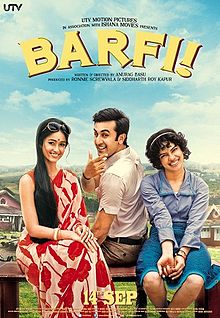
Like its namesake confection, Barfi! is certainly sweet. Not a frothy sweetness but a complex one with real depth and substance. Barfi! is not to be missed.

The film defies convention yet feels familiar. Flashbacks within flashbacks within flashforwards play with typical narrative format in a way that works better than it should.

The bulk of the action alternates between two times and places — 1972 and 1978, Darjeeling and Kolkata — framed by scenes set in the present day. The film’s narrator, Shruti (Ileana D’Cruz), recalls how her life changed in 1972 when her family moved from Kolkata to Darjeeling and she met Barfi (Ranbir Kapoor).

“Barfi” is how the deaf young man pronounces his given name, Murphy, so everyone calls him by his nickname. Unemployed Barfi spends his days making mischief around town, to the consternation of police inspector Dutta (Saurabh Shukla). Though he has a crush on Shruti, Barfi settles for friendship with her, because she is engaged. The two spend their days racing bicycles and bumming rides on train cars, falling in love in the process.

In the hands of a writer-director less skilled than Anurag Basu, Barfi’s penchant for mischief could be a cheap way to substitute quirkiness for character development. That’s not the case here. Barfi acts like an overgrown child because no one expects anything from him. He’s the town’s beloved mascot, cared for by his doting father, but that’s it.

Barfi’s outsider status makes a romantic match with Shruti impossible, even if she didn’t have a perfect-on-paper fiance waiting for her back in Kolkata. There’s no way her parents would accept a deaf son-in-law, even if the reason they give is their desire to spare her from the harsh judgements of society.

Shruti herself fails Barfi’s loyalty test. She lets go of his hand and leaps from his side as a light pole falls toward them. Having doctored the light pole himself, Barfi knows they were never in any danger. Like others before her, Shruti abandoned Barfi at the first sign of danger.

The one person to pass the loyalty test is Jhilmil (Priyanka Chopra), the autistic granddaughter of a wealthy local man. Having spent most of her childhood at a sanitarium — so as not to embarrass her snooty parents — she’s summoned to the side of her ailing grandfather. Barfi’s father is the grandfather’s driver, and Barfi and Jhilmil were childhood friends.

Jhilmil’s parents are no less embarrassed by their now-adult daughter when she returns. Jhilmil shuns almost all physical contact, screams and panics when she gets mud on her shoes, and loudly sings along with the band at a society party. The only person in Darjeeling who warms to Jhilmil is Barfi. Caring for her gives him purpose, and he provides her with a sense of security.

These themes — security and purpose — are universal, and those are the main challenges for Barfi and Jhilmil, not their special needs. Basu writes the characters as real people, not as a collection of physical and mental issues to be triumphed over. Shruti — the “normal” character among the three — is actually the most flawed, in that she lacks courage.

D’Cruz, an actress who has predominantly worked in Telugu films thus far, is a fine avatar for the audience. She nicely portrays the conflict inside Shruti, who would like to follow her heart but lacks the will to do it.

Ranbir Kapoor is the only actor who could have played Barfi. He has great physicality, both in scenes where he runs from Inspector Dutta (Saurabh Shukla is also great in the film) and where he bares his soul to Shruti using only gestures, no words. Kapoor makes Barfi more than just a lovable rascal.

But the standout performance in the film is by Priyanka Chopra. I’ve long appreciated the risks she takes in the roles she chooses, even if they don’t always work out. Playing an autistic woman could have gone poorly, but Chopra is perfect.

Like Kapoor, Chopra has very little dialog in the film. Jhilmil spends most of the time staring at the ground or observing the action around her, yet Chopra makes it easy to read Jhilmil’s emotions. Chopra’s depiction of autistic characteristics is accurate and respectful. Despite having a condition that makes forming emotional connections with other people difficult, there’s a lot to love about Jhilmil.

Other things to love about Barfi! include the beautiful scenery and music. Transitions between scenes are frequently accomplished by a pan over the silhouettes of three musicians — a guitarist, a violinist, and an accordion player — who seem to follow the characters everywhere.

Barfi! is a really special film. I laughed out loud, I cried, and I would happily watch it again tomorrow.

Links

Movie Review: Supermen of Malegaon (2008)

4 Stars (out of 4)

Buy Supermen of Malegaon at Amazon

I enjoy watching movies about making movies, especially those that are able to remind us of why we like going to the cinema in the first place. Supermen of Malegaon is one of those films.

The documentary follows small-time filmmaker Shaikh Nasir as he creates a localized spoof titled “Malegaon Ka Superman” (“Superman of Malegaon”). Nasir doesn’t consider himself an artist, rather a hobbyist who enjoys making low-budget versions of big-budget films for the enjoyment of the cash-strapped residents of Malegaon. His ultimate dream is to earn enough money to reopen his own video hall, which famously once ran James Cameron’s The Abyss for two months.

Nasir’s versions of blockbusters like Sholay rely heavily on local references and dialect and utilize local talent. Teen boys relish the anticipated boost to their social status just for appearing in the background of “Malegaon Ka Superman.”

Superman himself is played by a skinny guy named Shafique, who takes time off from his job working a power loom to star in the film. Shafique’s other film duties include organizing props and shopping for makeup with Nasir.

What makes the story especially interesting is that “Malegaon Ka Superman” actually looks entertaining. It’s not a ripoff but a comical remake. Malegaon’s Superman spends more time being saved than he does saving people. He can’t swim, so he floats around the lake on a rubber tire. If he flies too high, air pollution inflames his asthma.

The documentary’s director, Faiza Ahmad Khan, never makes fun of Nasir, Shafique, or the other crew members. One of my problems with another excellent documentary about a low-budget filmmaker, American Movie, is that the documentary director sometimes seems to poke fun at the men being filmed. Supermen of Malegoan doesn’t do that. The circumstances of making “Malegaon Ka Superman” are funny, but the men themselves are not.

In fact, the experience of working on “Malegaon Ka Superman” is a stepping stone for a couple of members of the crew. With his acting, editing, directing, and musical abilities, crew member Akram knows he stands a chance of building a real movie career in Mumbai. Co-writer Farogh is also aware that his job prospects are limited in Malegaon.

Farogh gives one of my favorite interviews in the film when he talks of the pain of being a screenwriter. He laments that 80% of the film he sees in his mind won’t make it to the screen. It can’t. Farogh explains that it’s a pain all writers have to live with, and that no amount of accolades or money can relieve it.

The sentiment illustrates the truth at the heart of the film: in its purest form, filmmaking is a passion. Urged on by the need to create, a group of people make a special film on a shoestring budget and with outdated equipment. Supermen of Malegaon is as inspirational as it is fun.

Links

Movie Review: Kahaani (2012)

4 Stars (out of 4)

Buy or rent the movie at iTunes
Buy the DVD at Amazon
Buy the soundtrack at Amazon

With each film she makes, Vidya Balan reaffirms her status as India’s best actress (one of the best in the world, in fact). She does it again in Kahaani, a gripping thriller about identity.

Balan plays Vidya Bagchi, a heavily pregnant woman from London who arrives in Kolkata searching for her missing husband. Her husband, Arnab, had been in constant contact with Vidya for the first half of his month-long assignment, but she’s heard nothing from him in two weeks.

When Vidya files a missing persons report at the local police station, the head inspector repeatedly pronounces her name “Bidya,” insisting that “b” and “v” are interchangeable in Kolkata. Adding further confusion, a junior inspector, Rana (Parambrata Chatterjee), explains that everyone in Kolkata has two names: a “pet name” and an official name. Rana is the pet name that everyone uses; his official name is Satyoki.

The guest house and office where Arnab was supposed to have stayed and worked while in Kolkata have no record of his having been there. Vidya gets a lead when the head of human resources at the office says that Arnab’s photo bears an uncanny resemblance to a former employee named Milan Damji, a suspected terrorist who’s been on the run for two years. Is Arnab’s disappearance a case of mistaken identity, or could he and Milan Damji be the same man?

Kahaani is wonderfully atmospheric in the way it emphasizes the impossible task before Vidya. The city is crowded and unfamiliar to Vidya, who staggers in the heat under the weight of her pregnant belly. Kolkata is at its most chaotic during a climactic scene set during Durga Puja, a festival celebrating the Hindu goddess Durga, a renowned demon-slayer who also embodies maternal compassion and patience.

Vidya is aided throughout by Rana, and their rapport is central to the movie’s success. Rana develops a crush on Vidya, feelings which are doomed to amount to nothing. If he succeeds in helping her find Arnab, she’ll leave, reunited with the father of her unborn child. If he fails her, she’ll be heartbroken.

Vidya is perhaps more playful with Rana than she should be. But, as pointed out by Intelligence Bureau Officer Khan (Nawazuddin Siddiqui), a pregnant woman is no threat to anyone.

Balan and Chatterjee are both spectacular. Balan makes Vidya tenacious within the physical limitations of her pregnancy. Chatterjee tinges the lighter moments Rana shares with Vidya with a longing for a love that can never be.

One of the villains deserves a special mention: Bob (Saswata Chatterjeeas). He’s a paunchy, balding, middle-aged guy in glasses that you’d take no notice of if you saw him on the street, but it’s a bad omen whenever he shows up on screen in Kahaani. His very ordinariness makes him a chilling presence.

The plot is well-paced, allowing enough time for character development and tense action scenes. The cinematography gives scenes a grainy, yellowish tinge, as though a smoggy cloud obscures Vidya’s search through the bustling city. Kahaani is an accomplished thriller that doesn’t disappoint.

*Some theaters list Kahaani‘s runtime as 2 hrs. 30 min. It’s closer to 2 hours long.

Links

Movie Review: Chak De India (2007)

4 Stars (out of 4)

Buy or rent the movie at iTunes
Buy the DVD at Amazon
Buy the soundtrack at Amazon

My niece isn’t old enough for movies with subtitles yet, but I want Chak De India to be the first foreign film she sees. It’s a touching parable about the virtues of tolerance, set within a familiar sports movie format. A second viewing on Netflix streaming confirmed that it’s just as good as I thought it was when I first saw it in the theater.

Shahrukh Khan stars as Kabir Khan, the former captain of India’s national men’s field hockey team. He left the sport in disgrace after missing a penalty shot that awarded victory to Pakistan, India’s archrival on and off the pitch. In a gesture of sportsmanship, Khan shook the hand of a Pakistani player, leading the media to accuse him of having thrown the match.

After seven years in exile, Khan returns to coach the Indian national women’s field hockey team, a team which exists only to fulfill federal gender equality requirements. No one else wants the job, but Khan sees it has his last chance to participate in the game he loves and prove his loyalty to his country.

The team comprises young women from most of India’s 28 states. All of the women are used to being the biggest fish in their comparatively small ponds, and none are willing to accept less than a starring role on the team. Before Khan can even contemplate getting the girls to the world championships, he must find a way to get them to work together.

First and foremost, Chak De India is a really well-executed sports movie. The first hour of the film follows the team through training, and the second covers the international tournament. In-game shots from the tournament are exciting and beautifully filmed, giving a sense of the speed and ferocity of the game. Shots from the training sessions give a sense of the physical demands placed on players, which is helpful for viewers unfamiliar with the sport.

What elevates Chak De India is its depiction of diversity. The actresses in the cast represent the wide array of Indian women: big and small, dark-skinned and light-skinned, urban and rural. Two team members from states bordering Myanmar (on India’s far-eastern border) are mistaken for Chinese or Nepalese and lament being treated like foreigners in their own country.

Chak De India also asserts the fundamental equality of women. The team not only has to fight to be taken seriously, but individual players have to fight for the right to play. Little Komal (Chitrashi Rawat) defies her father to join the team, and goalkeeper Vidya (Vidya  Malvade) joins against the wishes of her husband and his family. Goalscorer Preeti’s (Sagarika Ghatge) fiance, himself a captain on the men’s national cricket team, doesn’t see the irony in asking her to quit the team because “it’s just a game.”

Throughout, Khan encourages his players to focus their frustration with a society that considers them inferior to men into success on the pitch. He knows from experience that nothing is more satisfying than proving one’s detractors wrong.

Links

Movie Review: 7 Khoon Maaf (2011)

4 Stars (out of 4)

Buy or rent the movie at iTunes
Buy the DVD at Amazon
Buy the Soundtrack at Amazon

Director Vishal Bhardwaj’s movies have always suffered a bit in translation. Whether due to a lack of nuance in the English subtitles or particular regional references that require context, I felt like I didn’t fully experience films like The Blue Umbrella, Omkara or Kaminey.

Not so with 7 Khoon Maaf (“Seven Murders Forgiven”). It’s Bhardwaj’s most universally accessible work yet. It’s perfect in the way of all cult films: not flawless, but giddy, emotionally effective and memorable.

7 Khoon Maaf chronicles the love life of a black widow named Susanna (Priyanka Chopra). The film is based on “Susanna’s Seven Husbands,” a short story by Ruskin Bond. The title itself is a clue that things don’t turn out so well for the men in Susanna’s life.

The story is narrated by Arun (Vivaan Shah), a forensics expert tasked with confirming the death of the serial spouse murderer. Arun explains to his wife (Konkona Sen Sharma) the nature of his relationship with Susanna when she was alive: he was Susanna’s ward, and she funded his education. But the more Arun explains, the more bizarre the story becomes.

Shortly after the death of her father, the wealthy, orphaned twenty-year-old Susanna marries Major Edwin Rodriques (Neil Nitin Mukesh). Edwin has a temper, and he terrorizes his wife and her loyal servants: a butler named Ghalib (Harish Khanna), a maid named Maggie (Usha Uthup) and a stablehand named Goonga (Shashi Malviya).

As Edwin becomes more dangerous, Susanna and her servants decide to get rid of him in a way that looks accidental. Thus begins the deadly cycle of Susanna’s romantic life.

The film is darkly humorous, and a bit perverse at times. Some of the more visceral visuals reminded me of Guillermo del Toro’s films like The Devil’s Backbone and Pan’s Labyrinth, though there are few special effects in 7 Khoon Maaf.

Also reminiscent of del Toro is the pervasive religious symbolism throughout the film. Susanna is a Christian, so hymns pervade the soundtrack, which was also composed by Bhardwaj. Given the number of weddings and funerals Susanna must attend, church is a frequent setting.

Much attention in the promotions for the film has been given to Susanna’s husbands: the rock star (John Abraham), the poet (Irrfan Khan), the healer (Naseeruddin Shah). But all of them, by design, have limited roles in the film.

Much more central to the plot are Susanna’s accomplices, Ghalib, Maggie and Goonga. They evolve from pragmatic problem solvers into a trio of gleeful assassins. The three actors deserve much credit for enriching the film.

Arun likewise plays a central role, aging from a child to a man throughout the film. Vivaan Shah is competent in his first film role, playing a man who watches his patron’s life unravel from a distance — sometimes a physical one but also an emotional distance, due to being much younger than Susanna.

But the success of the movie depends entirely on Chopra, Bollywood’s most ambitious actress, and she does not disappoint. Susanna ages approximately 35 years through the course of the film, and Chopra adapts accordingly. She walks a fine line, making Susanna charming and innocent, and then merciless and deadly.

7 Khoon Maaf is an all-or-nothing film. It either works for you or it doesn’t. Its strangeness will be a turn-off for some viewers, while others will lament a lack of explosive action scenes. But, if you’re in the mood for something a little different, beware: Susanna might just steal your heart.

Links

Movie Review: Dhobi Ghat (2011)

4 Stars (out of 4)

Buy the DVD at Amazon

I live in a busy Chicago suburb with 150,000 residents. Despite living in a condominium building with several other families, I can go days without talking to anyone besides my husband. I see the UPS delivery man more often than my friends, who are scattered across the metro area.

This is the type of modern, urban isolation that writer-director Kiran Rao captures in her debut effort, Dhobi Ghat (Mumbai Diaries). All four of Dhobi Ghat‘s main characters are, in their own ways, isolated, despite living in crowded Mumbai.

Rather than impose a convenient narrative upon the four lead characters, Rao’s plot drops in on them during a specific period in their lives and leaves before delivering a tidy ending. It feels more like a documentary than a fictional film.

Adding to the documentary feel, the film opens with home movie footage shot from the backseat of a taxi, by a woman we later learn is Yasmin (Kriti Malhotra). Having recently moved to Mumbai after getting married, she records mundane scenes from her new life to send to her brother back home.

Brooding artist Arun (Aamir Khan) finds some of Yasmin’s video letters and forms something of an obsession with the woman on the tapes. His video obsession is more convenient than a relationship with a real woman, such as American investment banker Shai (Monica Dogra), who’s herself a bit obsessed with Arun.

Shai befriends the young man who does her laundry, aspiring actor Mannu (Prateik Babbar). Mannu, who also does Arun’s laundry, quickly develops a crush on Shai.

There’s an emotional distance between all of the characters, and Rao uses the camera to emphasize it. The characters are shown through windows or through the lens of amateur photographer Shai’s camera. Their reactions are captured in the reflections of mirrors.

The relationship between Shai and Mannu is the most interesting. How deep can their friendship be when he works for her? Is he really her peer? Shai doesn’t give it much thought. Mannu does.

Prateik Babbar is perfect as Mannu: a handsome guy whose shy nature and low social rank have made him incongruously meek. Khan, Dogra and Malhotra are compelling as the other leads, making as much out of their silent moments as they do out of their dialog.

Dhobi Ghat is a remarkably quiet movie. Not exactly quiet, but absent most of the usual sound effects and musical score. Much of the background noise is provided by urban sounds: rain, traffic, old movie music played on a record player in a nearby apartment.

Mumbai itself has a starring role in Dhobi Ghat. The film is shot in locations around the city, not on movie sets. There’s no attempt to hide Mumbai’s flaws, which serve to make the city more appealing and familiar, even to one who’s never been there.

Aamir Khan used his star power to force Indian multiplexes to show Dhobi Ghat without the usual intermission break. It may have cost the theaters some concession sales, but it allowed the movie to flow for its entire 100 minute runtime. An interval would broken the movie’s spell.

Should Dhobi Ghat succeed at the box office, it could persuade more Indian filmmakers to craft shorter films meant to be viewed in one sitting. Rao’s economy of characters, plot and runtime demonstrate how less can often be much more.

Links

Movie Review: Udaan (2010)

4 Stars (out of 4)

Buy or rent the movie at iTunes
Buy the DVD at Amazon
Buy the soundtrack at Amazon

A character in Udaan (“Flight”) says that fathers always want their sons to grow into men just like themselves. When the father is an abusive alcoholic, he’d better hope his wish doesn’t come true. Someday, his son will be bigger and stronger than him.

The father in Udaan (played menacingly by Ronit Roy) is about as mean as a character can be without veering into cackling super-villain territory. He doesn’t have any grand evil plan; he’s just convinced that he’s right and that everyone should obey him. He forces his children to call him “Sir,” correcting them when they accidentally call him “Papa.”

Udaan‘s protagonist is Sir’s 17-year-old son, Rohan (Rajat Barmecha). He’s a smart kid and a gifted writer, but a poor student. He takes reckless chances despite knowing the consequences. He’s expelled from boarding school when he and three friends sneak off campus to watch dirty movies. His friends return to their wealthy families in Mumbai, while Rohan returns to the industrial town Jamshedpur and the father he hasn’t seen in the eight years since Rohan’s mother’s death.

Rohan finds a six-year-old boy living in his childhood bedroom, the product of a second marriage that his father said “didn’t work out” and that he didn’t bother to tell Rohan about. The half-brother, Arjun (the impossibly cute Aayan Boradia), already mimics their father’s verbal abuse but casually mentions that Sir hits him sometimes.

Sir refuses to entertain the possibility of Rohan becoming a professional writer and puts his eldest son to work in the factory he owns. Rohan attends engineering college in the afternoon, with the expectation that he will one day inherit the factory. At night, Rohan acts out, taking the family car on joyrides to drink and smoke at a local bar.

Rohan is shaken from his drudgery when Arjun winds up in the hospital. Sir claims the boy fell down the stairs, but Rohan suspects child abuse. Sir leaves town for a few days, giving the brothers time to bond. Rohan entertains Arjun and other people in the hospital ward with his original stories until his father returns, once again crushing his Rohan’s chances for happiness.

Udaan is the rare movie that actually justifies a runtime of more than two hours. The plot unfolds at a pace appropriate for its teen protagonist. He’s in an impossible situation: he can’t live his own life under his father’s rule, but he has no adult to turn to for guidance. His uncle, while compassionate, is himself subject to Sir’s abuse. When I wanted to scream, “Just run away!” I had to remind myself that Rohan is supposed to be a real teenager, not some cinematic creation wise beyond his years.

The movie also strives for realism in the relationship between father and son. A lesser movie would aim for a sentimental conclusion espousing the belief that there’s good inside everyone. Sir is a jerk, and Rohan himself is far from perfect. The movie is more about protecting what you love, be it a dream or a vulnerable sibling. Udaan isn’t about redemption. It’s about self-respect.

Links

Movie Review: The Japanese Wife (2010)

4 Stars (out of 4)

Buy or rent the movie at iTunes
Buy the DVD at Amazon
Buy the book at Amazon

On rare occasions, I break with my policy of reviewing only Hindi movies, and instead review a movie in another Indian language. I recently watched The Japanese Wife — which features dialog in English, Japanese and Bengali — because it will be featured on October 3rd at Chicago’s inaugural South Asian Film Festival. Also, it’s directed by Aparna Sen, mother of Bollywood actress Konkona Sen Sharma. Since the movie is already available on DVD at Netflix, I thought I’d give it a shot.

The DVD’s menu screen describes the movie as “A Love Poem by Aparna Sen,” and that seems appropriate. It’s a heartbreakingly romantic film about the lengths we go to on behalf of those we love and how the written word brings us closer together.

Rahul Bose stars as Snehamoy, a high school arithmetic teacher in a small, remote village in West Bengal. He lives with an aunt who raised him after his parents drowned when he was a boy. He’s unbearably shy and has only one close friend: Miyage (Chigusa Takaku), his Japanese pen pal. She’s just as shy and lives with her ailing mother. They write letters to each other in imperfect English every week.

Scenes from the present — a giant package from Japan making its way through Snehamoy’s village to his house — are intercut with voiceovers and scenes cataloging how the friendship between Snehamoy and Miyage develops through their letters.

After three years of correspondence, Snehamoy writes to Miyage about his aunt’s attempt to find a bride for him. The girl, Sandhya (Raima Sen), is so timid she won’t even let Snehamoy see her face. He turns down the marriage, and Sandhya weds another man.

Miyage proposes that she and Snehamoy get married, even though they’ve never met and have no prospect of doing so in the near future. She has to take care of her mother, and his monthly $100 salary isn’t enough to afford an expensive plane ticket to Japan. But they agree to get married anyway. She sends him a silver ring, and he sends her some coral bangles and vermillion powder to wear in the part of her hair, signifying their status.

Several years later, widowed Sandhya and her son, Poltu (Sagnik Chowdhury), move in with Snehamoy and his aunt. Sandhya becomes Snehamoy’s unofficial wife, in practice: she cooks and cleans, and he escorts her shopping and helps her raise Poltu. She’s at least physically present, while Miyage remains in Japan.

The movie raises questions about the definition of marriage. Can Snehamoy and Miyage really be married without having ever met? And what of Snehamoy’s relationship with Sandhya? They actively build a life together with some degree of mutual affection. Which “marriage” is more real?

The movie unfolds beautifully as the love between Snehamoy and Miyage is revealed through their words. Because English isn’t either of their native languages, they write honestly and without euphemisms. The musical score alternates between traditional Indian and Japanese harmonies.

Probably the most striking aspect of the movie is the contrast between their places of residence. Snehamoy lives in a small village with no electricity that’s only accessible by boat. I wasn’t sure in which decade the movie was set until he journeyed to a big city and mentioned that he had Miyage’s email address.

Yet it makes complete sense that Miyage, living in a big city in Japan, could fall for Snehamoy. One can be lonely and isolated even in a crowded place.

Links