
 3 Stars (out of 4)
Buy or rent the movie at iTunes
Buy the DVD at Amazon
Buy the soundtrack at Amazon
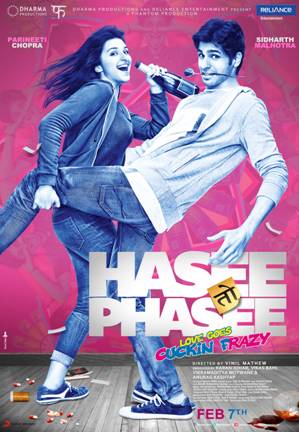
Finally, a movie in which the nerdy girl wins the hero’s heart without having to undergo a glamorous makeover. The tomboy reigns supreme in Hasee Toh Phasee (“She Smiles, She’s Snared“).
The tomboy at the heart of the film is Meeta (Parineeti Chopra), a clever, socially awkward young woman who stands out from her sisters because of her Harry Potter hairdo. In 2006, she flees from her sister’s wedding with the aid of stranger with a Rick Springfield coiffure, Nikhil (Sidharth Malhotra).
Nikhil is also clever, but more socially adept and far more cautious than Meeta. She invites him to join her on a trip, but he declines and returns to the wedding. Inside, he immediately falls in love with the first pretty woman he sees, a model named Karishma (Adah Sharma).
Fast-forward seven years, and Nikhil is hoping to finally do something right in Karishma’s eyes by marrying her. Things get complicated for the groom when Karishma asks Nikhil to look after her loony sister and keep her away from the wedding. The sister is Meeta, of course.
Meeta is one of the most well-developed characters in recent memory. All of her social tics — e.g. her extreme literalness and tendency not to blink during conversations — make her feel real, and they seem appropriate for a woman who’d rather be working in her chemistry lab than making small talk at a wedding.
Meeta comes alive in Chopra’s hands. She makes a character that could’ve been annoying into a vibrant and lovable person, and she’s at her best in a scene in which Meeta’s emotions get the best of her. Meeta’s relationship with her father, Devesh (Manoj Joshi), is touching. Unlike most people, he sees past Meeta’s quirks to who she really is.
In a movie with a character as memorable as Meeta and the theme of being true to oneself, Nikhil is a little too nebulous, especially since his character’s emotional development drives the story. It’s not clear why Nikhil is as reticent and fearful of disappointing people as he is, so his constant self-sabotage seems to come from nowhere. Even his final decision is forced on him more than it is self-generated.
Malhotra performs well as Nikhil, but he’s hampered by the way his character is written. He’s also too conventionally handsome for the part. When Devesh rhetorically asks what Karishma sees in him, it’s obvious: he makes nice arm candy at industry parties, in addition to being irrationally devoted to her.
There are several entertaining supporting characters in the film, none more so than Nikhil’s cousin, Abhinandan, who once almost became a contestant on “Indian Idol.” He sings and shimmies, hoping to impress Meeta, who barely notices him. One could make the case that he’d be as devoted a partner to Meeta as Nikhil, even if he’s not her intellectual equal.
The other component keeping Hasee Toh Phasee from perfection is the story structure. It starts too slowly, and the flow is interrupted along the way. Many scenes are too long relative to the degree that they show character development or move the story forward.
That said, Hasee Toh Phasee is worth checking out for its progressive female lead character, who’s both smart and pretty, even in jeans and a hoodie. That she’s played by a superstar in the making is an added bonus.
Links